MASAM clears more than 11,000 explosive devices from Midi district in Hajjah
 Yemen Herald News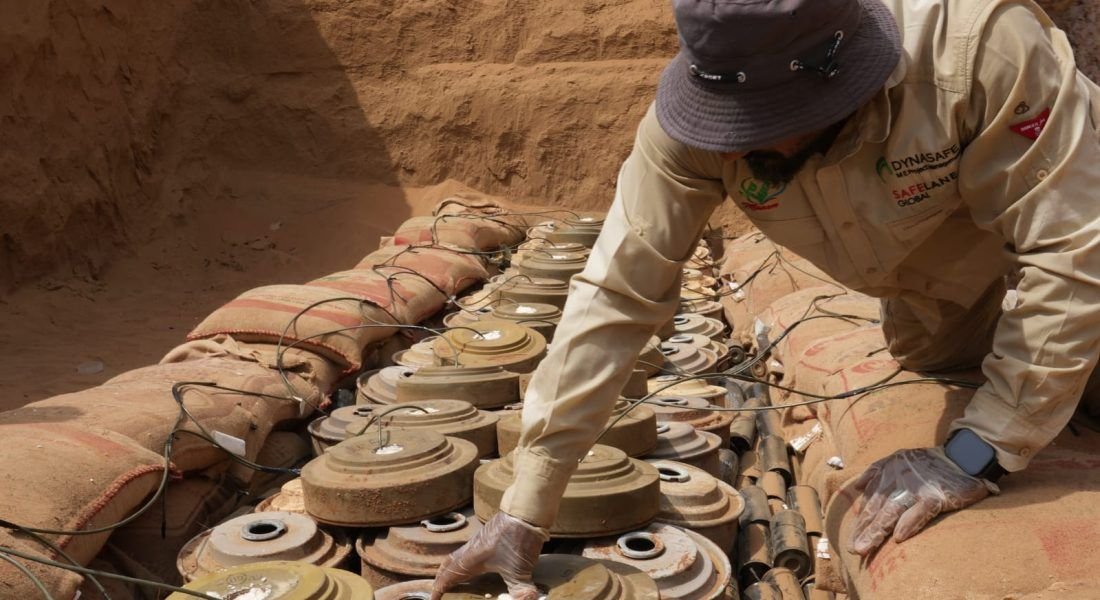
A Saudi-funded demining programme has cleared more than 11,000 landmines, improvised explosive devices and other explosive remnants of war from Midi district in Yemen’s north-western Hajjah governorate, one of the largest single-district totals the project has reported since it began work eight years ago.
The clearance in Midi comprised 2,669 anti-tank mines, 153 anti-personnel mines, 142 improvised explosive devices and 8,285 items of unexploded ordnance, according to figures released by the project. The proportions are informative in themselves. Anti-tank mines and unexploded ordnance dominate the total, a pattern consistent with a district that sat on an active front line and absorbed sustained shelling and air strikes, rather than one that was simply mined for defensive purposes and then left alone.
The programme, formally the Saudi Project for Landmine Clearance and known by its Arabic acronym MASAM, is run by the King Salman Humanitarian Aid and Relief Centre. It began operations in Yemen in the middle of 2018 and has since become the largest single demining effort in the country, working across territory held by the internationally recognised government. The project said in 2026 that it had expanded to 42 demining teams, and its managing director, Ousama Algosaibi, has described the contamination as persisting on a scale that continues to outrun clearance capacity.
Cumulative figures give a sense of that scale. By late July 2026 the project reported having located and destroyed 578,226 landmines, items of unexploded ordnance and improvised explosive devices since 2018. That total breaks down into roughly 408,000 items of unexploded ordnance, some 152,000 anti-tank mines, about 7,600 anti-personnel mines and around 8,600 improvised devices, across more than 83 million square metres of land released back to civilian use.
Midi’s contamination has a specific history. The district lies on the Red Sea coast close to the Saudi border, on the northern edge of the Tihama plain, and it became one of the most heavily contested points on the western front. Fighting there displaced most of the local population, and returning families found farmland, fishing approaches, roads and the remains of their houses seeded with devices they had no way of identifying. Clearance in such places is slow because contamination is layered, repeatedly laid and relaid over years of shifting front lines.
The project separately reported destroying 4,271 landmines and explosive remnants of war in the Dufas area of Abyan governorate in southern Yemen. That figure comes from the project’s own reporting and has not been independently confirmed. MASAM also publishes weekly nationwide clearance totals, which through 2026 have typically fallen between roughly 1,400 and 4,700 items in a given week, so district-level operations of this size represent an unusually concentrated find rather than a routine week’s work.
The comparatively small number of anti-personnel mines in the Midi total should not be read as reassuring. Anti-personnel mines are designed to maim rather than destroy, they are small enough to be mistaken for debris or toys, and they account for a disproportionate share of civilian casualties, particularly among children and among herders and farmers who work open ground. Yemen ratified the Mine Ban Treaty in 1998, and the use of anti-personnel mines by any party to the conflict is prohibited under that instrument.
For displaced families the practical significance of clearance is straightforward. Land that has not been surveyed cannot be safely farmed, grazed or rebuilt on, and humanitarian agencies are reluctant to site infrastructure on it. Releasing land therefore does more than remove an immediate hazard; it determines whether return is possible at all, and whether agricultural production in districts that once supplied regional markets can resume. In a country where the United Nations estimates more than 18 million people need some form of assistance, restoring productive land carries weight beyond the safety statistics. Aid organisations working in returnee areas have also pointed out that mine risk education, which teaches families how to recognise and report devices rather than move them, has to run alongside clearance, because survey teams inevitably reach some communities long after people have gone back to them.
The work is expensive and dangerous. KSrelief has extended the project’s contract for further one-year periods, most recently at a reported cost of just over 52.5 million dollars, funding that covers equipment, vehicles, medical support and the salaries of Yemeni and international technical staff. Manual clearance in contested terrain is among the more hazardous forms of humanitarian work, and progress is measured in square metres rather than square kilometres.
How much remains is not precisely known. No comprehensive national survey of contamination has been completed, and MASAM does not operate in areas under Houthi control, which means a substantial portion of the country’s contaminated land has never been assessed by the project at all. Estimates of the total number of devices laid since 2015 vary widely between agencies, and Yemeni officials and mine action bodies broadly agree that clearance at current rates would take many years even if the fighting stopped.
Clearance also cannot resolve the conditions that produced the contamination. Devices continue to be laid where fighting continues, and areas cleared once can be re-contaminated if front lines move again. What operations such as the one in Midi achieve is narrower but real: a defined area handed back to the people who live in it, with the hazard removed and mapped rather than merely known about.
About the Author