Houthi Missile and Drone Strikes Kill Dozens of Yemeni Troops in Marib and Hadramawt as Saudi Arabia Warns of Wider Attacks
 Yemen Herald News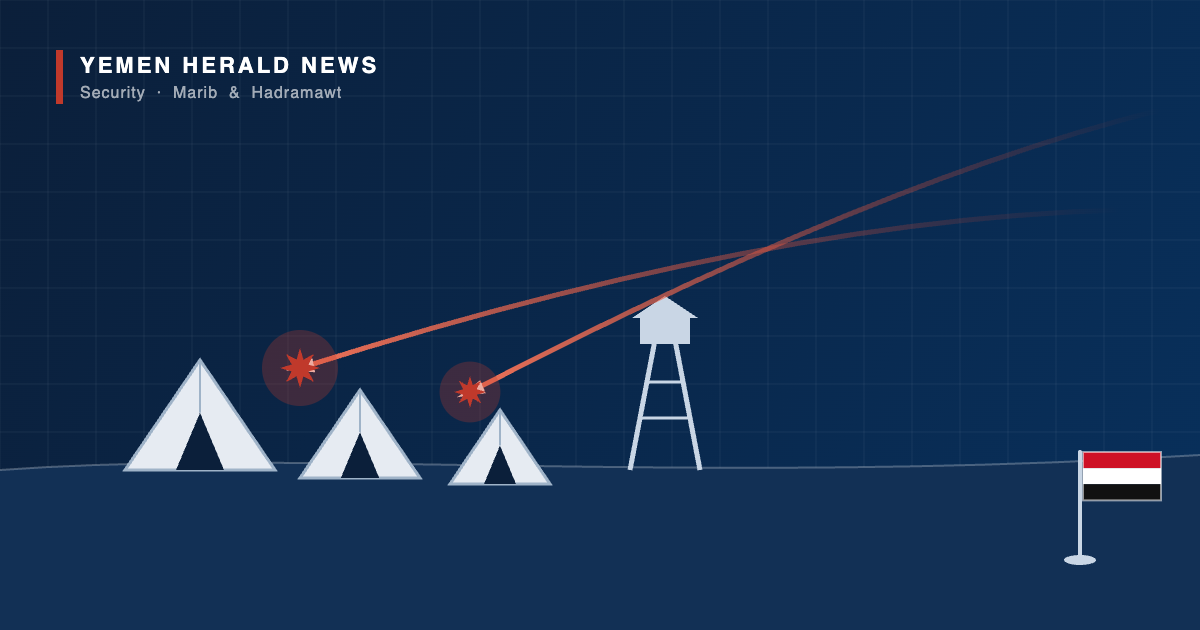
Houthi missile and drone strikes on military camps in the Yemeni governorates of Marib and Hadramawt killed dozens of government soldiers on Thursday, in one of the deadliest single days of fighting since the collapse of formal truce talks. Hours later, projectiles fired across the border injured civilians in Saudi Arabia’s Najran region, and Saudi authorities warned that further attacks on civilian targets were possible. The two incidents together mark the sharpest escalation Yemen has seen in months.
Yemeni government sources said eight missiles were launched from al-Jawf governorate, which the Houthis control, in a coordinated salvo that combined ballistic missiles with one-way attack drones. The projectiles struck camps housing forces loyal to the internationally recognised government in the Marib desert and in the Hadramawt interior, hitting accommodation blocks and, according to officials, at least one ammunition store.
Casualty figures diverged sharply in the hours that followed. Yemeni officials cited by international agencies initially reported at least 30 soldiers killed and around 50 wounded, and cautioned that the toll would rise as bodies were recovered from collapsed structures. Later reporting by several international outlets put the number of dead between 45 and 58. A Houthi military spokesman said the group had targeted Saudi-backed troops and claimed “hundreds” of casualties, a figure no independent source has corroborated. The government has not issued a final accounting.
The Houthis presented the strikes as a response to what they described as a growing Saudi military build-up in eastern Yemen, and said they had destroyed camps and weapons depots. Government officials rejected that framing, describing the targets as regular army positions and the timing as deliberate. Independent verification of either account is not possible; access to the strike sites is controlled by the parties themselves.
Yemen’s defence ministry acknowledged the attacks and said it would respond at a time of its choosing. It also instructed hospitals in Marib and Hadramawt to raise readiness for a large intake of wounded, an unusual public instruction that suggested officials expected either a high toll from Thursday’s strikes or further attacks to follow.
The cross-border dimension emerged the same day. Maj. Gen. Turki al-Maliki, spokesman for the Saudi-led coalition, said on Friday that 11 civilians had been injured in Najran by what he called Houthi projectiles. The wounded included seven Saudi nationals, one Yemeni, two Egyptians and one Pakistani; among them was a four-year-old child who suffered second-degree burns. Al-Maliki condemned the strike as indiscriminate and said the coalition would take deterrent measures.
Saudi Arabia and several partner governments have since raised alert levels. Intelligence assessments circulated by Washington, Riyadh and other capitals in the region warned that Houthi forces and Iraqi armed groups, coordinated by Iran, may attempt strikes on key civilian sites. Those warnings have not specified targets publicly, but they have prompted visible increases in security around energy infrastructure and airports in the kingdom’s south.
The escalation is difficult to read in isolation from the wider regional confrontation. Fighting in Yemen has intensified in parallel with a far larger conflict between Iran on one side and the United States and Israel on the other, and Yemeni officials argue that the Houthis are now functioning as one front in that campaign rather than as a purely domestic actor. The Houthis, for their part, have consistently framed their operations as independent decisions taken in Sanaa.
Marib’s prominence in the target list is not accidental. The governorate holds much of Yemen’s remaining onshore oil and gas production and the country’s only functioning liquefied-gas infrastructure, and it has been the government’s most important stronghold in the north since the Houthis captured Sanaa. It also hosts very large camps for civilians displaced from other governorates, which is why sustained fighting there carries humanitarian consequences well beyond the front line.
Hadramawt, Yemen’s largest governorate by area, has until now been comparatively insulated from missile attack. Its oil fields and the port city of Mukalla sit far from the northern front, and the strikes there signal both a lengthening of Houthi missile reach and a willingness to open pressure points the government had treated as secure.
At sea, the picture has deteriorated in parallel. Vessels transiting the Red Sea, the Bab al-Mandab Strait and the Gulf of Aden have come under repeated attack, and some analysts have argued that the campaign is intended partly to squeeze Saudi crude exports that move through the corridor. Shipping lines that had begun tentatively returning to the route have again slowed transits, adding cost and time to voyages between Asia and Europe.
The truce at issue was brokered by the United Nations in April 2022 and formally expired six months later, but its main effects endured: major front-line offensives largely stopped, a limited number of commercial flights resumed from Sanaa airport, and fuel imports through Hodeidah eased. Aid agencies credit that period with a measurable fall in civilian casualties, which is why the past week’s strikes have alarmed humanitarian organisations as much as diplomats.
The United Nations has warned that the combined effect of the land and maritime attacks risks unravelling what remains of the informal calm established by the 2022 truce and drawing Yemen into a broader regional war. For now, the government has promised retaliation, the coalition has promised deterrence, and neither has said what form either will take.
About the Author