Houthi missile and drone barrage strikes Yemen’s al-Mokha port, killing at least seven
 Yemen Herald News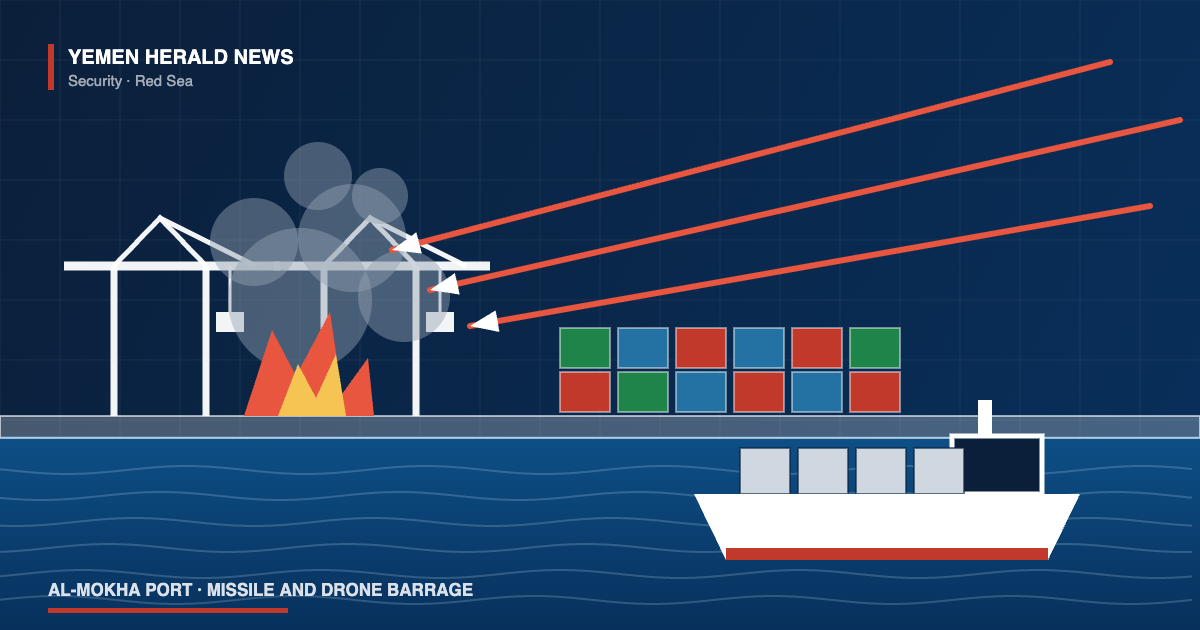
Iran-aligned Houthi forces struck the Red Sea port of al-Mokha in Yemen’s Taiz governorate with a barrage of ballistic missiles and armed drones on Sunday, killing at least seven people and wounding dozens more in the sharpest escalation between the group and the internationally recognised government in more than three years. The assault hit a facility that had only recently been restored to working order, and Yemeni officials described it as a deliberate strike on the country’s civilian and commercial infrastructure.
Transport Minister Mohsen al-Amri, whose account was carried by the state news agency Saba, said the port was hit by no fewer than 25 projectiles. He listed damage to economic zones inside the port, employee housing, warehouses, private fuel stations, storage tanks and sections of the pier, along with commercial goods and food supplies held on site. Much of what was destroyed, he said, formed part of rehabilitation work carried out over recent months to bring al-Mokha back to something approaching full operating capacity.
Casualty figures reported in the hours after the attack varied. A medical source in al-Mokha told AFP that three civilians and eight military personnel had been killed and 32 people wounded, six of them civilians. Other accounts put the death toll at seven. Such discrepancies are common in the immediate aftermath of strikes in Yemen, where casualties are counted separately by medical facilities, military authorities and government ministries, and where figures are frequently revised upward as the wounded are treated.
The Houthi movement confirmed that it had carried out the operation. Military spokesman Yahya Saree said in a statement posted to Telegram that the missiles and drones had targeted what he described as Saudi troop concentrations and weapons depots in the al-Mokha area, calling it a large-scale operation. The government rejects that characterisation, pointing to the damage sustained by port installations and residential buildings. Independent verification of what was struck inside the port perimeter has not been possible.
Rashad al-Alimi, chairman of Yemen’s Presidential Leadership Council, described the attack as an extension of Iranian escalation directed at economic facilities, maritime routes and the interests of countries across the region. Al-Amri called on international organisations to take a clear position on the Houthis’ conduct, arguing that strikes of this kind obstruct aid delivery and deepen an already severe humanitarian emergency.
Al-Mokha’s significance is out of proportion to its size. The port sits on Yemen’s Red Sea coast a short distance north of the Bab al-Mandab Strait, the narrow channel through which a substantial share of global container and energy traffic passes on its way to and from the Suez Canal. With other western ports operating well below capacity during the war, al-Mokha has carried an increasing share of imports into government-held territory, including food and fuel for a population overwhelmingly dependent on goods brought in from abroad.
The strike coincided with Houthi claims of an attack on Saudi Aramco oil infrastructure, pointing to a coordinated escalation rather than an isolated incident. Taken together, the two operations mark a shift away from the relative quiet that had held since a United Nations-brokered truce in April 2022. That agreement formally lapsed months later but produced a durable reduction in front-line fighting which, until now, had largely endured.
Yemen’s war began in earnest in 2015, after Houthi forces seized the capital Sanaa and a Saudi-led coalition intervened on behalf of the government. The years since have produced one of the largest humanitarian caseloads anywhere: United Nations agencies estimate that well over 18 million people require assistance, and more than four million remain displaced. Aid operations have been repeatedly constrained by funding shortfalls and by access restrictions imposed by parties to the conflict.
Attacks on ports carry consequences that extend well beyond the immediate casualty count. Damage to piers, cranes and fuel storage slows the discharge of vessels, raises insurance premiums for shipping companies and can push importers toward longer and costlier routes. In a country that imports the overwhelming majority of its staple foods, even a temporary reduction in port throughput tends to register within weeks as higher prices in local markets, renewed pressure on the currency, and reduced purchasing power for households already stretched thin.
Whether al-Mokha can resume normal operations quickly will depend on the extent of the structural damage to the pier and on how rapidly replacement equipment can be sourced. Port authorities had not published a technical assessment at the time of writing, and the minister’s statement described the damage rather than setting out a timetable for repairs.
The wider question is what the escalation means for a peace process that has been effectively stalled. Successive rounds of indirect talks have failed to produce a settlement, and the Red Sea has since become entangled with broader regional confrontation. Attacks of this scale, directed at economic rather than purely military targets, complicate any return to negotiations and raise the prospect of retaliation drawing the front lines back toward the coast.
For residents of al-Mokha, the consequences are more immediate. The town has absorbed displaced families from across the western coast during the war, and its economy is bound up almost entirely with the port. Workers who lost housing in the strike now face displacement of a different kind, and damage to warehouses holding food stocks may be felt across the surrounding district long before repair work begins.
About the Author