Bahrain Says Iranian Attack Struck a Manama Hotel and Two Residential Buildings Without Casualties
 Yemen Herald News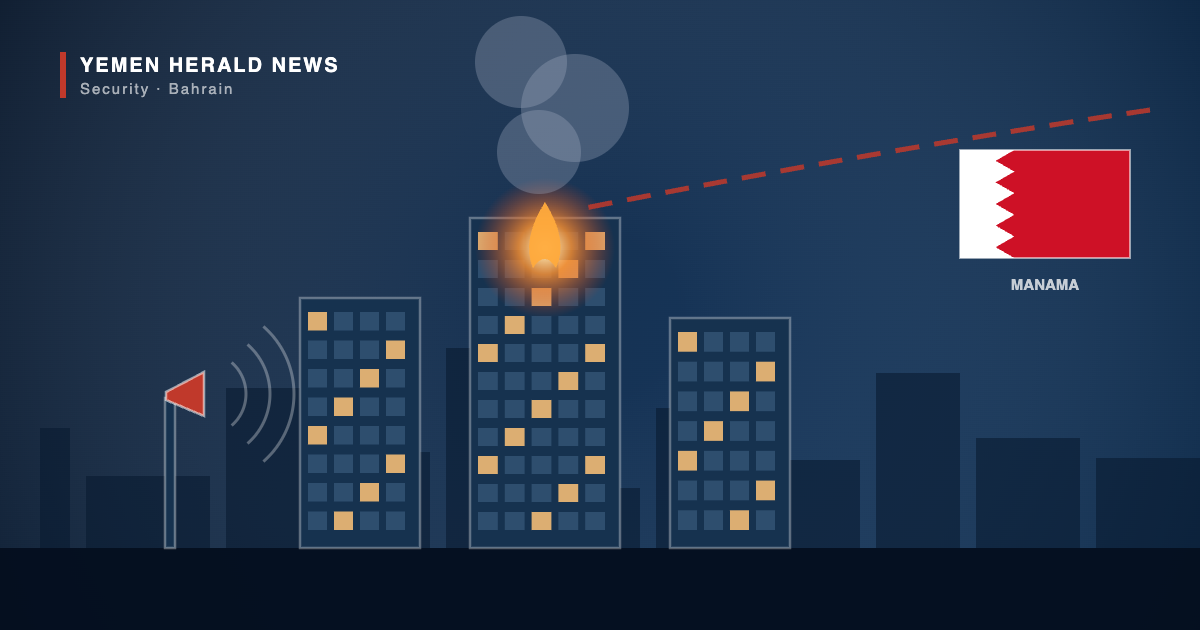
Bahrain’s Ministry of Interior said that an Iranian attack early on Friday 6 March 2026 struck a hotel and two residential buildings in the capital, Manama. The ministry reported material damage only, with no casualties. Civil defence teams were sent to the scene and brought under control a fire that had broken out in one of the affected apartments.
Warning sirens were activated across the city as the attack unfolded. The ministry urged citizens and residents to remain calm, move to safe locations and follow official instructions, a procedure Bahraini authorities had used repeatedly during the preceding week.
The General Command of the Bahrain Defence Force said its air defence systems had been engaging successive waves of Iranian missiles and drones, and that since the start of the attacks it had destroyed 78 missiles and 129 drones aimed at the kingdom. Those were the Defence Force’s own cumulative figures and were not independently verified at the time. The command condemned the strikes, saying that directing ballistic missiles and drones at civilian sites and private property amounted to a serious violation of international humanitarian law and the United Nations Charter.
The attacks on Bahrain began on 28 February 2026, when Iran launched retaliatory missile and drone salvoes across the Gulf following joint United States and Israeli strikes on Iranian territory. Among the districts hit in that opening round was Juffair in Manama, where the United States Navy’s Fifth Fleet is headquartered at Naval Support Activity Bahrain. Subsequent strikes concentrated on American military installations alongside industrial, commercial and residential buildings.
Bahrain’s exposure owes much to its role as a base for Western forces. Naval Support Activity Bahrain has hosted the American Fifth Fleet’s headquarters for decades, and the base was struck in the opening attack on 28 February. Around 300 British personnel were stationed nearby, and Canadian officers were serving on exchange with the United States military at the headquarters at the time; none were reported hurt. Iranian statements through the period described American military sites as the intended targets, while Bahraini officials pointed to the civilian buildings that were hit instead.
Hotels in the capital had already been identified as a concern. On 1 March the United States Embassy in Bahrain advised Americans in the country to avoid hotels in Manama, and said one of the buildings struck was the Crowne Plaza. Two employees of the United States Department of Defense were reported wounded in a strike on a hotel in the days before the 6 March attack.
Other incidents in the same period were more serious. On 2 March a missile struck Mina Salman Port, and a Bangladeshi shipyard worker was killed by falling debris after a separate missile was intercepted overhead. Two other people were injured and the American-flagged tanker MT Stena Imperative caught fire, though its crew reported no casualties. Debris the same day struck an Amazon Web Services facility, causing power problems at the site.
On 5 March Bahrain said the industrial area of Ma’ameer had been targeted, again reporting limited material damage and no casualties. Two days after the hotel strike, on 8 March, an Iranian drone damaged a desalination plant.
The pattern of damage without loss of life did not hold. On 9 March an explosion near Manama started a fire close to a petroleum refinery and injured at least 32 Bahraini citizens, four of them seriously. An analysis by academic researchers, reviewed by Reuters, later concluded that an American-operated Patriot interceptor was likely involved in the blast after it destroyed an Iranian drone in mid-air. Bapco, the state oil company, declared force majeure on its group operations.
On 10 March debris from a drone attack on an office tower in the Seef District killed a 29-year-old Bahraini woman and injured eight others, the first death of a Bahraini citizen in the campaign. Gulf Air, the national carrier, moved its fleet out of Bahrain International Airport to airports in neighbouring Saudi Arabia.
The Defence Force’s running tallies continued to climb through the spring. On 12 March it put the cumulative total at 112 ballistic missiles and 186 drones intercepted; by 15 March the figure was 125 missiles and 211 drones, and by late March it stood at 174 missiles and 391 drones. As with the 6 March figures, these were official Bahraini counts of what air defences say they stopped, without a published breakdown of how many projectiles were fired in total or how many reached their targets.
By 11 June 2026, three deaths and more than 51 injuries had been recorded in Bahrain since the start of the war. The kingdom also pursued the matter diplomatically. On 26 March it joined Saudi Arabia, Kuwait, the United Arab Emirates, Qatar and Jordan in a joint statement condemning attacks by Iran and allied armed groups in Iraq on countries and infrastructure in the region. Holding the presidency of the United Nations Security Council, Bahrain put forward a resolution on the Strait of Hormuz; a softened draft was vetoed by Russia and China on 7 April by a vote of 11 to 2.
Hostilities did not end with a truce. On 8 April, after a ceasefire agreement between the United States and Iran, Bahrain’s Interior Ministry reported a further night of Iranian attacks on houses in the Sitra area, with sirens sounding again after a fresh round of drone strikes.
About the Author