Yemen’s Women’s Affairs Minister and New US Chargé d’Affaires Discuss Widening Women’s Role in State Institutions
 Yemen Herald News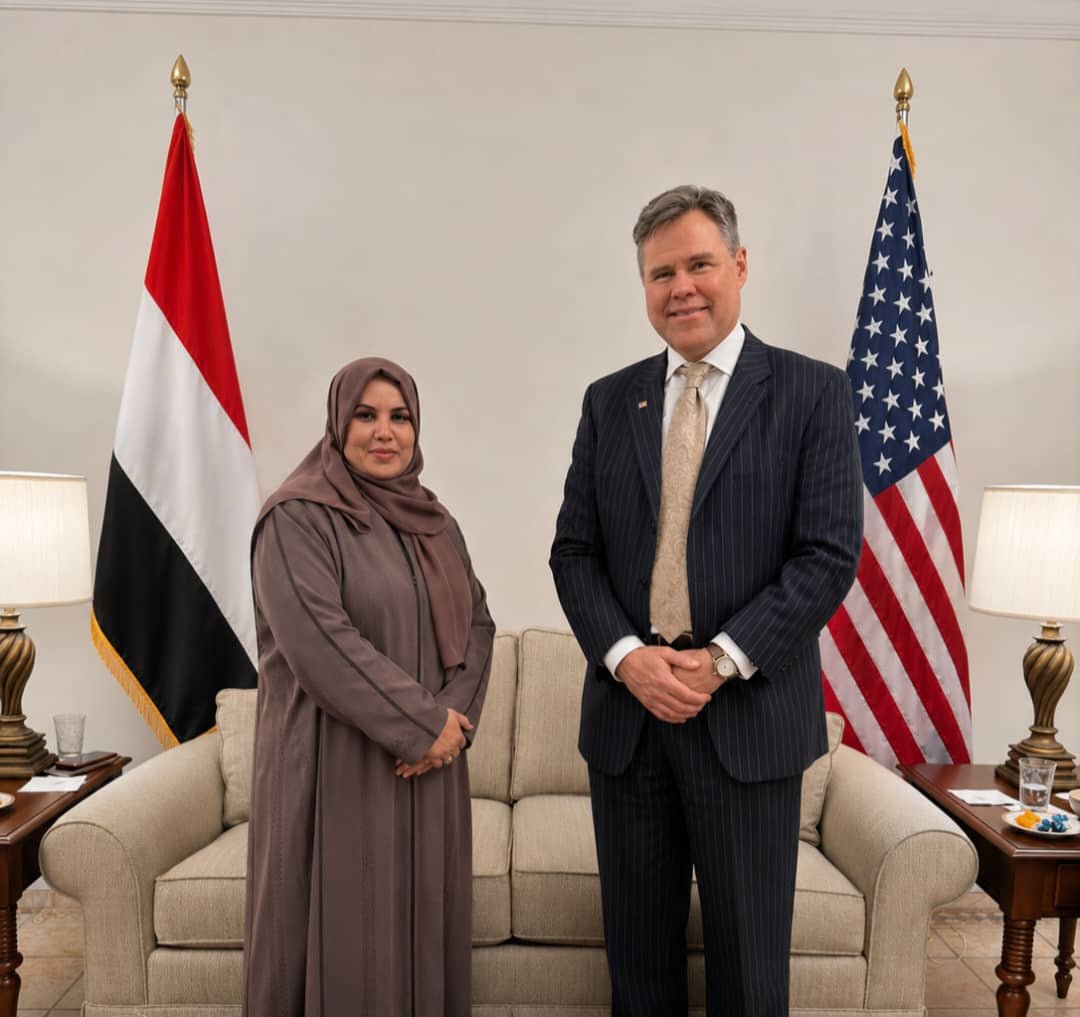
Yemen’s Minister of State for Women’s Affairs, Dr. Ahed Jaassous, met the new United States Chargé d’Affaires to Yemen, Neil Hop, in Riyadh on Monday for talks on widening the role Yemeni women play across government and public life. The state news agency Saba, which carried the readout of the meeting, said the two discussed ways to strengthen joint cooperation on empowering Yemeni women and on supporting their participation in various fields and sectors within state institutions.
According to that account, the meeting focused on the difficulties confronting women amid Yemen’s current economic, social and security conditions. The two sides also examined how response mechanisms might be developed so that they strengthen the protection of women, support their rights and widen the opportunities open to them in public life. No specific programme, timetable or funding commitment was announced in the readout.
Jaassous stressed the importance of coordinated governmental and international effort on women’s issues, and of increasing women’s presence in decision-making and peacebuilding processes in a way that matches the priorities of the current stage and the needs of Yemeni society. She praised the role the United States has played in supporting programmes connected to women’s empowerment, according to the agency’s summary of her remarks.
Hop, for his part, reaffirmed Washington’s commitment to continuing to support efforts to empower Yemeni women and to broaden their participation across different fields. He highlighted what the readout described as the importance of partnership and coordination between the two sides in backing programmes that improve women’s conditions and strengthen their role in peacebuilding and development.
The meeting is among the first publicly reported engagements of Hop’s tenure. The U.S. Mission to Yemen announced on 5 August that he had arrived as Chargé d’Affaires. A career member of the Senior Foreign Service with the rank of Counselor, he has spent more than two decades in State Department and interagency foreign policy and national security posts, including as director of the Office of Israel and Palestinian Affairs, as office director and acting deputy assistant secretary for Pakistan, and as a senior adviser on technology diplomacy.
Because the American embassy in Sanaa suspended operations in 2015, the U.S. Mission to Yemen works from outside the country, and much of its contact with Yemen’s internationally recognised government takes place in Riyadh, where the Presidential Leadership Council and the cabinet are based. Hop met the council’s chairman, Rashad al-Alimi, on Sunday, a day before the talks with Jaassous, in a meeting dominated by the Houthi missile and drone attack on al-Mokha port.
Jaassous took up her portfolio in February, when a 34-member cabinet under Prime Minister Shaya al-Zindani was sworn in in Riyadh. Three of its members are women, the first time women had held ministerial office in a Yemeni government since 2015. Alongside Jaassous, Afrah al-Zouba was appointed minister of planning and international cooperation and Judge Ishraq al-Maqtari minister of legal affairs. A republican decree issued later in the year kept Jaassous in post.
The scale of the need her ministry is addressing is set out in the United Nations humanitarian plan for Yemen published in March. It estimates that more than 22 million people, among them close to 11 million women and girls, require humanitarian assistance and protection services this year. That figure includes some 5.2 million people displaced inside the country. The UN and its partners have asked for 2.16 billion dollars to reach 12 million of them.
Food security indicators remain among the worst anywhere. UN assessments this year put the number of acutely food-insecure Yemenis at 18.3 million and estimate that more than two million children under five are acutely malnourished, a burden that falls heavily on mothers and on female-headed households. Aid agencies also report that repeated displacement leaves women disproportionately exposed, often without documentation or reliable access to health care.
Questions of representation have run alongside the humanitarian picture. The office of the UN special envoy for Yemen has maintained a Yemeni Women’s Technical Advisory Group to channel women’s perspectives into the political track, yet women have remained largely absent from the formal negotiating delegations. Yemeni officials and international partners alike have argued that changing this matters for the durability of any eventual settlement.
What empowerment inside state institutions means in practice has been a recurring theme of the minister’s public remarks. In her April talks with the U.S. side, Saba reported, she raised the question of increasing women’s presence in diplomatic representation specifically. Yemeni women have historically formed a small minority of the foreign service and of senior civil service grades, and rebuilding those pathways depends on institutions that a decade of war has left underfunded and fragmented.
Monday’s meeting also fits a pattern of engagement by Jaassous since her appointment. Saba reported that she discussed much the same themes with the then U.S. ambassador, Steven Fagin, in Riyadh in April and, more recently, with the Chinese embassy’s chargé d’affaires, Zhao Zheng. She has also met the Italian ambassador and signed a cooperation memorandum with a civil society foundation working on women’s programmes.
As with those earlier encounters, the readout of Monday’s talks describes intent rather than outcome. Neither the ministry nor the U.S. mission published details of a new project, budget line or joint mechanism, which leaves the practical test of the stated commitments to whatever follows in the coming months.
About the Author