Al-Alimi asks sponsoring states for firmer backing after Houthi strikes on Mokha port
 Yemen Herald News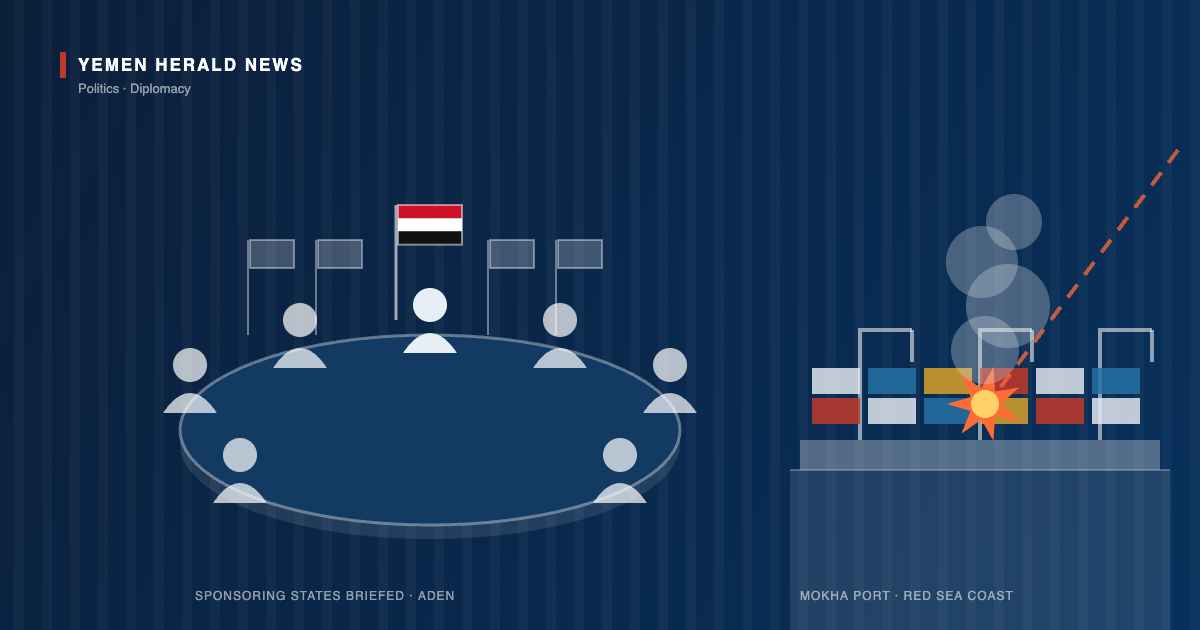
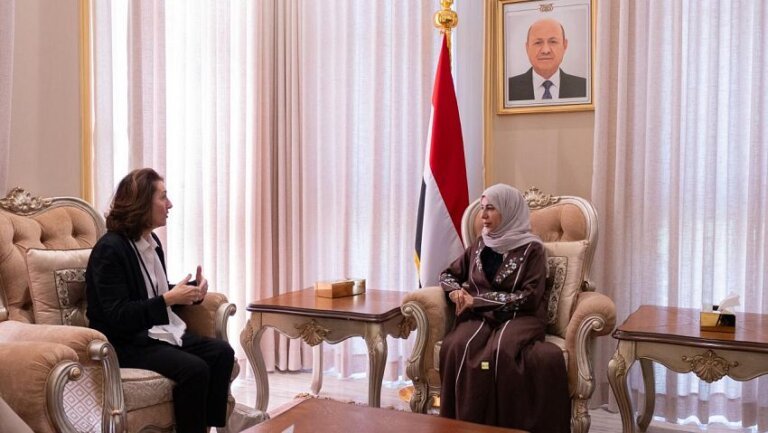
President Rashad al-Alimi, chairman of Yemen’s Presidential Leadership Council, told ambassadors of the countries sponsoring the political process on Monday that the government had not started the latest round of fighting and would not allow its commitment to peace to leave the Houthi movement free to choose when and where to attack.
The briefing followed a large-scale assault on the port city of Mokha, on Yemen’s Red Sea coast in Taiz governorate, on 9 August. The Yemeni military said the attack involved more than twenty ballistic missiles and armed drones launched over several hours, and reported that seven people were killed and about thirty wounded. Casualty accounts differed: military sources put the dead at seven including both service personnel and civilians, while some medical sources in the city gave a higher military toll and counted six civilians among the injured.
According to the army’s account, the strikes hit housing used by port employees and accommodation for staff at the Saudi-funded hospital in the city, rather than front-line positions. Air defences were reported to have intercepted eleven of the drones involved. Yemeni officials described the targeting of a working commercial port as an attack on an economic and relief lifeline; al-Alimi characterised it as an extension of Iranian escalation against economic facilities and maritime routes.
Mokha sits on the approaches to the Bab al-Mandab strait and handles commercial and humanitarian cargo for parts of the west coast and Taiz. Damage there has consequences beyond the immediate casualties, because alternatives for moving goods into the area are limited and insurance costs rise sharply whenever a port is struck.
In his account to the ambassadors, al-Alimi placed Mokha alongside other recent attacks on civilian targets, including strikes on displacement camps and residential districts in Marib. State media reported that missiles and drones hit camps and neighbourhoods in Marib city on 7 August, killing two people and wounding fourteen. The president argued that the pattern showed a movement that expects to act without consequence, and said restraint by the government had been read as permission rather than as good faith.
He returned to an argument he has made repeatedly to Yemen’s international partners: that a durable settlement is not achievable while an armed movement outside state authority retains ballistic missiles and long-range drones, and uses them to set the terms of negotiation. He also said the Houthi leadership’s claim to a special religious standing places it, in its own view, above the institutions of the state, which he presented as a structural obstacle to any negotiated outcome.
Al-Alimi asked the sponsoring states for more than expressions of concern. He called for clear condemnation of the attacks, for a firmer distinction to be drawn between the recognised government and armed groups outside it, and for support directed at restoring state institutions and their capacity to deliver services. According to the government’s account of the meeting, the ambassadors condemned the strikes and reaffirmed support for a political settlement.
The United Nations special envoy for Yemen, Hans Grundberg, said he was deeply concerned by the recent attacks and that the escalation must stop, adding that civilians and civilian infrastructure must be protected. His office has spent much of the past two years attempting to revive a roadmap covering a nationwide ceasefire, the payment of public salaries, the reopening of roads and a resumption of political talks, a process that has repeatedly stalled.
The Houthi movement, which controls Sanaa and much of northern Yemen, said its operations in Mokha targeted arms depots and troop concentrations. Independent verification of claims made by either side is difficult, and casualty and damage figures in Yemen are routinely contested.
The exchanges come after a period in which the front lines had been comparatively static, with no formal truce in place since the UN-mediated agreement of 2022 lapsed but with major ground offensives largely absent. The recent strikes on the west coast and Marib mark a shift back towards sustained long-range attacks on populated areas, and Yemeni officials have warned that a response is under consideration.
For the sponsoring states, the appeal presents a familiar difficulty. Their stated preference has been to keep a negotiated track alive rather than endorse a return to full-scale fighting, and stronger backing for the government’s military position sits awkwardly with that. At the same time, repeated attacks on ports and displacement camps make it harder to argue that the current approach is protecting civilians.
Al-Alimi has chaired the Presidential Leadership Council since it was formed in April 2022, when President Abd Rabbuh Mansour Hadi transferred his powers to the eight-member body. The council brings together political and military figures with distinct regional bases, and differences among them over southern governance and over control of revenue have surfaced periodically. That is part of why unified international backing matters to the leadership in Aden: it strengthens the council’s hand at home as well as abroad.
Yemen’s war began in 2015 and has produced one of the world’s largest humanitarian emergencies, with well over half the population dependent on some form of assistance and millions displaced. Attacks on ports and aid infrastructure have a compounding effect, raising the cost of imports in a country that brings in most of its food, and narrowing the corridors through which relief supplies reach people already living on the margin.
About the Author