Israeli Strike on Central Beirut Hotel Kills Four in Raouche District
 Yemen Herald News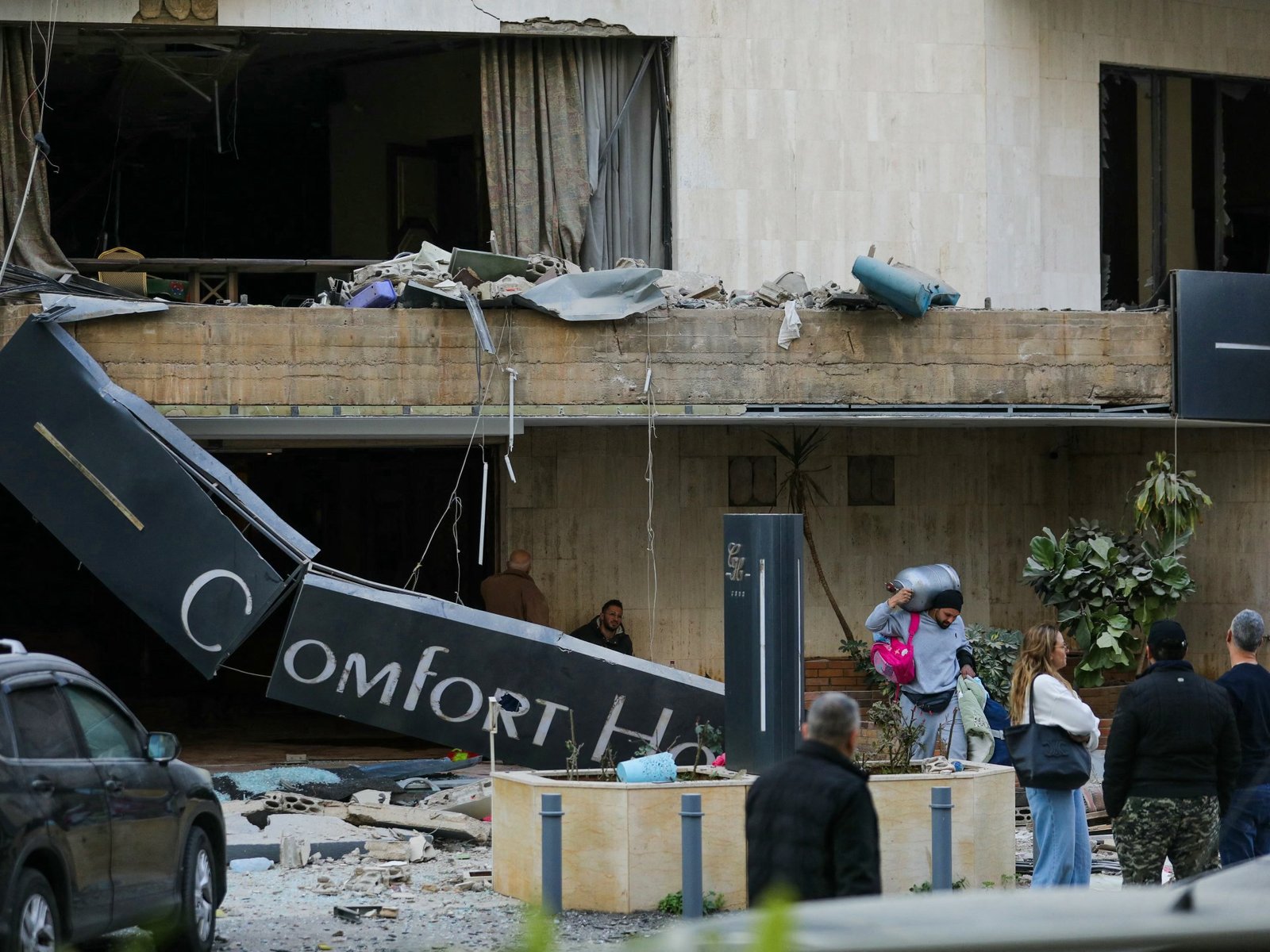
An Israeli air strike on a hotel in central Beirut killed at least four people and wounded at least ten in the early hours of Sunday, 8 March 2026, according to Lebanon’s Health Ministry, in an attack that carried the regional war into a district of the capital that had been spared throughout the previous round of fighting.
The ministry said the raid struck a hotel room in Raouche, a seafront quarter on the Mediterranean better known as a tourist area than a target. Reports at the time placed the strike at around 2:40am, and identified the building as the Ramada Plaza hotel. Photographs from the scene showed a single apartment-style unit torn open while the rest of the structure remained standing.
The Israeli military said it had targeted senior commanders of the Quds Force, the extraterritorial arm of Iran’s Islamic Revolutionary Guard Corps, but did not name them in its initial statement. It said the commanders of the Quds Force’s Lebanon Corps had worked to advance attacks against Israel and its civilians while operating simultaneously for the IRGC inside Iran.
The Israeli account and the Lebanese one did not align on numbers. Israeli officials later said five senior Quds Force figures had been killed in what they described as a naval strike, and characterised the dead as officers of the force’s Lebanon and Palestine corps involved in funding and intelligence support for Hezbollah and Hamas. Lebanon’s Health Ministry recorded four dead. Neither side published names at the time, and the discrepancy was never publicly reconciled.
What made the strike significant was less the toll than the map. Raouche had gone untouched during the 2023-24 war between Israel and Hezbollah, which ended in a ceasefire in November 2024, and through the period of Israeli strikes that followed in breach of that agreement. The attack was the first on central Beirut since 26 November 2024, the night before the truce took effect.
The area along that stretch of coast holds dozens of hotels, and by March 2026 they were crowded with people who had fled fighting elsewhere in the country. The hotel that was hit was itself sheltering displaced families from southern Lebanon and from Beirut’s southern suburbs. Residents were seen leaving the building after the strike, fearing further raids.
Lebanon had been pulled into the wider conflict on 2 March 2026, when Hezbollah launched attacks on Israel in response to the killing of Iran’s Supreme Leader, Ayatollah Ali Khamenei, in the American and Israeli strikes that opened the war on 28 February. Within days the country was absorbing a bombardment on a scale it had not seen since the previous war.
Lebanon’s Health Minister, Rakan Nassereddine, said on the same Sunday that Israeli strikes had killed 394 people across the country in the preceding week, among them 83 children and 42 women. Nine rescue workers were also among the dead, a figure that drew particular attention because it pointed to strikes hitting responders arriving at earlier scenes.
The Beirut hotel strike came amid a broader escalation. Israel had launched successive waves of strikes across Lebanon that week and moved ground troops into border areas. Lebanon’s National News Agency reported at least twelve people killed in three separate strikes in the south overnight. The Israeli military announced a further wave of attacks on Beirut’s southern suburbs, a Hezbollah stronghold, and footage from the area showed smoke rising after at least two raids hours apart.
It was also the second Israeli attack on a hotel in the Beirut area within a week. The previous Wednesday, a strike hit a hotel in Hazmieh, a predominantly Christian district outside the capital. Taken together, the two attacks suggested a deliberate widening of the target set beyond the areas conventionally associated with Hezbollah’s military infrastructure.
Hezbollah said its fighters carried out rocket attacks early on Sunday against Israeli forces and a city across the border, and reported clashes with Israeli troops near the frontier town of Aitaroun. Air raid sirens sounded across parts of northern Israel, with no immediate reports of casualties or damage on that side of the border.
The Israeli military issued fresh forced evacuation orders for four villages in southern Lebanon the same day, adding to the displacement already straining the country. Lebanon had entered the conflict with a state weakened by years of financial collapse and little capacity to house large numbers of people moved at short notice.
Lebanon’s Prime Minister, Nawaf Salam, said the consequences of the displacement, humanitarian and political, might well prove unprecedented, and described the country as having been drawn into a devastating war it neither sought nor chose — a formulation that acknowledged Hezbollah had acted without the government’s authority while placing responsibility for the destruction on Israel.
The targeting of a hotel sheltering displaced civilians raised immediate legal questions. Israel’s position was that the building housed legitimate military targets. Lebanese officials and humanitarian organisations argued that striking a residential-use hotel in a dense urban district could not be squared with the obligation to distinguish combatants from civilians.
By the time of the Raouche strike the war was in its second week with no sign of a negotiated pause. For Beirut, the March attack marked the point at which the city centre ceased to be treated as off-limits.
About the Author