Communications Minister and UN Envoy’s Office Discuss Yemen’s Telecom Sector
 Yemen Herald News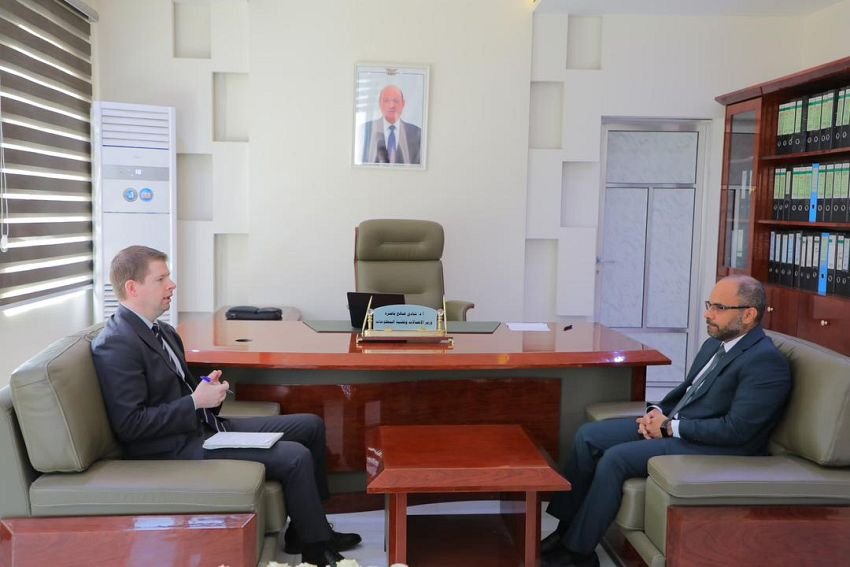
Yemen’s Minister of Communications and Information Technology, Dr. Shadi Basurah, has met the Director of the Office of the United Nations Special Envoy to Yemen, Bert Scott, in Aden to discuss the situation in the country and the role of the telecommunications sector in supporting stability and recovery. The talks centred on the latest developments and on the importance of enhancing coordination to advance economic recovery efforts.
During the meeting, the two sides examined the challenges facing the Yemeni government, with particular attention to the telecommunications and internet sectors. Minister Basurah stressed that his ministry is aligned with the government’s priority programme, which seeks to implement the economic, financial, service and institutional reforms considered necessary for the country’s recovery.
The minister outlined the ministry’s vision and strategic plans for advancing the telecommunications and information technology sectors during what he described as a critical phase. He also acknowledged the significant role played by the Office of the UN Special Envoy in promoting peace, situating the ministry’s work within the broader international effort to stabilise the country.
Telecommunications have assumed growing importance in Yemen, as elsewhere, as a foundation for economic activity, the delivery of services and the connectivity of communities. In a country fragmented by conflict, reliable communications infrastructure is essential not only to commerce but to the functioning of institutions and the ability of people to stay connected with one another and the wider world.
The sector, however, faces considerable challenges. Years of conflict have strained infrastructure, disrupted services and complicated the management of networks in a divided country. Interruptions to internet access and telecommunications have periodically affected Yemenis, underscoring the fragility of systems on which daily life and economic activity increasingly depend.
The alignment of the ministry with the government’s priority programme reflects the integration of telecommunications into the broader reform agenda. Economic, financial, service and institutional reforms are interconnected, and progress in the telecommunications sector can support wider recovery efforts by enabling commerce, improving service delivery and strengthening the infrastructure of a modern economy.
The emphasis on economic recovery points to the significance of the sector for Yemen’s future. A functioning and modern telecommunications system can facilitate business, attract investment and support the digital services that are increasingly central to economic life. Developing this infrastructure is therefore an important element of efforts to revive the economy.
The involvement of the Office of the UN Special Envoy reflects the connection between technical and sectoral matters and the broader political process. The envoy’s office works to support stability and to advance a resolution to the conflict, and coordination on issues such as telecommunications forms part of the wider engagement between the government and the international actors supporting Yemen.
Enhancing coordination, a theme of the meeting, is essential to effective progress in a complex environment. Aligning the efforts of the government, international partners and other stakeholders can help ensure that initiatives are coherent and mutually reinforcing, avoiding duplication and maximising the impact of limited resources in support of shared goals.
The strategic plans referenced by the minister suggest an intent to approach the development of the sector in a considered and forward-looking manner. Articulating a vision for telecommunications and information technology can help guide investment, coordinate efforts and provide a framework for measuring progress, particularly important in a phase the minister described as critical.
Information technology, encompassed within the ministry’s remit, holds significant potential for Yemen. Digital services and technologies can improve the efficiency of government, expand access to services and create economic opportunities, and developing capacity in this area could contribute to the country’s modernisation and recovery over the longer term.
The challenges of managing telecommunications in a divided country are considerable. With different authorities controlling different parts of Yemen, questions of infrastructure, connectivity and control are complicated by the broader fragmentation of the state, adding a political dimension to what might otherwise be purely technical matters.
The government’s efforts to strengthen the telecommunications sector are thus bound up with its broader struggle to assert its authority and rebuild institutions. Developing reliable connectivity in areas under its control and expanding the reach of services are part of the wider effort to demonstrate capacity and to serve the population.
Realising the vision outlined by the minister will require investment, expertise and a stable environment, all of which are in short supply amid the ongoing conflict. Developing telecommunications infrastructure is a resource-intensive undertaking, and progress will depend on the ability to mobilise support and to navigate the challenges of the current situation.
Yemen’s connectivity has also been shaped by its heavy reliance on a small number of undersea cables running through the Red Sea, which carry the bulk of the country’s internet traffic. Damage to or disruption of these links has, at times, slowed or cut connectivity, exposing the vulnerability of a system with limited redundancy. Diversifying and reinforcing the country’s connections, alongside modernising domestic networks, is widely seen as important to building a more resilient telecommunications sector capable of supporting economic activity and withstanding the strains of a difficult operating environment.
For now, the meeting between Basurah and Scott reflected the government’s determination to advance the telecommunications sector as part of its recovery agenda and the continued engagement of the international community in supporting Yemen. As the country works toward stability, the development of reliable communications infrastructure is likely to remain an important element of its efforts to rebuild.
About the Author