Saudi Arabia Reported Downing Drones Near Riyadh as Its Defence Minister Urged Iran to Show Restraint
 Yemen Herald News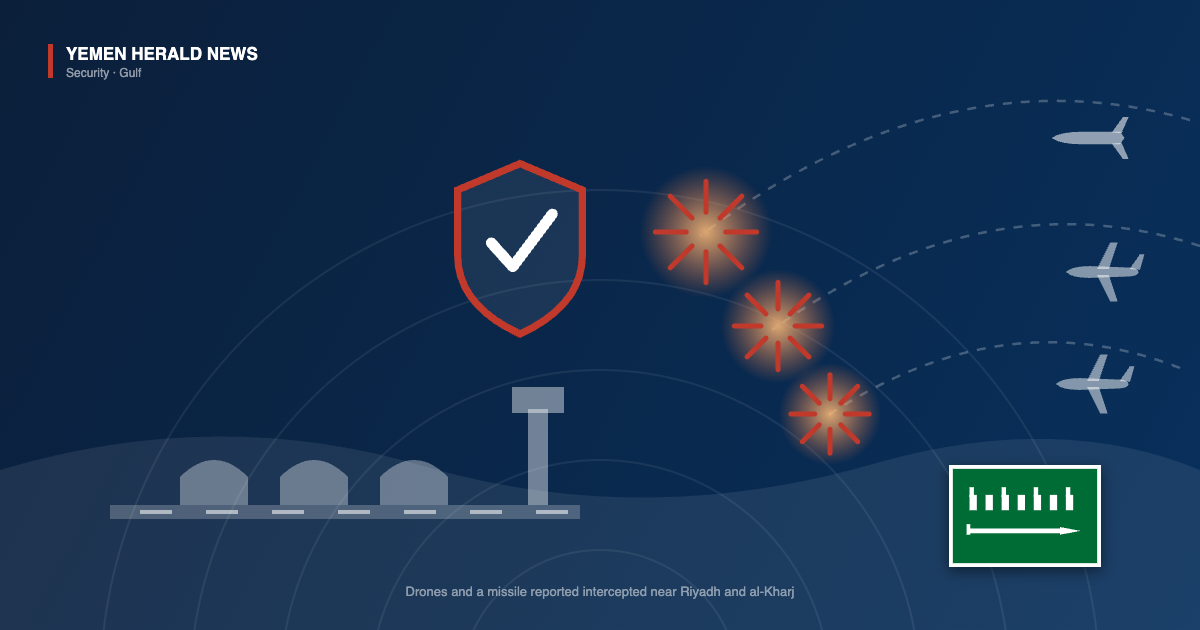
Saudi Arabia’s Ministry of Defence said on Sunday 8 March 2026 that its air defences had intercepted and destroyed six drones east of Riyadh, adding that eight further drones had been brought down earlier the same day after entering Saudi airspace, and that another drone had been destroyed in the same area on Saturday evening. The ministry also reported a ballistic missile directed at Prince Sultan Air Base, which it said came down in an uninhabited area without causing casualties.
The statements were issued by the ministry’s spokesman, Major General Turki al-Maliki, through the Saudi Press Agency, in the format that became standard through the campaign: a location, a count and an outcome, without detail on the systems used or the proportion of incoming munitions that evaded interception. That reticence was consistent across Gulf defence ministries, and it left independent assessment of interception rates largely dependent on the occasions when a strike caused visible damage.
Prince Sultan Air Base at al-Kharj, south of the capital, was a recurring target. It hosts United States military personnel and equipment, which placed it squarely within the logic of Iran’s stated campaign against Gulf states accommodating American forces. Reporting through the first half of March recorded repeated attempts against it: two ballistic missiles intercepted on 7 March, a further missile on 8 March, and six missiles reported destroyed on the approach to the base on 11 March.
The exchanges had begun on 28 February 2026, when Iran responded to a United States and Israeli military campaign against it by striking Gulf states hosting American assets. Saudi Arabia, the UAE, Bahrain, Qatar, Kuwait, Iraq and Jordan all reported launches directed at their territory in the opening days, and the kingdom found itself defending targets spread across more than a thousand kilometres, from the Eastern Province oil installations to the capital and the remote Shaybah field in the Empty Quarter.
Alongside the military response, Riyadh moved to shore up its external partnerships. On 7 March the Saudi Defence Minister, Prince Khalid bin Salman, received Pakistan’s Chief of Army Staff and Chief of Defence Forces, Field Marshal Asim Munir. The two discussed the Iranian attacks on the kingdom and the measures needed to halt them within the framework of the Joint Strategic Defence Agreement concluded between the two countries.
In an account of the meeting published on his own account, Prince Khalid said the two had stressed that such actions undermined regional security and stability, and expressed the hope that the Iranian side would exercise wisdom and avoid miscalculation. The phrasing was deliberately measured. Saudi Arabia had spent years reducing friction with Tehran, including through the 2023 restoration of diplomatic relations, and its public language during the campaign consistently left room for de-escalation rather than committing the kingdom to retaliation.
The involvement of Pakistan carried its own weight. The Joint Strategic Defence Agreement, signed the previous year, established a mutual defence understanding between a nuclear-armed state and the Gulf’s largest economy, and its invocation during an active air campaign was closely watched in the region and beyond. Pakistani statements about the meeting were correspondingly careful, emphasising consultation and the shared objective of ending the attacks rather than describing any operational commitment. Neither side set out what the agreement would require in practice if the strikes continued, and that ambiguity appeared to be intentional on both parts.
Saudi interception tallies continued to accumulate through March. Air defences reported destroying seven ballistic missiles and 22 drones in one period, and on 12 March the ministry announced 31 drones and three ballistic missiles brought down across the kingdom, the largest single-day total of the war to that point. Drones aimed at the Shaybah oil field were intercepted repeatedly over the Empty Quarter, including four on 7 March and two on 12 March.
Not everything was stopped. On 2 March a Saudi Aramco refinery at Ras Tanura was struck by drones, an incident recorded separately from the running interception counts and one with implications for global energy markets that downed drones over open desert did not carry. The pattern of targeting energy and, later, industrial capacity persisted through the month, culminating on 28 March in strikes that Iran’s Islamic Revolutionary Guard Corps claimed against aluminium plants in Abu Dhabi and Bahrain.
The daily statements served a purpose beyond record-keeping. Published promptly and in a consistent format, they were intended to reassure a domestic audience and international energy markets that the kingdom’s infrastructure remained protected and its production uninterrupted, while conveying to Tehran that attacks were being absorbed without prompting the escalation that a direct Saudi military response would have entailed. Restraint of that kind is easier to sustain when the defending side can credibly report that most incoming munitions are being stopped.
The engagements reported around 8 March 2026 were, in isolation, unremarkable within a campaign that would produce far heavier nights. Their significance lay in the pairing that week of a routine air defence bulletin with a senior defence meeting and a carefully worded appeal to Tehran, illustrating how Riyadh sought to manage the confrontation on two tracks at once: intercepting what was launched, while working to ensure the exchange did not widen into something the kingdom would struggle to contain.
About the Author