Houthi Missile and Drone Strikes Hit Marib’s Residential Areas and Displacement Camps
 Yemen Herald News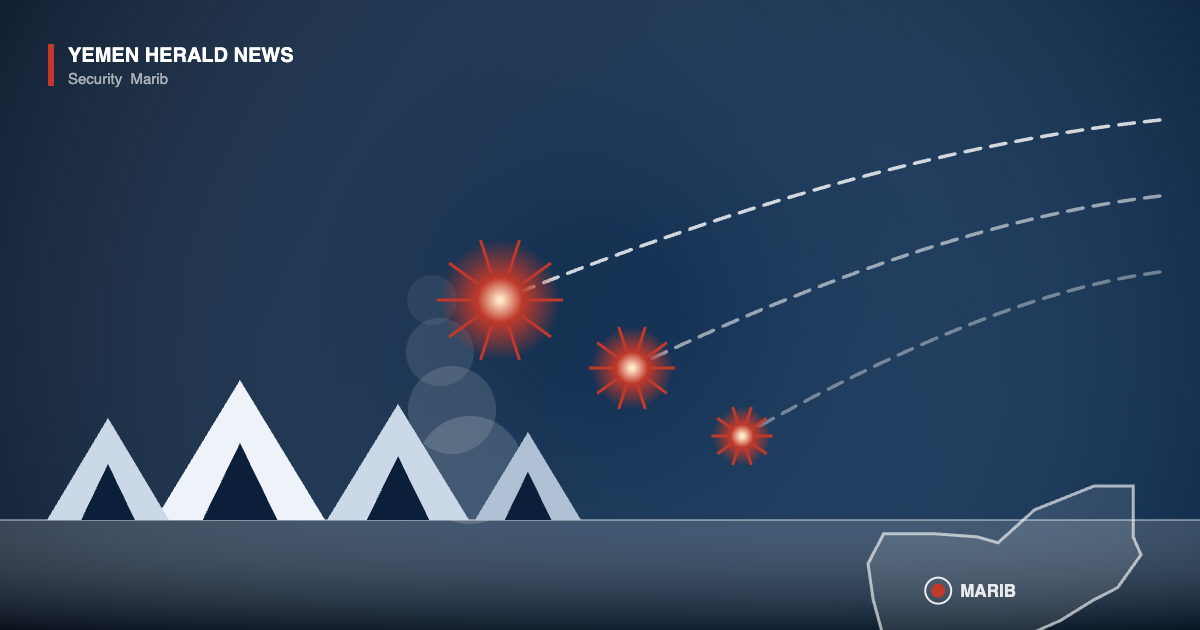
Yemen’s Houthi movement struck the government-held city of Marib with a sustained series of ballistic missiles and drones over the weekend, hitting residential neighbourhoods and areas around camps for displaced families, according to the province’s local authority. The strikes caused injuries and damaged homes, vehicles and other property, officials said, in one of the heaviest concentrations of fire the city has absorbed during a fortnight of sharply escalating violence across Yemen.
Marib’s provincial authority reported that the group fired four ballistic missiles and four drones at the city on Saturday, wounding several people. Officials from the governorate later said a fifth ballistic missile launched the same day injured one more person. Early on Sunday, they added that a sixth ballistic missile had been fired towards Marib overnight. The authority described the barrage as part of an ongoing assault that, in its words, threatens the lives of civilians, displaced persons’ camps and residential neighbourhoods.
Video footage from the aftermath of Saturday’s strikes, verified by Al Jazeera, showed damage in the affected districts. Yemen’s Ministry of Information said on X that the continued targeting of densely populated areas amounted to a dangerous escalation that threatens lives and deepens civilian suffering. The Houthi movement, which is aligned with Iran, controls much of northern Yemen, including the capital, Sanaa.
Marib’s significance in this war is inseparable from its population. The city hosts the largest concentration of internally displaced people anywhere in Yemen: more than two million of the roughly five million Yemenis uprooted during the conflict now live in and around it. Many arrived after fleeing fighting elsewhere in the country, and large numbers remain in informal camps on the city’s outskirts with limited access to water, electricity and healthcare. Strikes that fall on residential districts therefore land on communities that have already been displaced at least once.
The current sequence of attacks on the city began earlier in the month. On 7 August, a reported Houthi ballistic missile attack struck the Mail al-Saila camp for displaced people on the outskirts of Marib. Yemen’s internationally recognised government said that strike and the attacks around it killed at least two civilians and wounded 14 others. Footage filmed by the AFP news agency at the camp afterwards showed residents walking past damaged shelters.
Days earlier, at the start of August, Houthi missile and drone strikes on government military camps in Marib and Hadramout killed at least 30 soldiers and wounded others, according to the government; the Houthis claimed a considerably higher toll. Yemeni officials described it as the deadliest single episode of the conflict in years, and it marked the point at which a long period of relative, if fragile, calm began to give way.
The violence has not been confined to Marib. Yemen’s government said Houthi missiles struck the Red Sea port city of al-Makha, also rendered as Mocha, killing civilians there, with officials reporting four killed in one salvo and seven across the wider sequence of strikes on the port. The government has also accused the group of attacks at sea: on 12 August, officials said six people were killed in an assault on a cargo vessel in the Bab al-Mandab strait, the narrow chokepoint linking the Red Sea to the Gulf of Aden.
Fighting has intensified on the ground as well. Yemeni government forces said drone strikes on Saturday killed three Houthi fighters, including field commanders, and wounded others along the Maqbanah front west of Taiz. A separate strike destroyed a Houthi military vehicle in Jabal al-Zuhayb, killing several more fighters, a military source told the state-run Yemeni News Agency, Saba. Those accounts come from one side of the conflict and have not been independently verified.
The escalation has alarmed international mediators. Hans Grundberg, the United Nations Special Envoy for Yemen, told the Security Council on Thursday that the country faces its highest risk of returning to full-scale war since the UN-brokered truce of April 2022. That truce was never formally renewed after its initial terms lapsed, but it substantially reduced front-line fighting for more than four years. Grundberg warned that simultaneous fighting on multiple fronts now threatens to unravel those gains.
Aid agencies working in Marib have long described the province’s services as running at their limit. Hospitals in government-held areas depend heavily on external funding, and the displaced population’s needs consistently outstrip what is available. Renewed shelling of residential districts adds casualties to a health system already under strain and can force humanitarian staff to suspend movement, slowing deliveries of water, food and medical supplies to camps at precisely the moment demand rises.
Civilian harm in Yemen has come from more than one direction. A Pentagon review reported this month concluded that United States strikes in Yemen killed 153 civilians during 2025, a figure well above earlier official estimates. The finding has added to longstanding calls from humanitarian organisations for closer scrutiny of the civilian cost of all parties’ operations.
For now, the immediate question in Marib is whether the salvos continue. Provincial officials say the pattern of the past ten days, with repeated ballistic missile launches falling near camps and residential streets rather than concentrated on military positions, is what has made this round of fighting different for the city’s civilians. No party has announced a pause, and no mechanism comparable to the 2022 truce is currently in place to halt the exchange.
About the Author