Yemen’s coastguard puts Tihama casualties at 16 after Houthi double strike in Bab al-Mandab
 Yemen Herald News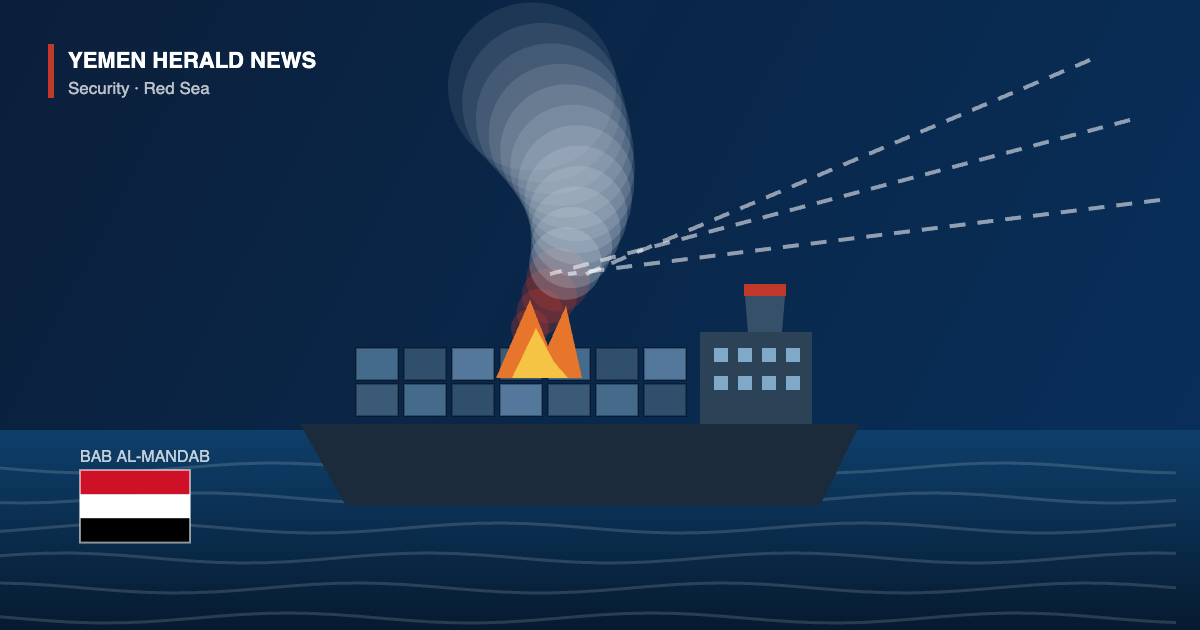
Yemen’s coastguard said on Tuesday that the number of people killed or wounded in a Houthi attack on the commercial vessel Tihama in the Bab al-Mandab Strait had risen to 16, after both the ship and the rescue teams sent to reach it were struck in a sequence of missile strikes.
Authorities in Aden confirmed six deaths. Three of those killed were Pakistani crew members and one was an Indonesian sailor, according to Yemen’s Transport Ministry. The coastguard identified the two remaining fatalities as servicemen from the government’s Second Naval Brigade, while international news agencies reported that the two men belonged to the anti-Houthi National Resistance Forces. Ten other people were wounded, among them seven of the ship’s crew and three members of the response teams.
The Transport Ministry said the Houthis fired three ballistic missiles at the Egyptian-owned vessel, starting a fire and causing what it described as significant damage to the hull and superstructure. The ship was close to the Yemeni coast at the southern end of the Red Sea when it was hit.
In a separate statement, the coastguard said a further missile was launched at the Tihama while rescue personnel were evacuating the dead and the wounded. “The attack struck the site of the rescue operation and resulted in deaths and injuries among the forces participating in the response operation,” it said. At least two members of the response force were killed in that second strike.
About three hours after the initial attack, Yemeni forces reported detecting a remotely operated boat packed with explosives moving towards the damaged vessel. Coastguard units and other government forces intercepted and destroyed the craft before it reached the ship, the Aden authorities said.
Yemen’s Foreign Ministry condemned the attack and urged the international community “to move from condemnation to effective and decisive action” against the Houthi movement.
There was no official comment from the Houthis on the Tihama. The group’s own news agency reported that it had attacked a Saudi ship carrying military equipment in Bab al-Mandab, but it did not name the vessel, and Saudi authorities did not respond publicly to that account.
The deaths matter beyond the immediate toll. They are the first fatalities aboard commercial shipping linked to the Houthis since the United States and Israel began their war on Iran on 28 February, and they come as the strait is once again being treated as a conflict zone rather than a trade route.
The attack follows the collapse of the truce that had held, in various forms, since 2022. The United Nations-brokered arrangement between the Houthis and the internationally recognised government unravelled after a Saudi air strike on the runway at Sanaa airport on 13 July, which prevented an Iranian aircraft carrying a senior Houthi delegation from landing.
The Houthis responded by striking Abha airport in south-western Saudi Arabia and, on 20 July, declaring a naval blockade on Saudi shipping in the Red Sea. They have since attacked Saudi vessels and energy facilities inside the kingdom. The Saudi-led coalition, in turn, has struck Houthi-held Hodeidah and Kamaran, Yemen’s largest Red Sea island.
Inside Yemen, the fighting has returned to the front lines that defined the earlier years of the war. The Houthis have launched missile and drone attacks on the Red Sea port city of al-Makha, known as Mocha, and on Marib in the centre of the country. Yemen’s government said at least 30 of its troops were killed in attacks on Marib province on 6 August; the Houthis claimed a considerably higher figure.
Civilians have been caught in the same exchanges. On 7 August, a Houthi strike on the outskirts of Marib hit camps housing displaced families, killing at least two people and wounding 14, according to the government. Marib shelters more than two million of the roughly five million Yemenis displaced by the war, and the settlements around the city are among the most crowded in the country.
The commercial consequences are already visible on shore. Mokha port suspended operations after repeated attacks, with local authorities putting the resulting losses at around 16 million dollars. Yemen’s government said on Tuesday that Houthi forces had fired ten missiles and four drones at sites along the country’s western coast in a further series of attacks.
Bab al-Mandab is one of the narrowest and busiest chokepoints in world trade, linking the Red Sea and the Suez Canal route to the Gulf of Aden and the Indian Ocean. Sustained attacks there push carriers towards the far longer passage around southern Africa, raising freight and insurance costs and slowing the delivery of aid into a country that depends on imports for most of its food and fuel.
The United Nations has called for restraint, warning that the renewed hostilities risk drawing Yemen into a broader regional confrontation with devastating consequences for its people.
Several details of the attack remain contested. The Houthis have not acknowledged targeting a civilian ship, and the government’s account of the vessel’s movements and of the affiliation of the two servicemen killed has not been independently confirmed. What is not in dispute is that a crew of foreign sailors was working in a strait that has become one of the most dangerous stretches of water anywhere, and that six of the people aboard or alongside the Tihama did not survive it.
About the Author