UAE’s local-partner strategy in Yemen unravels after the STC’s collapse in Aden
 Yemen Herald News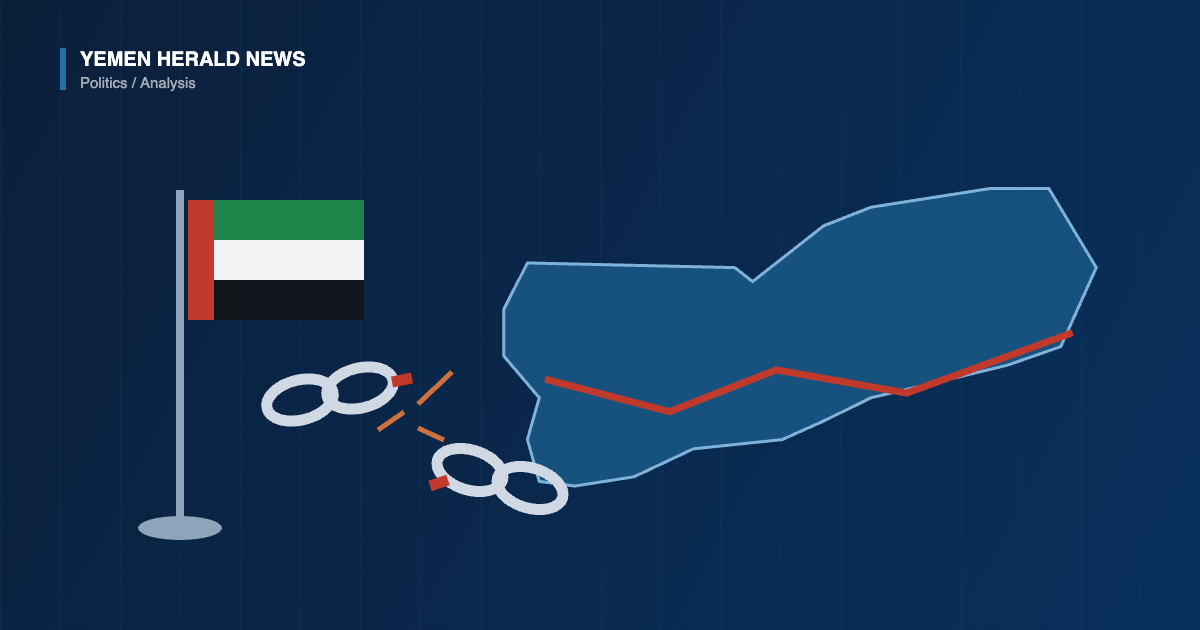
Yemen’s war entered its second decade with a question that outlasted every round of fighting: which outside strategy actually worked? For most of the past ten years the answer appeared to favour the United Arab Emirates, which built its influence through local armed partners rather than through Yemen’s official institutions. Events in the south over the winter of 2025 and 2026 have complicated that judgement.
From the early stages of the war, the Emirati approach in southern Yemen and along the western coast rested on direct relationships with local formations. Abu Dhabi backed the Southern Resistance and helped build military and security units that became among the better organised armed forces in the country. The logic was practical rather than legal: instead of working through recognised chains of command, the UAE identified fighters who could take ground and then hold it.
Aden was the proving ground. Houthi forces pushed into the city in the spring of 2015, and months of street fighting followed between southern resistance fighters and the Houthis, with support from the Saudi-led coalition, including Emirati units. The Houthis were driven out of Aden in the summer of 2015, and that campaign opened the way to further operations across the southern governorates. Over the following years, what had begun as scattered neighbourhood resistance was reorganised into units capable of larger operations.
The fighting was not confined to the Houthis. Forces trained and equipped with Emirati backing also conducted counter-terrorism operations against al-Qaeda in the Arabian Peninsula and Islamic State affiliates in Aden, Abyan, Shabwa and Hadramout. Over time the relationship shifted from episodic military support to a standing partnership with its own command structures and logistics.
The model was extended up the Red Sea coast. By the summer of 2018, Yemeni forces supported by the coalition had reached the outskirts of Hodeidah, the country’s main Red Sea port and the entry point for most of its imported food and fuel. The offensive stalled amid international pressure over the humanitarian consequences of a battle inside the port, and was overtaken by United Nations-brokered talks that produced the Stockholm Agreement in December 2018.
That outcome still shapes the map. The Houthis retained Hodeidah and the coastline around it, and from late 2023 used that stretch of territory to launch attacks on commercial shipping in the Red Sea and the Bab al-Mandab strait. Analysts disagree over whether an uninterrupted offensive in 2018 would have prevented those attacks. What is not disputed is that control of the coast has given the group leverage in negotiations reaching well beyond Yemen’s borders.
Saudi Arabia took the opposite route, channelling its support through the internationally recognised government and its formal military institutions. On paper the logic was sound: a recognised state with a defence ministry and a chain of command is the natural partner. In practice the armed forces fragmented. Reporting by the United Nations Panel of Experts on Yemen and by the government itself has described payrolls inflated with so-called ghost soldiers, names drawing salaries without corresponding troops in the field. The government has since introduced biometric registration and direct bank payment of military salaries to address the problem.
For most of the decade the comparison therefore ran in the Emirati favour. The southern forces the UAE had built were the ones taking and holding ground, while the recognised army struggled to mount sustained operations toward Sanaa.
That reading was upended in December 2025, when the Southern Transitional Council, the UAE’s principal southern partner and by then the dominant authority in Aden, launched an offensive that seized the eastern governorates of Hadramout and al-Mahra from rivals within the Presidential Leadership Council. Saudi personnel guarding the council’s headquarters in Aden withdrew from the city, and Saudi-aligned members of the council, including its chairman Rashad al-Alimi, left with them.
The overreach proved decisive. Government forces, with direct Saudi military support, counter-attacked in early 2026 and recovered most of the east. On 7 January 2026 they entered Aden, and the council’s forces in the city collapsed. A council delegation in Riyadh announced two days later that the organisation would dissolve, although its spokesman and several senior figures rejected that statement as having been made under duress and maintained that the body remained legitimate and operational. The dispute has not been resolved. The UAE withdrew its remaining forces from Yemen the same month.
The episode is a hard test of the local-partner model. Building capable proxies delivered battlefield results that institution-building did not, but it also produced a force with political ambitions of its own, and the arrangement unravelled quickly once those ambitions collided with the coalition that had armed it. Nor did the collapse settle the underlying grievance. The Southern Question, meaning what constitutional status the formerly independent south should hold, remains open.
In the north none of this touched the Houthis, who continue to govern the most populous parts of the country and retain the Red Sea coastline that gives them leverage over international shipping. A decade of external intervention has rearranged authority in the south several times over while leaving the central military balance close to where it stood in 2018. Any durable settlement will have to address both the north-south division and the question of who commands the forces that actually hold Yemeni territory.
About the Author