Hijacking Off Somalia Extends a Piracy Wave That Has Already Reached Yemeni Waters
 Yemen Herald News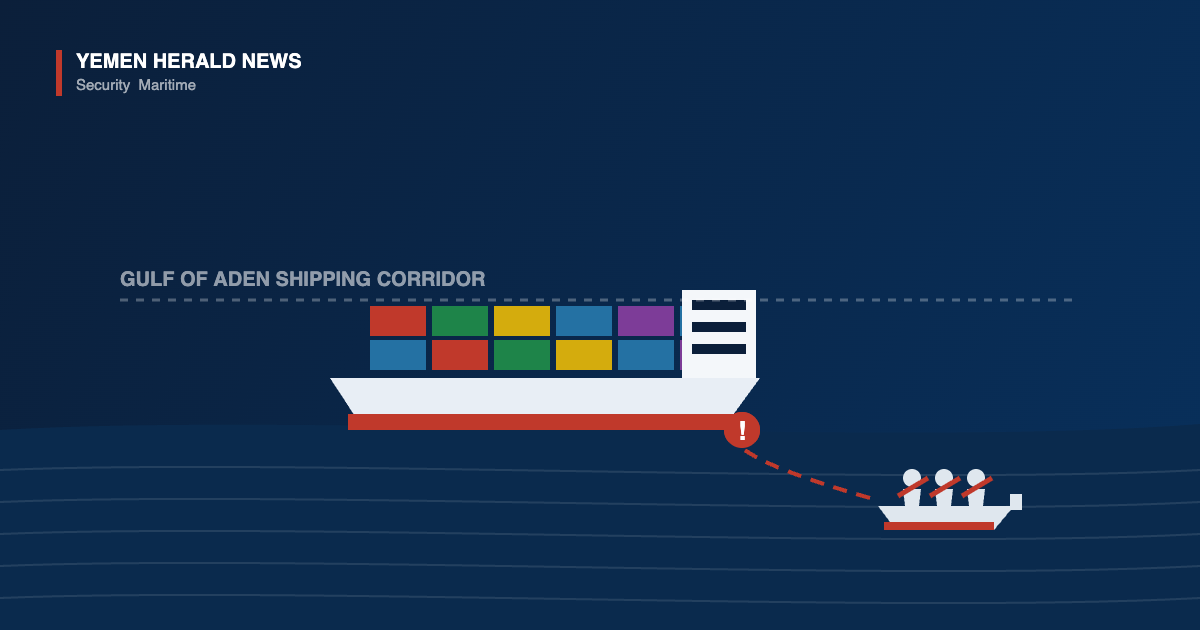
The United Kingdom Maritime Trade Operations centre has reported that eight armed men boarded a cargo vessel and took control of it about four nautical miles south of Mareeyo, on the Somali coast, in an incident it classified as a hijacking. UKMTO said the vessel’s company security officer raised the alarm at 1136 UTC on Monday, 17 August, and that authorities were investigating. Ships operating in the area were advised to transit with caution and to report any suspicious activity to the centre.
UKMTO did not release the vessel’s name, flag or cargo, gave no account of its crew, and did not identify the boarders. That leaves the questions that matter most unanswered: how many seafarers are aboard, where the ship is being taken, and whether those who seized it intend to hold vessel and crew for ransom.
For Yemen, this is more than a distant maritime bulletin. The water where the seizure took place lies at the southern edge of the Gulf of Aden, the corridor that runs the length of Yemen’s coastline from Aden and Mukalla towards the Bab al-Mandab strait and the Red Sea beyond. A sustained revival of piracy in that corridor places Yemeni ports, Yemeni fishing fleets and the imported cargo the country depends on directly in its path.
That risk is not hypothetical. On 17 July, armed men widely described by regional authorities as Somali pirates boarded the chemical tanker Asana roughly 65 nautical miles off Al Mukalla, in Hadramawt. The hijacking therefore began in the waters off Yemen’s own southern coast rather than off Somalia. The Tanzanian-flagged vessel was then taken south across the Gulf of Aden, and by the following weekend officials in Puntland said it had reached waters off Caluula, in the semi-autonomous region’s Bari district. Weeks earlier, on 1 July, UKMTO issued an advisory after a merchant ship was illegally boarded by armed personnel off Yemen and a second vessel nearby reported a suspicious approach.
Attacks are no longer confined to the Somali littoral. Groups operating from the Horn of Africa appear willing to cross the gulf, work the lanes on the Yemeni side and bring seized vessels back to anchorages on the Somali coast, turning what was once read as a Somali problem into a shared regional one.
The scale of the current wave is already substantial. The Joint Maritime Information Center assessed at the weekend that four merchant vessels were being held in the wider region, among them the product tanker Honour 25 and the general cargo ship Sward, both hijacked off Somalia in April. Monday’s boarding, if the vessel is not quickly released, would add to that tally.
The human cost has drawn attention at the highest levels of the shipping industry. In early July the secretary-general of the International Maritime Organization, Arsenio Dominguez, called for urgent international action to secure the release of 44 seafarers then held captive by pirates in Somali waters. When the IMO Council opened its session in London days later, maritime security, including piracy in the north-west Indian Ocean, sat near the top of the agenda.
What makes Monday’s incident notable is its timing. The south-west monsoon usually suppresses piracy by making it difficult for small skiffs to operate far from shore, and the Joint Maritime Information Center said at the weekend that rougher offshore conditions were indeed limiting extended-range operations. It warned, however, that sheltered coastal waters still offered opportunities. A boarding four nautical miles from the Somali shore fits that assessment precisely, and suggests the threat has adapted to the season rather than paused for it.
The consequences for Yemen are largely economic, and they land on top of an already severe humanitarian situation. United Nations agencies have repeatedly noted that Yemen imports the overwhelming majority of its food and fuel by sea, through Aden, Mukalla and Hodeidah. When underwriters raise war-risk and piracy premiums for a stretch of water, or operators add security teams and route further offshore, those costs are passed into landed prices and reach the market quickly.
There is a second, less visible exposure. Yemeni fishermen and the small dhows that carry goods between Yemeni ports and the Horn of Africa work the same waters without armed guards, citadels or the reporting links commercial shipping relies on. Vessels of that kind have historically been seized and used by pirate groups as platforms for further attacks, and their crews rarely appear in international tallies of seafarers held.
Two threats are often conflated and are worth separating. The attacks on shipping attributed to the Houthis in the Red Sea and Gulf of Aden have been politically framed. Somali piracy is a criminal enterprise driven by ransom, and its targets are chosen for vulnerability rather than affiliation. They overlap only in geography and in effect: together they have made a heavily used sea route more expensive and harder to insure.
Naval patrols remain in place, including the European Union’s counter-piracy operation, but the recent run of successful boardings has renewed a long-standing argument that policing alone cannot settle the problem. What happens next with Monday’s vessel, whether it is identified, where it is taken and how its crew are treated, will indicate whether this was isolated coastal opportunism or a further step in a resurgence that has already reached Yemen’s own coastline.
About the Author