Yemen’s water minister presses CARE International and UNESCO for closer project coordination
 Yemen Herald News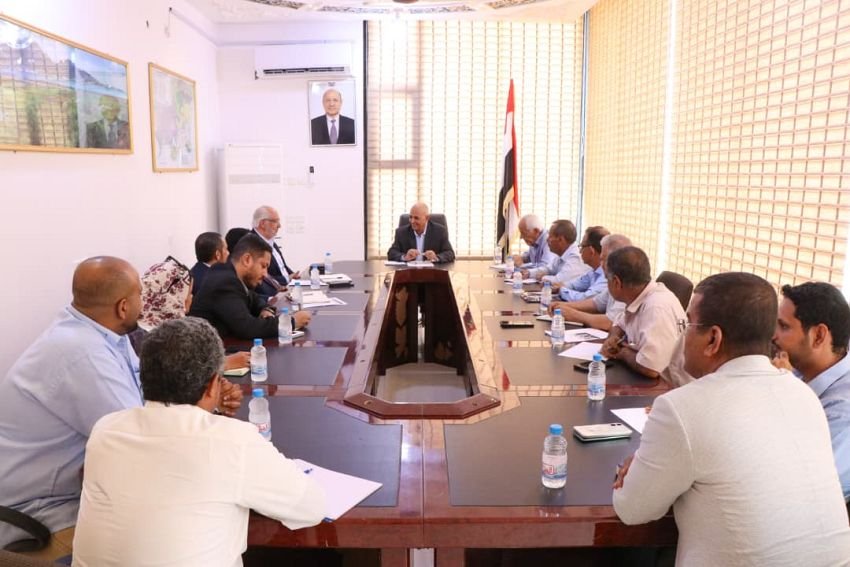
Yemen’s Minister of Water and Environment, Engineer Tawfiq al-Sharjabi, met the Regional Director of CARE International for the Middle East and North Africa, Hazem Fahmy, in Aden on Wednesday to discuss how the two sides can strengthen their partnership and better coordinate work across the country’s water and environment sectors. The state news agency Saba reported the meeting on 19 August 2026.
The talks reviewed the progress of joint projects already under way and the level at which each is being implemented, according to Saba’s account. The two sides also examined future opportunities and initiatives that CARE intends to carry out, and weighed them against the ministry’s own plans, priorities and the needs of the sector.
Much of the discussion turned on coordination itself. Al-Sharjabi and Fahmy considered mechanisms for directing interventions toward actual priorities rather than allowing aid programmes to drift away from where need is greatest, a persistent difficulty in a country where dozens of agencies operate across a fractured administrative map.
The minister affirmed the ministry’s commitment to continuing its partnership with CARE International and to expanding areas of cooperation. He said he hoped the organisation would keep coordinating with the ministry on its upcoming projects so that its interventions align with government plans and achieve the greatest possible impact.
CARE’s representatives praised the level of cooperation they have had with the ministry and proposed designating a focal point to act as a liaison between the two sides. Such an arrangement, they said, would make it easier to follow up on projects and programmes and would speed up coordination procedures, a practical fix in a setting where logistical delays routinely hold up both aid and development work.
In a related meeting, al-Sharjabi held talks with the UNESCO representative, Nuno Lavera, on areas of joint cooperation in the same sectors. Foremost among them was the Early Warning Project, which is intended to strengthen the capacity of the relevant Yemeni authorities to prepare for and respond to water and environment related risks.
The two sides discussed how to support and develop that project through its next phase, and how the ministry might draw on UNESCO’s expertise and programmes to support other priority work. Al-Sharjabi stressed the importance of the Early Warning Project for Aden in particular, where it would improve preparedness and reduce the impact of hazards. He said the ministry was committed to developing its partnership with UNESCO and to drawing on the organisation’s experience in the field.
Lavera, for his part, affirmed UNESCO’s commitment to continuing cooperation with the ministry and to supporting joint initiatives and projects in the water and environment sectors.
Yemen’s water problems long predate the war that began in 2014 and 2015. The country ranks among the most water-scarce in the world, and decades of groundwater over-extraction, much of it for agriculture, drew down aquifers well before the conflict started. The fighting then damaged pumping stations, treatment plants and distribution networks, and left the institutions responsible for them short of fuel, spare parts and trained staff.
The meetings therefore take place against the backdrop of one of the world’s most severe water crises. The UN Office for the Coordination of Humanitarian Affairs estimates that some 17.8 million people in Yemen lack access to safe water and adequate sanitation. Its Humanitarian Needs and Response Plan for 2026 projects that 14.4 million people will require water, sanitation and hygiene assistance during the year, with water scarcity and damaged infrastructure both driving the need.
The public health consequences are already visible. OCHA recorded more than 350,000 suspected cholera cases and over 1,100 associated deaths between March 2024 and November 2025, with cases reported in Taiz, Aden, Lahj, Al-Hudaydah, Hajjah, Sanaa, Al-Baida and Ibb governorates. Cholera spreads where drinking water and sewage systems fail, which makes the condition of Yemen’s water infrastructure a public health question as much as an engineering one.
As public water systems continue to deteriorate, millions of Yemenis depend on emergency measures rather than functioning networks: water trucking, borehole rehabilitation, chlorination systems, sanitation services and hygiene programmes. Those measures are expensive to sustain and do little to rebuild the underlying system, which is part of the reason the ministry has pressed international partners to align their spending with longer-term plans.
Funding remains the binding constraint. The water, sanitation and hygiene response in Yemen required roughly 176.9 million US dollars in 2025 but secured only about 37.4 million, a shortfall of close to 80 percent. Under those conditions, coordination is not merely administrative housekeeping, because duplicated or misdirected projects consume money the sector cannot replace.
Aden, where both meetings took place, illustrates the pressure. The city serves as the interim seat of the internationally recognised government and has absorbed large numbers of displaced people, straining water supply and drainage systems that were already inadequate. Seasonal rains regularly cause flooding in low-lying districts, which is the kind of hazard the Early Warning Project is designed to anticipate.
Neither meeting produced a signed agreement or a stated funding figure. Both were framed as coordination talks, and Saba’s report describes commitments to continue and expand existing partnerships rather than new pledges of money or new projects. Whether the proposed CARE focal point is appointed, and whether the Early Warning Project secures the support to move into a further phase, will be the practical tests of what was discussed in Aden this week.
About the Author