UN says aid reached 3.4 million in Yemen as it renews call to free detained staff
 Yemen Herald News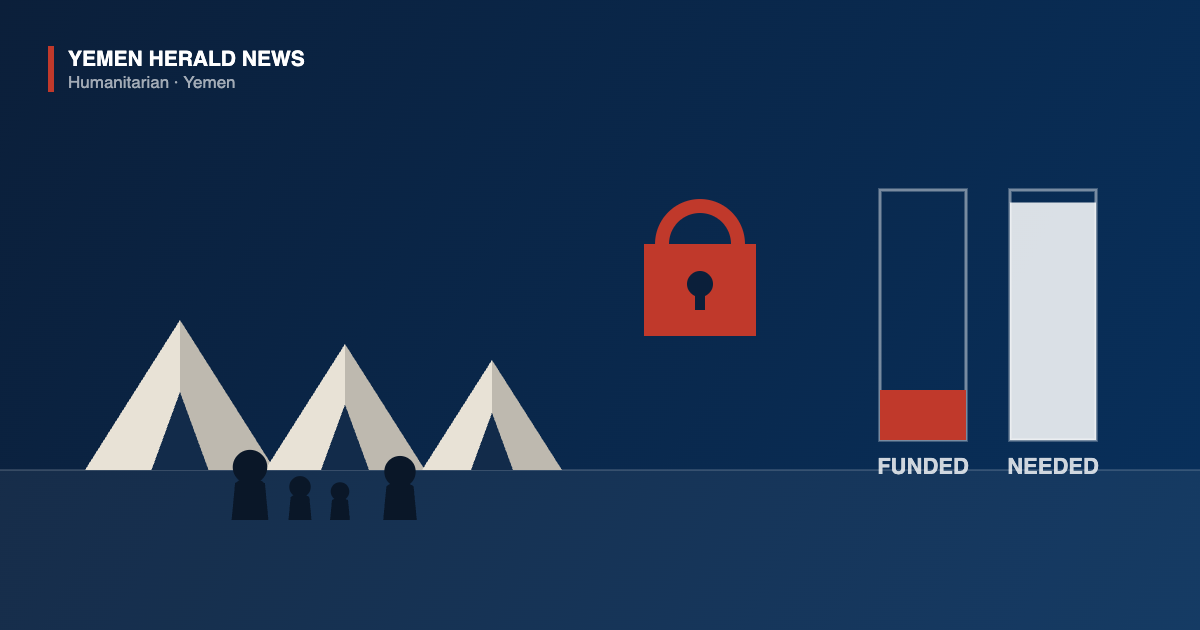
ADEN, Yemen — Humanitarian agencies reached 3.4 million people in Yemen in the first half of 2026, the United Nations said, renewing its call for detained aid workers to be freed.
The figure was given by the United Nations resident and humanitarian coordinator in Yemen in a statement marking World Humanitarian Day on Aug. 19.
The statement warned that needs were worsening and that the gap between those needs and available money was widening.
It said the 2026 Yemen Humanitarian Needs and Response Plan had received about 20 per cent of the funding it requested. Agencies had cut back life-saving programmes as a result, according to the statement.
The World Health Organization’s eastern Mediterranean office marked this year’s World Humanitarian Day under the theme of protecting those who protect others.
The European Commission and partner governments issued a joint statement on the protection of aid workers on Aug. 18, a day before the observance.
The plan seeks $2.16 billion and targets 12 million people, according to the UN Office for the Coordination of Humanitarian Affairs.
Two of every five health facilities in Yemen are not operating, or are operating only in part, the coordinator’s statement said.
It called for relief workers to be protected and for the immediate release of dozens of humanitarian staff held in detention.
The statement praised relief workers, and Yemeni staff in particular, for continuing to deliver aid despite the risks, the access restrictions and the funding shortfall.
Seventy-three UN staff remain in the custody of the Houthi de facto authorities, Tom Fletcher, the UN under-secretary-general for humanitarian affairs, told the Security Council on Aug. 13.
Workers and former workers from non-governmental organisations, civil society groups and diplomatic missions are also being held, Fletcher said.
Human Rights Watch said in January that the detentions had halted aid delivery in parts of the country. The group repeated its call for the detainees to be freed in June.
In November 2025 a Houthi court sentenced 17 staff affiliated with humanitarian organisations, three of them from the UN, to death on espionage charges, according to the rights group.
Secretary-General Antonio Guterres has said the detentions violate international law and damage relief operations.
More than 200 humanitarian access incidents were recorded across Yemen between July 2025 and July this year, Fletcher told the Council. He listed interference, violence against staff and restrictions on movement among them.
He set out three requests. He asked donors for flexible and predictable money, asked all parties to protect civilians and release the detained staff, and asked the Council to keep Yemen on its agenda.
The drivers of the deterioration were regional tension pushing up prices, economic decline eroding livelihoods and the shortfall in funding, Fletcher said.
Health facilities lack basic supplies and staff, and disease outbreaks are spreading, according to his briefing.
Fletcher described the Aug. 13 session as OCHA’s sixth briefing to the Council on Yemen this year.
The response reached an average of 5.3 million people a month in 2025, he said.
The Yemen Humanitarian Fund and the Central Emergency Response Fund both channel money into the response, Fletcher said, thanking governments that contribute to them.
More than half of Yemen’s population is acutely food insecure, according to his briefing. Six million people face what the UN classifies as emergency levels of deprivation, which he said was the highest such figure in any country.
In June, more than 60 per cent of households reported inadequate food consumption, and the pattern held in every governorate, Fletcher said.
Authorities in Marib have declared a health emergency over a measles outbreak that Fletcher said carried the second-highest case count in the world this year.
Nearly 11 million women and girls need humanitarian support, including 5.5 million of reproductive age and more than 750,000 who are pregnant, he said.
Four in five women cannot obtain life-saving reproductive health services, and one health facility in five offers maternal care, according to the briefing. Three women die each day from preventable complications of pregnancy, Fletcher said.
El Nino conditions are forecast to cut rainfall by 40 per cent across Yemen’s main farming areas, he added.
Families have exhausted their coping mechanisms and are choosing between food and medicine, Fletcher told the Council.
Aid officials have said the detentions force staff to limit movement and office attendance, which narrows the areas agencies can reach.
OCHA’s March plan counted more than 22 million people in need of assistance and 18.3 million who were acutely food insecure.
It recorded more than 2.2 million acutely malnourished children under the age of five, including 516,157 with severe acute malnutrition, and 5.2 million people displaced inside the country.
Yemen’s war escalated in 2015, when the Houthis took the capital and a Saudi-led coalition intervened on the side of the internationally recognised government. The front lines have moved little since 2022, and the country remains split between a Houthi administration in Sanaa and a government seated in Aden.
Fletcher named the European Commission, Saudi Arabia, Britain, Germany and South Korea as the response’s largest donors.
He said he had released $10 million from the UN Central Emergency Response Fund for food security, and called the allocation a stopgap.
All of the detained UN staff are Yemeni nationals, according to accounts published in February. Seven have been released since the arrests began.
About the Author