Houthi sources tell AFP forces are massing for an offensive on Yemen’s west coast
 Yemen Herald News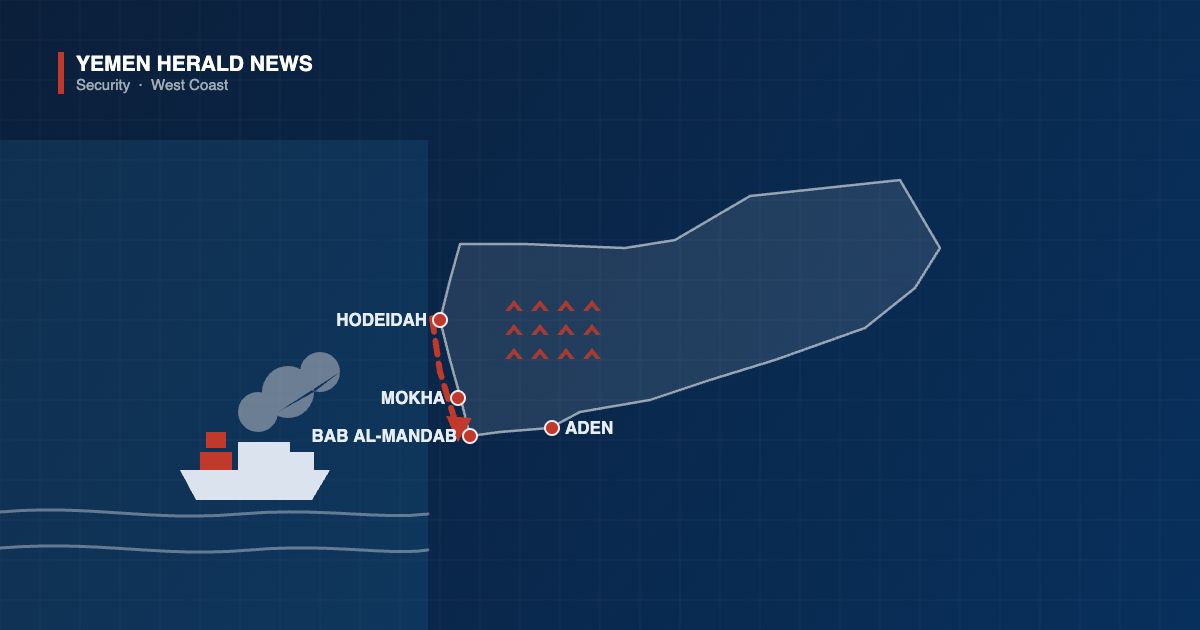
MOKHA, Yemen — Houthi forces are preparing an operation to seize government-held areas south of Hodeidah, three Houthi military sources told Agence France-Presse.
The sources spoke to the news agency on Aug. 19. They said about 2,000 fighters and missile launchers had been moved to front lines in Taiz and Hodeidah governorates ahead of the operation.
The Houthis have not announced a large-scale ground offensive on the west coast. The South24 Center, which carried the AFP report, said it could not independently verify the scale of the reported reinforcements or the details of any planned operation.
Yemen’s internationally recognised government reads the buildup the same way.
Information Minister Moammar al-Eryani told AFP the Houthis were working to create the conditions for controlling the Bab al-Mandab Strait by expanding their presence along the west coast and attempting to seize Yemeni islands in the Red Sea. He cited the group’s recent military buildup and its attacks on ports, vessels and civilian infrastructure.
Maj. Gen. Sadeq Duwaid, spokesman for the National Resistance Forces, told the agency the Houthis were seeking a foothold near the strait. He linked that objective to the continuing bombardment of Mokha and its port.
The National Resistance Forces control Mokha and other stretches of coastline. The formation is led by Tareq Saleh, a member of the Presidential Leadership Council.
Mokha has absorbed much of the recent fire.
The Houthis have launched repeated ballistic missile and drone attacks on the city and its port since Aug. 9. Port director Abdulmalik al-Sharabi said on Aug. 15 that the facility had been hit by more than 25 missiles, killing seven people and causing about $16 million in damage. Commercial and maritime operations were suspended afterwards.
The attacks did not stop when the port did. The National Resistance Forces said two more ballistic missiles struck Mokha port on Aug. 17, and that five others were fired toward the Bab al-Mandab area the same day.
The Houthis have struck inland targets as well. Six ballistic missiles and four drones hit residential districts of Marib on the evening of Aug. 15, wounding four people and damaging homes, Al Jazeera reported. Four people were killed and eight wounded in overnight attacks on al-Makha.
Ground fighting has picked up alongside the strikes. Government-aligned forces said they repelled a Houthi attack on the al-Barh front in western Taiz on Aug. 15 after hours of clashes.
At sea, the escalation has killed civilians.
The Tanzanian-flagged commercial vessel Tihamah was attacked near Bab al-Mandab on Aug. 11. Yemen’s coastguard said six people were killed, among them three Pakistani crew, one Indonesian crew member and two members of the Second Naval Brigade. Ten others were wounded.
The Ministry of Transport said the ship was carrying food supplies and was struck by three ballistic missiles, then targeted again while rescue work was under way.
The Houthis said the Tihamah was carrying Saudi military equipment. That claim has not been independently verified. Reuters described the attack as the first confirmed fatal Houthi strike on a commercial vessel since the latest regional war began in February.
The United Kingdom Maritime Trade Operations said on Aug. 19 that an unmanned cargo vessel about 40 nautical miles south-east of Mokha had been hit by several unidentified projectiles and was assessed as a constructive total loss. UKMTO did not attribute the attack to any party and said authorities were investigating.
The maritime campaign follows the Houthis’ announcement on July 20 of what they called a naval blockade of Saudi Arabia. The group has since claimed attacks on Saudi-linked oil tankers and other ships in the Red Sea, the Gulf of Aden and the Arabian Sea.
The July escalation followed the bombing of Sanaa airport, which is under Houthi control. The internationally recognised government claimed that strike. The announcement also came against the backdrop of the wider regional conflict involving the United States, Israel and Iran.
Houthi officials said on Aug. 19 that they had targeted eight Saudi oil tankers between July 20 and Aug. 19 and turned back 48 others. Those figures come from the group’s own account and have not been confirmed independently.
The United Nations has tracked the attacks separately. The Secretary-General’s monthly report on Houthi attacks against merchant shipping, circulated on Aug. 10, confirmed strikes on the Saudi-flagged Encelia on July 22 and the NCC Ghazal on July 28, and on the Dominica-flagged Daisy on Aug. 5.
The Security Council held its monthly briefing on Yemen on Aug. 13, followed by closed consultations. Special Envoy Hans Grundberg and Under-Secretary-General for Humanitarian Affairs Tom Fletcher briefed members.
Front lines along the west coast have barely moved for almost five years.
Government-aligned Joint Forces withdrew in November 2021 from positions around Hodeidah city and redeployed farther south, including around al-Khokha, while opening new fronts in western Taiz and southern Hodeidah. The redeployment came after years of restrictions on military operations around Hodeidah under the 2018 Stockholm Agreement.
Bab al-Mandab links the Red Sea to the Gulf of Aden. Traffic through the strait fell after the July blockade announcement. The data provider Kpler recorded a 34% drop, with 11 cargo vessels passing on July 27.
About the Author