EU naval mission marks 30 months in the Red Sea with mandate running to 2027
 Yemen Herald News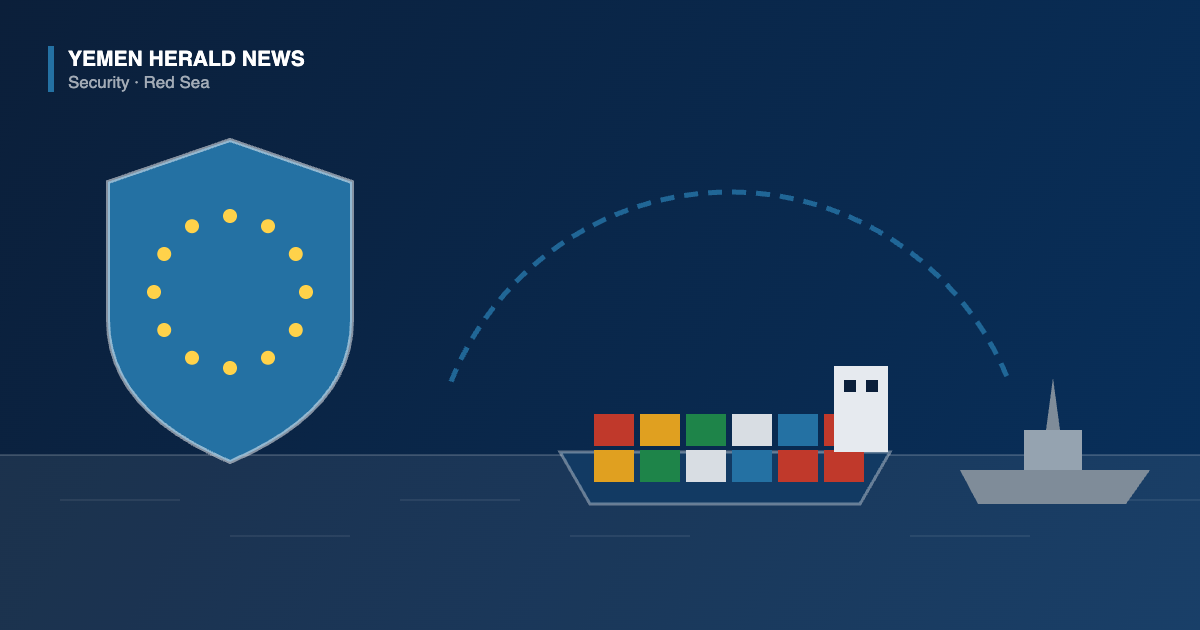
BRUSSELS, Belgium — The European Union’s naval operation in the Red Sea marked 30 months since its launch on Wednesday, with a mandate that now runs to the end of February 2027.
EUNAVFOR Aspides said in a statement dated Aug. 19 that the operation had reached the 30-month mark. It described its mandate as wholly defensive.
The operation was launched on Feb. 19, 2024, with an initial mandate of one year.
It was set up after Houthi forces began attacking merchant shipping in the Red Sea and the Gulf of Aden in late 2023, a campaign the movement said was tied to the war in Gaza.
The EU Council prolonged the mandate in February 2025 to Feb. 28, 2026, and extended it again on Feb. 23 this year.
The Council set a financial reference amount of close to 15 million euros to cover the operation’s common costs between March 1 this year and Feb. 28, 2027, according to its statement at the time.
A further strategic review of the operation is due in 2026 or 2027, the Council said.
Aspides operates across the Red Sea, the Gulf of Aden, the Arabian Sea, the Sea of Oman, the Gulf and the north-western Indian Ocean.
It runs under the EU’s Common Security and Defence Policy. Its operational headquarters is in Larissa, in central Greece.
Aspides takes its name from the Greek word for shields.
The European Union runs a second naval operation in the same waters, Atalanta, which was set up against piracy off Somalia and remains in place.
The operation has facilitated the safe passage of more than 2,240 merchant vessels and provided close protection to more than 690, according to figures the mission has published. Those tallies have not been independently audited.
In its first year the operation said it had supported more than 640 merchant ships, of which more than 370 received close-protection escorts.
By early June last year the close-protection total had reached 476 ships, according to figures reported at the time.
The mandate allows the operation to fire in self-defence and in defence of the ships it accompanies. It does not permit strikes on targets ashore.
That distinguishes it from the United States-led effort in the same waters, which was authorised to strike Houthi launch sites and radar positions.
The distinction has drawn criticism from analysts who argue that escorting ships without addressing the source of the attacks limits what the mission can achieve. The EU has said the defensive mandate is deliberate and is intended to avoid escalation.
Warships from several member states have served under the operation. The Italian frigate Caio Duilio acted as flagship in its early months, and German, French, Greek and Italian units have carried out escorts since.
Aspides warships came to the aid of the tanker Sounion after it was attacked and set on fire in the Red Sea, one of the incidents that pushed insurance costs up sharply on the route.
The Bab al-Mandab strait, between Yemen and the Horn of Africa, connects the Red Sea to the Gulf of Aden and carries traffic bound for the Suez Canal.
Traffic through the strait fell after the attacks began, as operators rerouted around the Cape of Good Hope. Industry bodies said the diversion added days and fuel costs to voyages between Asia and Europe.
The operation has said demand for escorts rises and falls with the tempo of attacks.
Yemen’s war escalated in 2015, when the Houthis took the capital and a Saudi-led coalition intervened on the side of the internationally recognised government.
The country remains divided between the Houthi administration in Sanaa and the government seated in Aden.
Member states contribute ships and aircraft on a rotating basis, and the force size has varied through the deployment.
The common costs covered by the Council’s financial reference are those shared by all member states, such as headquarters and communications. Nations bear the cost of their own vessels.
Fighting inside Yemen intensified through August, with strikes reported in Marib, Taiz and along the western coast.
The Houthis have said their maritime campaign is directed at vessels linked to Israel, the United States and Britain. Shipping bodies have said the movement has also struck vessels with no such connection.
The EU has repeatedly said the operation protects freedom of navigation rather than any party to the conflict.
The Council’s February decision did not change the operation’s rules of engagement.
The mission and the EU’s Maritime Security Centre for the Indian Ocean issue guidance to merchant operators on routing and on requesting escorts.
Operators are asked to register transits in advance so warships can plan which convoys to accompany.
The operation published a comparable summary at the 27-month mark, part of a pattern of updates issued roughly every three months.
Piracy off Somalia has revived alongside the Houthi campaign, adding a second threat on the same routes and stretching the naval forces assigned to them.
The mission publishes periodic updates on its transits and escorts through the European External Action Service and on social media.
It last set out its cumulative figures in a summary released in May.
About the Author