Yemen asks Global Environment Facility to raise climate funding at COP17
 Yemen Herald News
ULAANBAATAR, Mongolia — Yemen asked the Global Environment Facility on Saturday to increase the funding it allocates to the country under the fund’s next investment cycle.
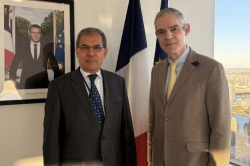
Ahmed al-Zamaki, deputy minister of agriculture and irrigation for the irrigation sector, made the request in talks with Ulrich Appel, a programme unit specialist at the facility, the state news agency Saba reported.
The two met on the sidelines of the 17th session of the Conference of the Parties to the United Nations Convention to Combat Desertification, known as COP17.
The conference opened in the Mongolian capital on 17 August and runs until 28 August. It draws delegates from the convention’s 197 parties under the theme “Restoring Land. Restoring Hope.”
Al-Zamaki said the support allocated to Yemen under the GEF-9 cycle, which is still being prepared, should match the scale of the environmental and climate pressures the country faces, according to Saba.
He named four areas where he said funding was needed: combating land degradation, addressing drought, managing natural resources sustainably, and building the capacity of farming communities to adapt to climate change.
He also thanked the facility for its existing support, citing its role in preparing Yemen’s national report on combating desertification and in financing environmental and climate projects, Saba said.
Appel said the facility intended to continue supporting least developed countries, including Yemen, the agency reported.
He praised coordination among Yemeni government institutions on projects the facility finances, saying it improved implementation and helped make results last, according to the same account.
Appel’s remarks, as reported, did not include a commitment to any specific figure for Yemen.
Saba is Yemen’s state news agency, and its report is the only published account of the meeting. No independent confirmation of what was discussed has appeared.
Among the projects al-Zamaki presented was the Hassan Strategic Dam in the Abyan Delta, which he described as aligned with the convention’s priorities and with climate adaptation goals.
The dam is designed to capture floodwater from Wadi Hassan and channel it through irrigation networks across the delta, water that at present runs to the sea.
Al-Zamaki said the projects he put forward were chosen for their fit with the convention’s aims, citing the dam’s expected effect on the resilience of farming communities, on farmer livelihoods and on food security, Saba reported.
Salinity is a documented constraint in the area. A quarter of farms surveyed in the Abyan Delta reported moderate to high soil salinity, and salinisation is expected to worsen along the coastal plain of Wadi Hassan.
The wider trend is one of steady land loss. Official figures put Yemen’s desertified area at about 405,000 square kilometres, or 71.6 percent of national territory, with a further 15.9 percent classed as at risk.
Between 3 and 5 percent of cultivated land is lost to desertification each year, shrinking the arable base available for food production.
Water is scarcer still. The UN Development Programme has warned that Yemen’s groundwater sources could run dry within two decades if extraction continues at current rates.
Agriculture accounts for roughly 90 to 95 percent of national water use. Qat cultivation alone takes about 27 percent.
Water scarcity, worsened by conflict and successive years of drought, has limited access to safe water for 17.8 million people.
Those pressures sit alongside a humanitarian caseload the United Nations counts at more than 22 million people in need, according to the response plan issued in March 2026.
The plan records 18.3 million people as acutely food insecure and more than 2.2 million children under five as acutely malnourished, 516,157 of them severely.
It puts the number of internally displaced people at 5.2 million and seeks 2.16 billion dollars to reach 12 million of those in need.
The Global Environment Facility is one of the financial mechanisms of the desertification convention. Its replenishment cycles set the envelope from which recipient countries draw for land, water and biodiversity work over a multi-year period.
Yemen is classified as a least developed country, the category Appel referred to in describing the facility’s priorities.
COP17 is the convention’s decision-making forum. Delegations arrived in Ulaanbaatar with drought finance and land restoration on the agenda, and several have pressed for existing pledges to be converted into disbursed funds.
Neither the agriculture ministry nor Saba stated how much Yemen received under the current facility cycle, or how much it is seeking under GEF-9.
A study cited by regional media has projected that desertification could extend across 86 percent of Yemen as the climate warms.
The session also draws representatives from business and civil society, along with scientists, youth groups, Indigenous peoples, pastoralists and smallholder farmers, according to the convention secretariat.
Yemen’s infrastructure and public services have been degraded by more than a decade of conflict that began in late 2014, when the Houthi group seized Sanaa and much of the north. A Saudi-led coalition intervened the following year in support of the internationally recognised government.
Large-scale fighting has eased in recent years, though the country remains divided between the Houthi authorities in the north and the internationally recognised government.
The national report on combating desertification is one of the periodic submissions parties make to the convention, and al-Zamaki said the facility helped fund Yemen’s.
Saba reported separately that Yemen is taking part in the conference.
About the Author