Yemen’s industry minister calls private sector a key partner in economic activity
 Yemen Herald News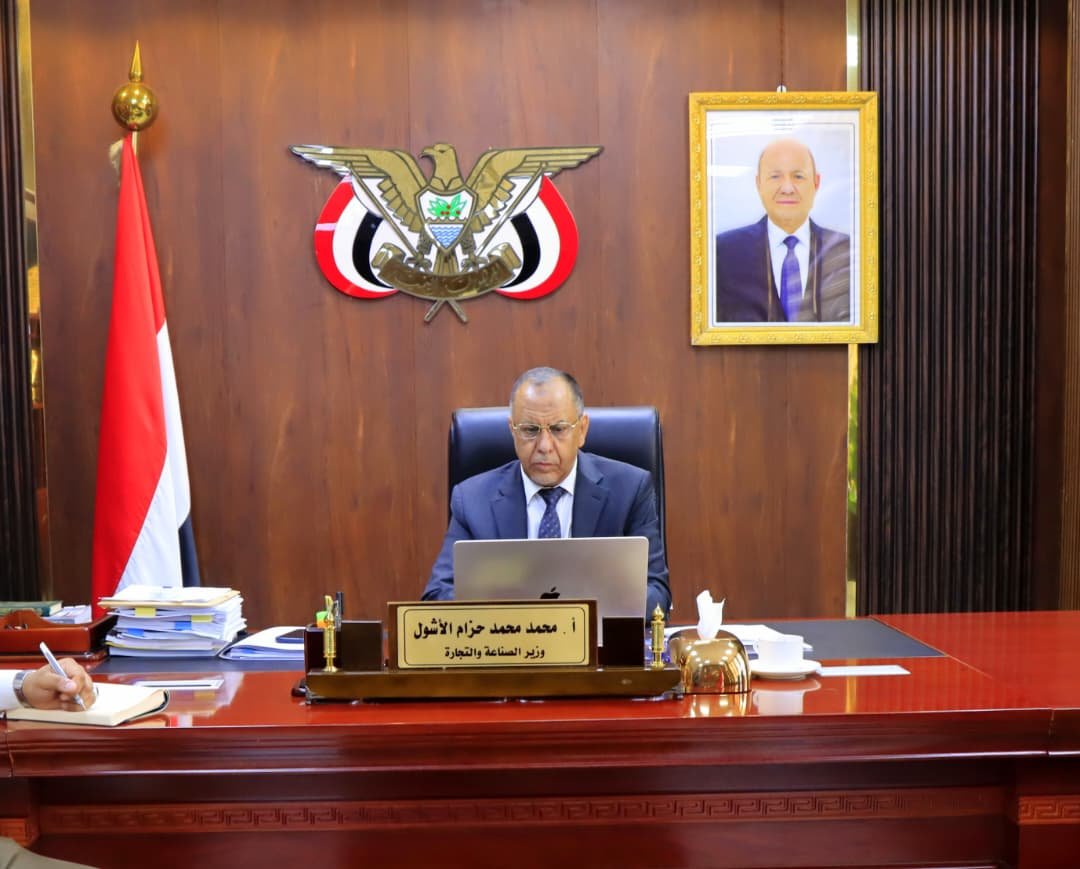
ADEN, Yemen — Yemen’s minister of industry and trade said on Sunday the government regards the private sector as a key partner and a driver of economic activity.
Mohammed al-Ashwal said the sector drove productive, commercial and investment activity and contributed to creating jobs and supplying markets with goods and services, the state news agency Saba reported.
He was speaking during deliberations on integrating partnership and activating dialogue between the government and private business, the agency said.
The discussions were held by video conference and organised by the Economic Reforms Team and the Center for Economic Studies and Media, according to Saba.
Al-Ashwal said institutional dialogue and a responsible partnership with private business were key to addressing economic challenges, advancing reform and improving the business environment, the agency reported.
The account of the session rests on Saba, the news agency of the internationally recognised government. No independent confirmation of the remarks or of the meeting has been published.
Saba did not report how many business representatives took part, nor whether the talks produced commitments.
The private sector carries much of Yemen’s supply chain. It provides up to 90 percent of the country’s imported food, according to research published by the International Food Policy Research Institute.
Yemen depends almost entirely on imports for staple food commodities, the World Bank has said.
A small number of trading houses dominate food importing and processing, including storage, milling and packaging.
Importers have turned to the informal currency market to obtain hard currency, particularly for fuel and food, according to ACAPS research on the food supply chain.
Money exchange companies handle much of the trade financing cycle in Yemeni riyals and in import finance.
The liquidity crisis and low confidence in the banking sector have left companies paying staff and suppliers in cash or by cash transfer.
Al-Ashwal has convened the private sector before. He chaired a meeting of the Joint Committee on Public-Private Partnership in Aden to discuss reforms to the business and investment environment before their submission to the cabinet, Saba reported.
That meeting reviewed regulatory and operational obstacles facing businesses, examined policy and legislative changes and discussed measures to strengthen institutional coordination, according to the agency.
He has also met the heads of provincial chambers of commerce to discuss partnership with the private sector and what Saba described as market irregularities.
Prime Minister Shaya al-Zindani has described the private sector as a key partner in achieving economic recovery, Saba reported separately.
The dialogue runs alongside the Central Bank of Yemen’s efforts in Aden to steady the currency.
The bank closed unauthorised exchange firms involved in currency speculation, centralised internal remittances and formed a committee to oversee imports and supply traders with hard currency.
Those steps slowed the riyal’s fall from about 2,900 to the dollar to roughly 1,500, Al Jazeera reported in April. The currency traded at about 215 to the dollar before the war began in 2015.
The measures brought a second problem. The central bank acknowledged a cash shortage in March, and traders have refused to accept large quantities of low-value notes, Al Jazeera reported.
Yemen and the International Monetary Fund reached a staff-level agreement on an 18-month reform programme covering fiscal and monetary policy and the management of public resources, the IMF said.
The government aims to narrow its budget deficit across 2026 and 2027 by raising domestic revenue, after the suspension of oil exports in 2022 cut its spending capacity.
Oil exports remain blocked. The World Bank said in May that activity across sectors was constrained by a difficult business environment, limited access to finance and weak domestic demand.
Salary payments for about 1.2 million public sector employees were disrupted from 2016 amid a liquidity crisis, and arrears have recurred since.
The government approved a 20 percent increase in civilian salaries and said it would seek what it called sustainable solutions to the electricity crisis.
The Bertelsmann Stiftung’s 2026 country report said established private businesses in Yemen were exposed to demands for informal payments by officials, contended with weak financial and judicial systems, and competed with armed groups involved in importing fuel, medicine and food.
Al-Ashwal has used the portfolio to court foreign trade partners. He discussed economic cooperation and investment opportunities with the United States ambassador, Saba reported.
He has sought a wider Yemeni-German trade partnership and pressed for stronger Arab industrial cooperation at a ministerial meeting, according to the agency.
The trade ministry has also held talks with Libyan counterparts on bilateral cooperation, Saba said.
The UN Office for the Coordination of Humanitarian Affairs said in its March 2026 response plan that more than 22 million people in Yemen need assistance and that 18.3 million are acutely food insecure.
Aden has served as the government’s temporary capital since the Houthis took control of Sanaa. The Presidential Leadership Council, which appointed the current cabinet, was formed in April 2022 with eight members.
The Sana’a Center for Strategic Studies attributed the riyal’s recovery to a revitalised central bank, while cautioning that the gains depended on continued external support and on reforms to trade and public finance.
More than 2.2 million children under five are acutely malnourished, 516,157 of them severely, OCHA said.
The plan seeks $2.16 billion to reach 12 million people.
Al-Ashwal took part in the session by video link from Aden, Saba said.
About the Author