Project Masam says it cleared 1,836 explosive devices in Yemen in a week
 Yemen Herald News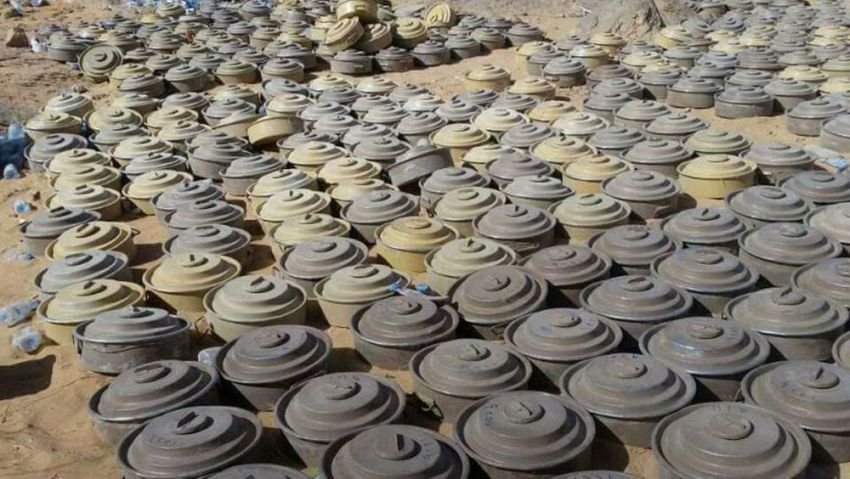
ADEN, Yemen — Project Masam cleared 1,836 landmines and other explosive items across Yemen in the week to Aug. 21, the Saudi-funded demining programme said Sunday.
The week’s haul comprised 13 anti-personnel mines, 25 anti-tank mines, 1,792 items of unexploded ordnance and six improvised explosive devices, the project said.
Teams covered 355,679 square metres during those seven days, according to the same report.
The account rests on Project Masam’s own operational figures. No independent monitor has published a verification of the weekly tally, and Yemen Herald could not confirm it from a second origin.
The project is run by the King Salman Humanitarian Aid and Relief Centre, Saudi Arabia’s state aid agency, known as KSrelief.
Masam put its running total for August at 9,280 explosive hazards cleared between Aug. 1 and Aug. 21.
That August figure breaks down into 48 anti-personnel mines, 162 anti-tank mines, 9,018 items of unexploded ordnance and 52 improvised explosive devices.
Unexploded ordnance accounted for more than 97 percent of the month’s total, according to the project.
Teams cleared 1,002,229 square metres across the first three reporting weeks of August, the report said.
Operations in the latest period ran across Aden, Al Dhale, Al Hudaydah, Hadramawt, Hajjah, Lahj, Marib, Shabwah and Taiz, according to the project.
Masam said it has cleared 587,506 explosive threats since operations began in mid-2018.
That cumulative total comprises 7,652 anti-personnel mines, 152,447 anti-tank mines, 418,744 items of unexploded ordnance and 8,663 improvised explosive devices.
Teams have made 84,734,060 square metres of land safe over the same period, the project said.
The figures cover areas held by Yemen’s internationally recognised government, which the project describes as liberated areas. They do not cover territory administered by the Houthis.
Masam says it works to International Mine Action Standards, the framework used by United Nations mine action programmes.
KSrelief extended the project’s contract for a further year at a reported value of 52.5 million dollars.
The project operates 32 demining teams and employs about 550 people, with its headquarters in Marib.
The British demining company SafeLane Global lists the Yemen project among its case studies.
Masam issued a safety warning to civilians on Aug. 22, a day before releasing the figures.
It said an increase in hostilities in several parts of Yemen risked leaving new unexploded ordnance and other explosive hazards behind.
The warning followed renewed missile and drone attacks, artillery fire and clashes across several parts of the country, according to the project.
Masam attributes much of Yemen’s contamination to mines laid by the Houthi movement. The Houthis reject that characterisation and have accused the Saudi-led coalition of causing civilian harm through airstrikes.
Yemen Herald found no independent adjudication of the competing accounts.
Clearance work continued at district level through the month. A Masam special task team destroyed 663 landmines and explosive remnants of war in a controlled demolition at Mukalla on Aug. 12, working with the Yemen Executive Mine Action Center.
That demolition included seven anti-personnel mines, eight anti-tank mines, 30 hand grenades and 66 37mm items, the project said.
In Taiz, a Masam team is clearing explosive remnants from the National Institute of Administrative Sciences in Al-Qahirah district.
The institute stopped operating entirely in 2015, and contamination has kept its eastern section closed, according to the project.
In Midi, in northern Hajjah governorate, teams have worked around water pumping and well sites alongside survey and risk education activities.
Masam stepped up risk education in the same district after minefields were found near populated areas and farmland.
In Al Dhale, in southern Yemen, a risk education team received a report of a suspected anti-personnel mine near a camp for displaced people.
Al Dhale sits on a corridor linking Aden with central and northern parts of the country.
The project reported 2,157 items cleared in the second week of August, of which 2,075 were unexploded ordnance.
Its cumulative total stood at 585,670 as of Aug. 14, a week before the latest statement.
Masam reported 7,101 items cleared across July, with weekly figures of 1,786 and 1,367 in the third and fourth weeks of that month.
The cumulative total reached 578,226 at the end of July, according to those reports.
Masam cleared 4,622 items across the first three reporting weeks of June, according to the project.
The project counted 529,951 items cleared and 75,487,756 square metres made safe by late December 2025.
Yemen’s contamination dates to the fighting that followed the Houthi seizure of Sanaa in 2014 and the Saudi-led intervention the following year.
Project Masam began work in July 2018 and operates alongside the Yemen Executive Mine Action Center, the national body responsible for mine action.
The humanitarian caseload behind the clearance work remains large. The United Nations response plan published in March records more than 22 million people in need across Yemen.
It counts 18.3 million people who are acutely food insecure and 5.2 million internally displaced.
More than 2.2 million children under five are acutely malnourished, of whom 516,157 are severely malnourished, according to the plan.
The plan seeks 2.16 billion dollars to reach 12 million people this year.
The project publishes its clearance figures at weekly intervals, with a separate cumulative statement covering the period since 2018.
About the Author