Yemen’s water minister and German ambassador plan September conference on Socotra
 Yemen Herald News
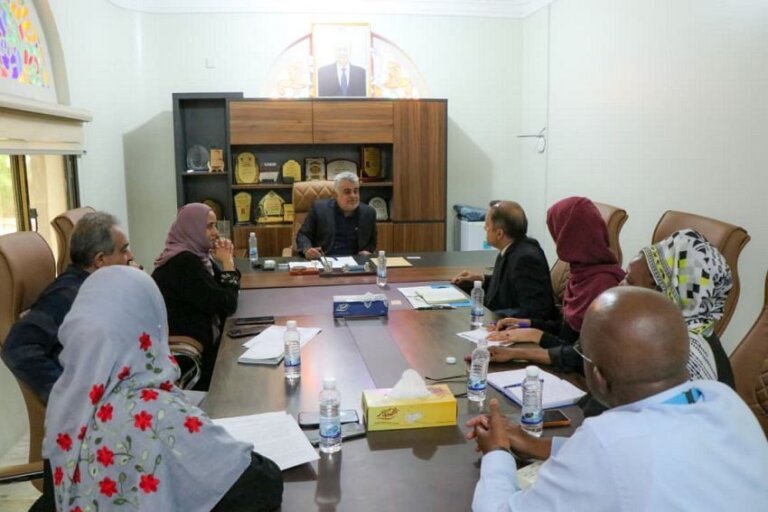
ADEN, Yemen — Yemen’s water and environment minister, Tawfiq al-Sharjabi, and Germany’s ambassador Thomas Schneider discussed preparations for a Socotra conference in Berlin next month, the state news agency Saba said.
The two spoke by video link on Wednesday, according to the agency. Germany’s deputy ambassador attended.
The 25th annual Friends of Socotra Conference is scheduled for 23 to 25 September, Saba said. Yemen’s embassy in Berlin is a joint organiser.
The meeting also covered preparations for an event Saba called Yemen Days. The agency gave no dates or venue for it.
Al-Sharjabi said his ministry had carried out communications, coordination and arrangements for the conference over the preceding period, the agency reported.
He said the event mattered for drawing attention to the environmental and climate pressures on the Socotra archipelago, and for showing its biodiversity.
Schneider said the September conference would focus on three areas of cooperation between the two countries, including a dedicated water-sector project, according to Saba.
That project would open scope for exchanging expertise, mobilising support and carrying out priority work in the sector, the ambassador said.
The wider discussion covered water, environment and adaptation to climate change, Saba reported. The two sides exchanged information on conditions in Yemen.
Al-Sharjabi thanked Germany for its support to the Yemeni water sector and for its backing of the National Water Strategy, the agency said.
He also praised the Saudi Program for the Development and Reconstruction of Yemen for supporting projects through bilateral partnerships.
Schneider praised the ministry’s work on water and environmental issues and its partnerships with international bodies, according to the report.
Yemen Herald could not independently verify the account, which rests on the Yemeni state agency’s summary of a closed video call. The German embassy had published no readout at the time of writing.
Socotra has held UNESCO World Heritage status since 2008. The archipelago lies in the Arabian Sea and is administered as a Yemeni governorate.
Its isolation produced an unusual concentration of species found nowhere else. UNESCO records that more than a third of Socotra’s plant species, nine in ten of its reptile species and almost all of its land snail species are found nowhere else on earth.
The archipelago is home to close to seven hundred endemic species, a concentration that conservation bodies rank among the highest of any island group of comparable size.
The best known is the dragon blood tree, Dracaena cinnabari, an umbrella-crowned tree that yields a bright red resin. The International Union for Conservation of Nature lists it as vulnerable.
Conservation assessments identify climate change and overexploitation as the main pressures on the species. Socotra is also designated a UNESCO biosphere reserve.
Schneider has represented Germany in Yemen through the current phase of the war and has given interviews to regional newspapers on Berlin’s approach to the conflict.
The water sector the two discussed is under severe strain. Annual availability has fallen to roughly 83 cubic metres a head, the Carnegie Endowment for International Peace has assessed, against an international scarcity threshold of 500.
Other estimates put the figure nearer 150 cubic metres, compared with a Middle East and North Africa average of about 1,250.
Groundwater beneath Sanaa is falling by four to six metres a year, the UN Development Programme has reported, making the capital one of the most water-stressed cities anywhere. Some thirteen thousand wells draw on the Sanaa basin alone.
UNDP estimates that more than 14.5 million people in Yemen lack access to safe drinking water and sanitation, most of them in rural and hard-to-reach areas. The piped network reaches less than 30 per cent of the population.
Agriculture accounts for more than 90 per cent of water use. Qat, grown as a cash crop, takes more than 40 per cent of renewable water resources and 32 per cent of groundwater withdrawals.
Water is among the sectors most exposed to the conflict. The UN Office for the Coordination of Humanitarian Affairs said in its March 2026 response plan that more than 22 million Yemenis need assistance and 18.3 million are acutely food insecure.
OCHA put the number of children under five with acute malnutrition above 2.2 million, of whom 516,157 are severely malnourished, and the number of internally displaced people at 5.2 million. Its appeal sought 2.16 billion dollars to reach 12 million people.
The talks took place during a sharp escalation. A United Nations-brokered truce agreed in 2022 has broken down, and international news organisations reported that the collapse followed a Saudi air strike on the runway at Sanaa airport on 13 July.
International reporting dates the start of the wider regional war to 28 February, when Iranian missile and drone attacks struck Bahrain, the United Arab Emirates, Saudi Arabia, Oman, Qatar and Kuwait, according to a Gulf Cooperation Council statement.
The government has changed leadership twice this year. The Presidential Leadership Council named Shaya Zindani prime minister on 15 January, and the foreign ministry passed on 23 July to Afrah al-Zouba, the first woman to hold it.
An earlier estimate put the number of people without safe water and adequate sanitation at almost eighteen million, a figure that covers households in areas held by both of the rival administrations.
Saba did not say where in Berlin the September conference will be held, how many delegates are expected, or which three areas of cooperation the ambassador had in mind beyond the water project.
About the Author