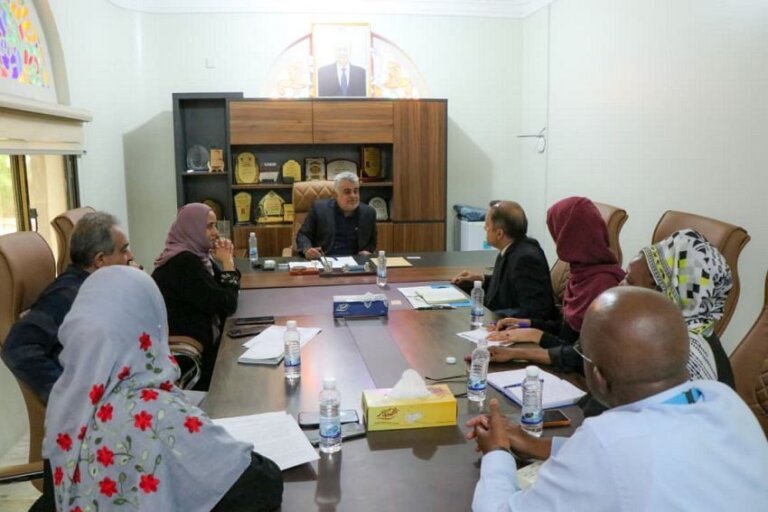
Yemeni envoy in Nairobi and Mombasa governor discuss closer Yemen-Kenya ties
 Yemen Herald News
NAIROBI, Kenya — Yemen’s acting chargé d’affaires in Nairobi met the governor of Kenya’s Mombasa County on Wednesday to discuss expanding trade and cultural ties, Yemen’s state news agency said.
Abdul Salam al-Awadhi and Governor Abdullswamad Sherrif Nassir reviewed ways to strengthen bilateral relations, the agency, Saba, reported.
The account of the meeting rests on Saba, which is run by Yemen’s internationally recognised government. Yemen Herald found no independent confirmation that the talks took place.
Al-Awadhi told the governor that relations between the two countries reach back hundreds of years, Saba said.
He said the Yemeni community in Kenya had contributed to commerce there and to Swahili culture, according to the agency.
Al-Awadhi also pointed to the position of both countries near the Gulf of Aden and the Bab al-Mandab strait, Saba reported.
Yemen controls the eastern shore of the Bab al-Mandab, the southern entrance to the Red Sea. The strait narrows to about 32 kilometres between Yemen and Djibouti. Ships sailing from the Indian Ocean to the Suez Canal pass through it.
Kenya’s coast lies roughly 2,000 kilometres to the south, on the Indian Ocean.
Al-Awadhi raised the effect of attacks on merchant shipping in the Red Sea, Saba said. He attributed those attacks to what he described as Iranian-backed Houthi militias.
The Houthi movement, which holds Sanaa and much of northern Yemen, rejects that description. It has said its campaign at sea is conducted in support of Palestinians in Gaza. Iran denies supplying the group with weapons.
Al-Awadhi said cooperation between Houthi forces and Somalia’s al-Shabaab threatened regional security, and called for bilateral work to counter it, according to Saba.
The UN Panel of Experts on Yemen told the Security Council in October 2025 that contact between the two groups had intensified. It described weapons smuggling, technical training in operational tactics and an exchange of logistical support.
Confidential sources told the panel that Houthi personnel were training al-Shabaab members in drone technology and in making improvised explosive devices.
The panel said about 400 Somali fighters had travelled to Yemen for military and ideological training in Houthi camps. It said around 70 more were under investigation over smuggling networks running between the two countries.
Somalia has become a transit point for weapons bound for Yemen, the panel said, in breach of the arms embargo imposed by Security Council Resolution 2216 in 2015.
Nassir said the historical relationship formed part of Mombasa’s cultural and commercial heritage, Saba reported.
He said developments in Yemen and the region had affected commodity prices in Kenya and other African countries, and said he wanted closer cooperation between the two sides, according to the agency.
Mombasa is Kenya’s principal seaport. It handles transit cargo for Uganda, Rwanda, Burundi, South Sudan and eastern Democratic Republic of Congo. Nassir has been governor of the county since 2022.
Shipping in the waters the two men discussed has been reduced for close to three years.
The Houthis began striking vessels in the Red Sea and the Gulf of Aden in November 2023, saying at the time that they were targeting ships linked to Israel. The campaign later took in vessels with no clear connection to it.
Traffic through the Bab al-Mandab fell 24 percent after the Houthis announced a maritime blockade of Saudi Arabia in July, according to Lloyd’s List Intelligence. It counted 269 transits in the week beginning 20 July, against 354 in the week before the announcement.
Volumes steadied after that fall, the same analysis found.
The Suez Canal’s share of world maritime traffic has dropped from 12 percent to 9 percent since attacks on shipping began in late 2023, according to S&P Global Market Intelligence.
BIMCO reported in January that Suez transits stood about 60 percent below normal 100 days after the most recent Houthi attack at that time.
Carriers routing around the Cape of Good Hope instead add roughly ten days to voyages between Asia and Europe. The longer passage raises fuel and charter costs, which are carried into freight rates.
Nassir did not give figures for the effect on Kenyan prices, and Saba reported none.
Yemen depends on imports for most of its food and fuel, and the same sea lanes carry them.
More than 22 million people in Yemen need humanitarian assistance, according to the UN Office for the Coordination of Humanitarian Affairs in its March 2026 response plan. The plan put the number of acutely food insecure people at 18.3 million.
It recorded more than 2.2 million children under five as acutely malnourished, including 516,157 classed as severely malnourished, and counted 5.2 million internally displaced people.
OCHA sought $2.16 billion for the year to reach 12 million people.
Yemen has been divided since 2015 between the Houthi authorities in Sanaa and the internationally recognised government, which is led by the Presidential Leadership Council and seated in Aden. The embassy in Nairobi represents that government.
Yemeni traders settled along the Swahili coast over several centuries. Families from Hadramawt, in eastern Yemen, established communities in Mombasa, Lamu and Zanzibar, and Arabic entered Swahili as a substantial source of loanwords.
Saba did not say whether the two sides agreed on any specific measure, and gave no date for further talks.
About the Author