Planning Minister Mohammed al-Faqmi discusses recovery plan with UK Ambassador Abda Sharif
 Yemen Herald News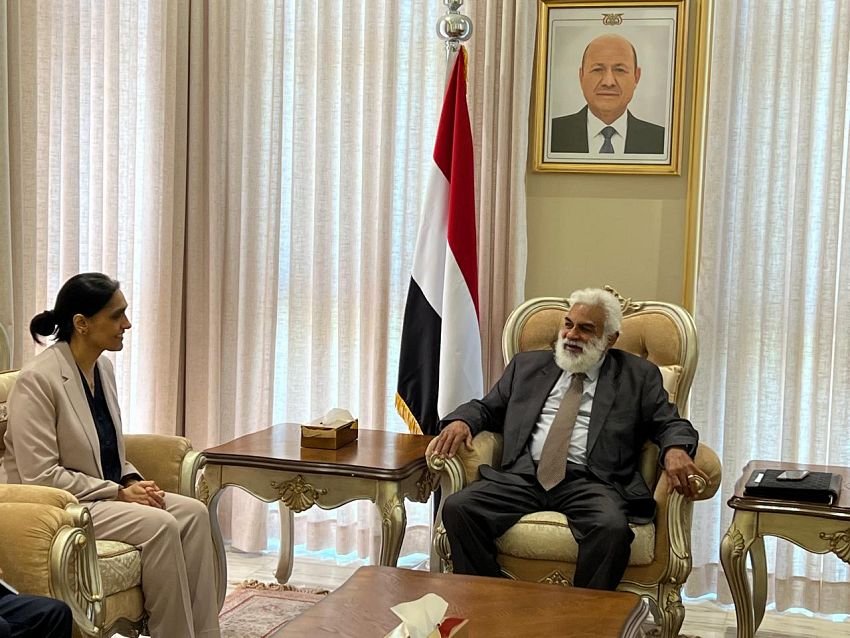
RIYADH, Saudi Arabia — Yemen’s planning minister met the British ambassador on Tuesday to discuss UK support for institutional reform and the government’s economic recovery plan.
Mohammed al-Faqmi, minister of planning and international cooperation, met Abda Sharif, the United Kingdom’s ambassador to Yemen, the Yemeni state news agency Saba reported.
The two discussed bilateral cooperation, development priorities and British support for institutional reform, capacity building and governance, according to Saba.
They also went over the government’s National Development and Economic Recovery Plan, the agency said.
The plan sets out a move from reliance on humanitarian aid towards sustainable development, Saba reported. The two sides also discussed Yemen’s humanitarian needs.
Sharif restated Britain’s continued support for Yemen, according to the agency.
Both sides agreed to stay in contact and to strengthen joint work on economic recovery and development, Saba reported.
The account of the meeting rests on Saba, the Yemeni government’s official news agency, which named no other source. No independent confirmation of the talks has been published, and Yemen Herald could not verify the account separately.
Saba did not report any figure or timetable attached to the discussion, and did not say who else attended.
The meeting took place in Riyadh. Yemen’s internationally recognised government has operated substantially from the Saudi capital since the Houthis took Sanaa in 2014 and the war widened the following year. Aden is its seat inside the country.
The Presidential Leadership Council, formed in April 2022, is the executive body recognised internationally as Yemen’s government.
Al-Faqmi holds the portfolio that Afrah al-Zouba ran from February until she was appointed foreign minister in July. The planning ministry handles the government’s relations with foreign donors and development lenders.
The government approved a work programme for 2026 built on the framework of an economic recovery plan covering 2025 and 2026, Yemen Monitor reported. It was drawn up under Presidential Leadership Council Resolution No. 11 of 2025 on economic reform priorities.
That programme sets six strategic priorities, according to the same report. They include consolidating political and security stability and extending state sovereignty, achieving economic stability and recovery, and sustaining basic services while ensuring fair access to them.
The remaining priorities cover institutional governance, digital transformation and the rule of law; community cohesion and the development of human capital; and partnership with the international community, Yemen Monitor reported.
Sharif has been Britain’s ambassador to Yemen since September 2023.
A lawyer and diplomat, she previously headed the Iraq and Arabian Peninsula Department in the Foreign, Commonwealth and Development Office’s Middle East and North Africa directorate, Arab News reported when she was named to the post.
Britain is the penholder on Yemen at the UN Security Council, the member state that leads the drafting and negotiation of resolutions on the file.
In May, Sharif announced £25 million, about $33.7 million, for the recovery of Yemen’s health sector, Yemen Monitor reported.
The money was to contribute to the running of more than 700 health centres across Yemeni governorates, according to the same report.
In July, Saudi Arabia and Britain jointly funded a $10 million package for food security in five governorates, Yemen Monitor reported.
The UK government said in January 2025 that it would provide £144 million for Yemen in the 2024/25 financial year, according to a House of Commons Library briefing.
Saudi Arabia announced a development package worth 1.9 billion Saudi riyals, about $507 million, for projects in health, education, energy, transport and water, Arab News reported.
The Central Bank of Yemen in Aden has led a push to steady the currency, curbing speculation, institutionalising import financing and requiring the exclusive use of the rial in domestic transactions, the Sana’a Center for Strategic Studies reported.
The bank suspended 30 exchange companies and establishments over alleged violations, according to the same analysis.
The Sana’a Center said the rial appreciated by more than 44 percent from late July. It cautioned that the recovery would prove temporary without deeper structural reform, and that the interventions would need to be turned into sustained policy.
Yemen imports most of its food, which ties household prices closely to the exchange rate and to the cost of financing those imports.
Rates in Houthi-controlled areas have diverged from those in government-held areas, leaving Yemen with two effective currency zones. The Yemen Economic Tracking Initiative monitors prices and exchange rates across both.
Saudi Arabia deposited $1 billion in the Aden-based central bank in 2023, Al Jazeera reported at the time.
The UN Office for the Coordination of Humanitarian Affairs sought $2.16 billion for Yemen in its response plan for 2026, published in March, to reach 12 million people.
The plan counted more than 22 million people in need of assistance and 18.3 million who are acutely food insecure.
It recorded 5.2 million internally displaced people. More than 2.2 million children under five are acutely malnourished, 516,157 of them severely.
The government has raised the same shift from relief towards development finance in other talks this week. Its foreign ministry put the argument to the Kuwait Fund for Arab Economic Development in Kuwait City, according to Saba.
Sharif was deputy ambassador to Lebanon from 2012 to 2016. She led the UK office in Benghazi, Libya, in 2011.
About the Author