Ambassador Asmahan al-Tawqi delivers Yemen’s statement at Non-Aligned Movement meeting in Belgrade
 Yemen Herald News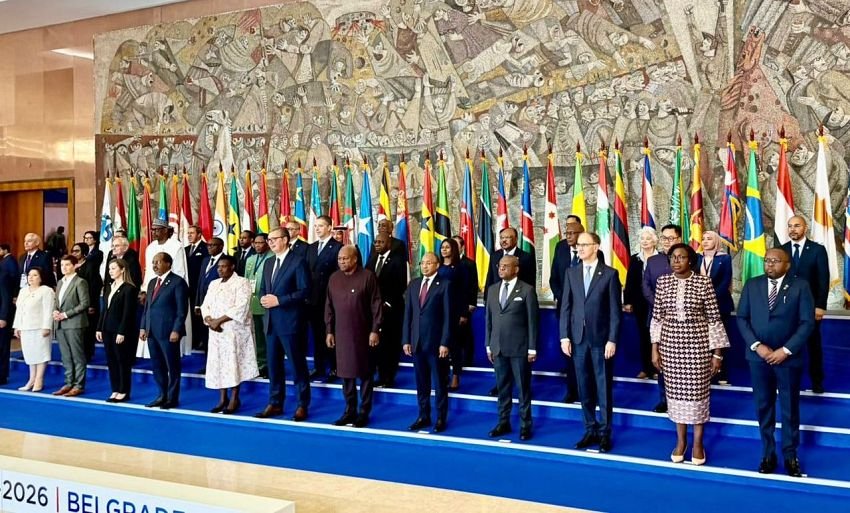
BELGRADE, Serbia — Yemen’s non-resident ambassador to Serbia, Asmahan al-Tawqi, delivered her country’s statement Tuesday at a meeting marking 65 years of the Non-Aligned Movement.
The gathering commemorated the anniversary of the movement’s first conference of heads of state and government, held in Belgrade from Sept. 1 to 6, 1961. The movement was founded by states seeking to remain independent of the rival blocs of the Cold War.
This year’s commemoration ran over two days, on Aug. 31 and Sept. 1, under the theme “The Legacy of Non-Alignment: Lessons for Today’s World.”
Yemen was represented at ambassadorial level rather than by a head of state or government. Al-Tawqi is accredited to Serbia on a non-resident basis, meaning she covers Belgrade from a diplomatic post based elsewhere.
She reaffirmed Yemen’s commitment to the movement’s founding principles, according to the state news agency Saba. She listed them as respect for state sovereignty and independence, dialogue and adherence to international law.
Saba said the ambassador told the meeting that Yemenis are paying a heavy price for what she called the coup carried out by the Iranian-backed Houthi terrorist militia. The Houthi movement rejects that description and casts its 2014 seizure of Sanaa as a popular revolution.
She said the group’s escalation inside Yemen, along with its attacks in the Red Sea and against neighbouring countries, calls for what she described as a sustainable approach to the root causes of those threats.
Those causes are an extension of the coup and its consequences, she said, among them the undermining of state authority and institutions.
Al-Tawqi also pressed for strengthening state institutions, Saba reported. She said peace remains the government’s strategic choice, and that it should lead to a just, comprehensive and sustainable settlement opening the way for Yemenis toward security, stability and development.
The ambassador restated Yemen’s solidarity with the Palestinian people and their right to an independent state with East Jerusalem as its capital, according to the agency.
She called for an end to violence and violations by Israeli occupation forces and for humanitarian assistance to reach those in need, Saba said.
Yemen Herald could not independently verify the Yemeni statement. The account of al-Tawqi’s remarks rests on Saba, the news agency of the internationally recognised government, and no independent report of what she said has been published.
The meeting itself was covered more widely. It was held at the Palace of Serbia in New Belgrade, the former Yugoslav federal palace built under Josip Broz Tito, and drew delegations from more than 30 countries.
Four presidents, three prime ministers and a number of senior state secretaries and foreign ministers attended, the Italian news agency ANSA reported. Representatives of the movement’s current Troika — Azerbaijan, Uganda and Uzbekistan — took part alongside delegations from what organisers called the historic core of the 1961 conference.
Serbian President Aleksandar Vucic hosted the session. Ugandan Vice President Jessica Alupo spoke on behalf of President Yoweri Museveni, whose country currently chairs the movement.
Vucic said the movement remains what he called the most solid bastion of multilateralism at a time when the foundations of the global order are shaking under the blows of a selective approach to international law.
He said the movement holds to the principle that the voices of independent countries carry equal moral weight regardless of geography or wealth. He recalled that Jawaharlal Nehru told the 1961 conference the world could not be divided into masters and servants, and that Gamal Abdel Nasser had stressed that freedom was earned through justice and equality.
Vucic announced three cooperation initiatives among member states: a programme he called Digital Non-Aligned, a Non-Aligned Film Festival, and an international seminar for young diplomats from member countries.
Alupo, delivering Museveni’s address, said the movement emerged in response to the rigid ideological divisions and polarisation of the Cold War.
Ghanaian President John Dramani Mahama called for what he termed positive neutrality, urging countries of the Global South to convert their collective weight into diplomatic results rather than align with competing power blocs.
Somali President Hassan Sheikh Mohamud spoke on South-South cooperation and multilateralism in addressing transnational problems, among them terrorism and climate vulnerability.
Angolan Foreign Minister Tete Antonio, Lebanese Defence Minister Michel Menassa, Indian Parliamentary Affairs Minister Kiren Rijiju and Cuban First Deputy Foreign Minister Gerardo Penalver Portal also attended, according to Xinhua.
Serbia is not a member of the movement. It holds observer status and has sought to preserve the diplomatic legacy of the 1961 conference. Belgrade also hosted the movement’s ninth summit, in 1989.
Yemen’s war began in 2014, when Houthi forces took Sanaa, and widened in March 2015 when a Saudi-led coalition intervened in support of the government now based in Aden.
The United Nations Office for the Coordination of Humanitarian Affairs said in its 2026 humanitarian needs and response plan, issued in March, that more than 22 million Yemenis need assistance and that 18.3 million are acutely food insecure.
The plan counts 5.2 million people displaced inside the country and more than 2.2 million children under five who are acutely malnourished, 516,157 of them severely.
It seeks USD 2.16 billion to reach 12 million people.
About the Author