Saudi Air Defences Down Iranian Drones as Riyadh Warns Tehran Over Gulf Attacks
 Yemen Herald News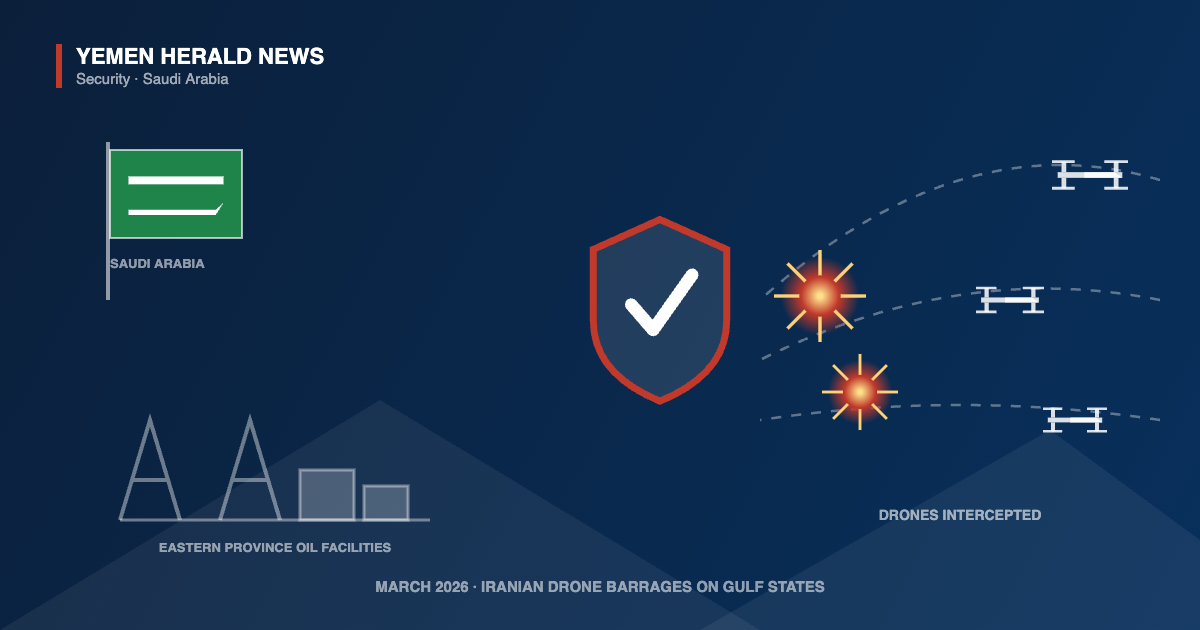
Saudi Arabia’s Ministry of Defence said in March 2026 that its air defences had intercepted and destroyed successive waves of Iranian drones over the kingdom’s Eastern Region, part of a barrage that struck Gulf states repeatedly through that month. The interceptions were announced by the ministry and carried at the time by Saudi state media. They formed part of the sharpest deterioration in relations between Riyadh and Tehran since the two governments restored diplomatic ties in 2023.
Speaking after a consultative meeting of Arab and Islamic foreign ministers held in Riyadh on 18 and 19 March 2026, Saudi Foreign Minister Prince Faisal bin Farhan said the kingdom reserved the right to respond militarily. He dismissed as weak Iran’s justification that it was targeting American interests in the region, said that neither Saudi Arabia nor its Gulf neighbours would accept blackmail, and warned that escalation would be met with escalation. The attacks, he argued, would deepen Iran’s isolation rather than strengthen its hand.
The exchanges followed a joint American and Israeli military operation against Iran that began on 28 February 2026. Tehran responded with repeated rounds of drone and missile launches aimed at targets across the region, and reporting at the time recorded strikes or attempted strikes against Gulf Cooperation Council states, Jordan, Azerbaijan and Turkiye. The Riyadh meeting was convened specifically to address that pattern and to look for a framework that might halt the escalation before it widened further.
The scale of the interceptions reported during March was substantial. On 12 March the Saudi defence ministry said its forces had brought down a large number of drones alongside ballistic missiles, with many of them over the Eastern Province, including drones it said were directed at the Shaybah oil field. Defence ministry spokesman Major General Turki al-Maliki said at the time that one drone had penetrated far enough to approach Riyadh’s Diplomatic Quarter, which houses dozens of foreign embassies, before being shot down. On 22 March the ministry announced the destruction of seven more drones over the Eastern Region.
The Eastern Province is where most of Saudi Arabia’s oil production, processing and export infrastructure is concentrated, including the Abqaiq processing facility and the Ras Tanura terminal. Attacks in that area carry consequences well beyond the kingdom’s borders. The 2019 strikes on Abqaiq demonstrated as much when they briefly removed a substantial share of Saudi output from the market and moved global crude prices sharply within a single trading session.
The near-daily interception statements were themselves notable. The Saudi defence ministry issued counts and locations with a regularity it has rarely applied to security incidents, a level of public disclosure that served two purposes at once: it reassured a domestic audience that the air defence network was holding, and it built a dated, documented record that Saudi diplomats could point to when pressing their case with international partners.
Riyadh escalated its response diplomatically as well as militarily. On 21 March the Saudi foreign ministry declared Iran’s military attache and four embassy staff persona non grata and gave them 24 hours to leave the country, citing the continued missile and drone attacks. Qatar had taken a comparable step days earlier against the security and military attache at Iran’s embassy in Doha. Analysts described the expulsions as placing the 2023 normalisation agreement between Saudi Arabia and Iran, brokered in Beijing, under serious strain.
Iran’s stated position throughout was that its launches were directed at American military assets and at Israel rather than at Gulf states, and that it was responding to attacks on its own territory. Gulf governments rejected that framing. They pointed to civilian sites and energy infrastructure among the targets, and to the practical reality that drones and missiles crossing their airspace place their populations at risk regardless of the intended destination.
For Yemen the episode carried a particular resonance. Saudi Arabia has spent years defending its southern border and its energy facilities against drone and missile launches, and the Houthi movement in Yemen has been aligned with Iran throughout the conflict there. The March 2026 barrages came from a different direction and a different source, but they tested the same air defence network, and they were watched closely in a country that has been on the receiving end of the same technologies.
The consultative meeting produced a joint statement and a stated commitment to preventing further deterioration, but it did not resolve the underlying confrontation. Regional governments spent the remainder of March balancing public condemnation of the attacks against a clear reluctance to be drawn into a wider war between Iran, Israel and the United States. That balance shaped how forcefully each of them was prepared to speak.
The joint statement issued after the Riyadh meeting was welcomed by regional bodies including the Muslim World League. On the margins of the gathering Prince Faisal held separate talks with his Jordanian and Turkish counterparts, and a further meeting with the foreign ministers of Egypt, Turkiye and Pakistan, an indication of how far beyond the Gulf the concern about escalation had spread.
By the end of the month the pattern had settled into something close to routine: nightly interception announcements, statements of condemnation, and formal diplomatic protests. What had begun as an emergency response had, within a few weeks, become the ordinary business of Gulf air defence.
About the Author