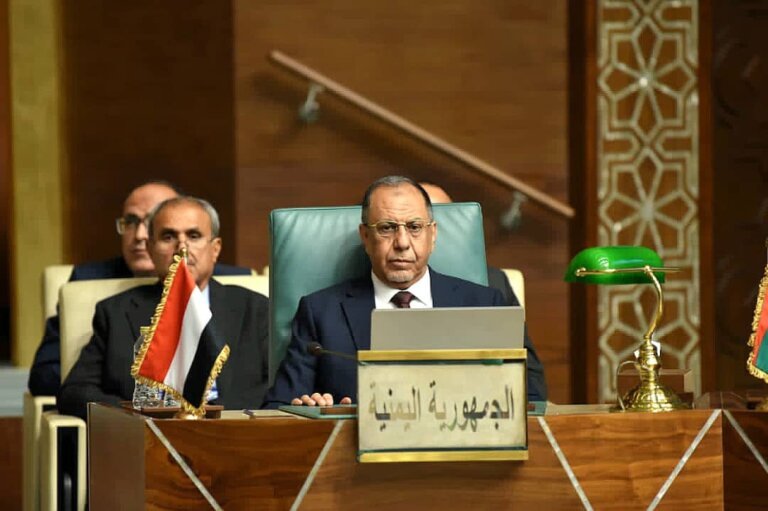
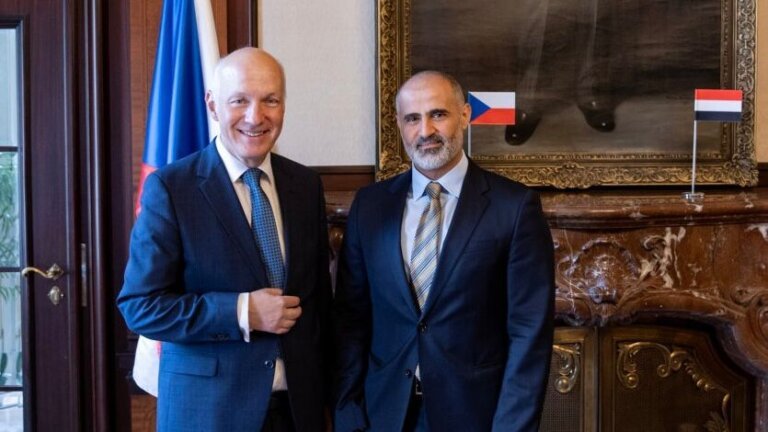
Planning Minister Mohammed al-Faqmi and France’s ambassador discuss education, health and food security
 Yemen Herald News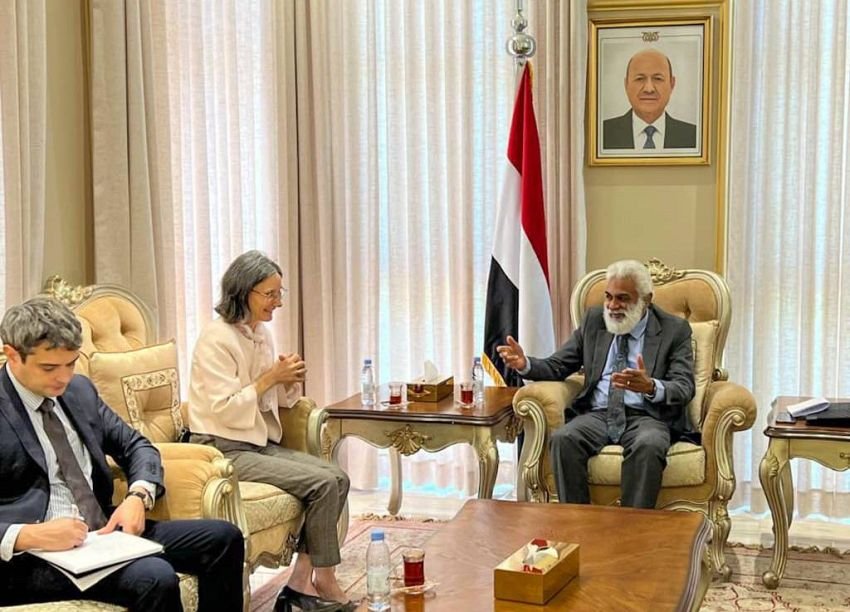
RIYADH, Saudi Arabia — Yemen’s planning minister and the French ambassador discussed cooperation on education, health and food security in Riyadh, the state news agency Saba reported.
Mohammed al-Faqmi, minister of planning and international cooperation, met Ambassador Catherine Corm-Kammoun to review bilateral relations.
Al-Faqmi thanked France for its contribution to humanitarian and development work in Yemen, according to the agency.
He named education, health, food security and capacity building as the areas concerned.
“We’re looking forward to further increase the Yemeni-French partnership and cooperation in the upcoming stage to sustain the government’s efforts aimed to achieve the economic recovery,” the minister said, in the agency’s translation.
Saba reported no new French commitment, no figures and no timetable.
The account rests on Saba, the news agency of Yemen’s internationally recognised government. The French embassy has not published its own account, no independent confirmation has appeared, and Yemen Herald could not verify the agency’s summary.
Corm-Kammoun has served as France’s ambassador to Yemen since September 28, 2023.
The French embassy to Yemen operates from Riyadh, as do several Western missions that left Sanaa after 2015.
She has travelled inside the country during her posting. Yemen Monitor reported a visit to Hadramawt to discuss cooperation and support for development programmes.
In an interview published by the European External Action Service, she argued that empowering women was vital to a lasting peace in Yemen.
Saba reported this week that her posting was drawing to a close, in an account of a farewell call between the ambassador and Presidential Leadership Council member Lt. Gen. Tareq Saleh.
No successor has been announced.
Al-Faqmi took the constitutional oath as planning minister before the president, Yemen Monitor reported.
He has held a run of meetings with donor governments. Saba has reported separate discussions in recent days with the German, British and United States missions covering recovery planning, water projects and investment in energy and mining.
France has contributed to the international response in Yemen through United Nations agencies.
It gave 3 million euros to the World Food Programme for the emergency in Yemen and for the United Nations Humanitarian Air Service, according to France’s permanent representation to the UN agencies in Rome.
France also provided about $1.05 million to the International Organization for Migration for protection and assistance to migrants in Yemen and the Horn of Africa, part of a $3.6 million package with the European Union and Norway, the organisation said.
The European Commission allocated 125 million euros in humanitarian aid for Yemen in a package announced in May 2024.
The United Nations Office for the Coordination of Humanitarian Affairs said in its March 2026 humanitarian needs and response plan that more than 22 million people in Yemen need assistance.
The plan recorded 18.3 million people as acutely food insecure.
It counted more than 2.2 million children under five as acutely malnourished, including 516,157 with severe acute malnutrition.
OCHA put the number of internally displaced people at 5.2 million.
The agency appealed for $2.16 billion to reach 12 million of those in need.
The 2026 appeal gives priority to health, nutrition, water and sanitation, child protection and education.
OCHA said Yemen entered 2026 in a more complex operating environment, shaped by funding constraints and a reform agenda across the aid system.
The planning ministry is the government’s channel for coordinating that assistance.
Yemen has been divided since 2014, when the Houthis took Sanaa. The internationally recognised government has been seated in Aden since 2015.
The Presidential Leadership Council was formed in April 2022 and is chaired by Rashad al-Alimi.
Much of the government’s donor contact takes place in Riyadh rather than in Yemen.
Economic conditions have shaped the government’s appeal to donors.
The rial has recovered ground in areas under government control this year. The dollar traded at about 1,800 rials after earlier approaching 2,900, according to reporting by Asharq Al-Awsat.
The Sana’a Center for Strategic Studies attributed the recovery largely to intervention by the central bank, including the revocation of licences held by 24 exchange companies accused of currency manipulation.
Al Jazeera reported in April 2026 that cash shortages persisted despite the currency’s stabilisation, with residents of Aden, Taiz and Mukalla describing a shortage of banknotes.
Saudi Arabia gave new support to the Central Bank of Yemen on Thursday, its development programme for Yemen said, without disclosing the amount.
The programme said Saudi Arabia had provided 1.3 billion riyals in February for operating expenses and salaries, followed by more than 224 million riyals in June.
France is one of the five permanent members of the United Nations Security Council, which has kept Yemen on its agenda through the UN special envoy’s mediation effort.
Yemen Herald could not independently confirm the aid figures cited by the agencies.
UNICEF set out its own requirements for Yemen in its 2026 humanitarian action appeal for children.
The International Organization for Migration published a separate Yemen crisis response plan for 2026 covering displacement and migration.
Aid agencies have said funding shortfalls, rather than access alone, now determine how much of the response can be delivered.
The planning ministry publishes periodic reports on donor commitments and disbursements.
Saba did not say whether the two sides set a date for further talks.
About the Author