UAE Says Air Defences Downed Seven Ballistic Missiles and 15 Drones Launched from Iran
 Yemen Herald News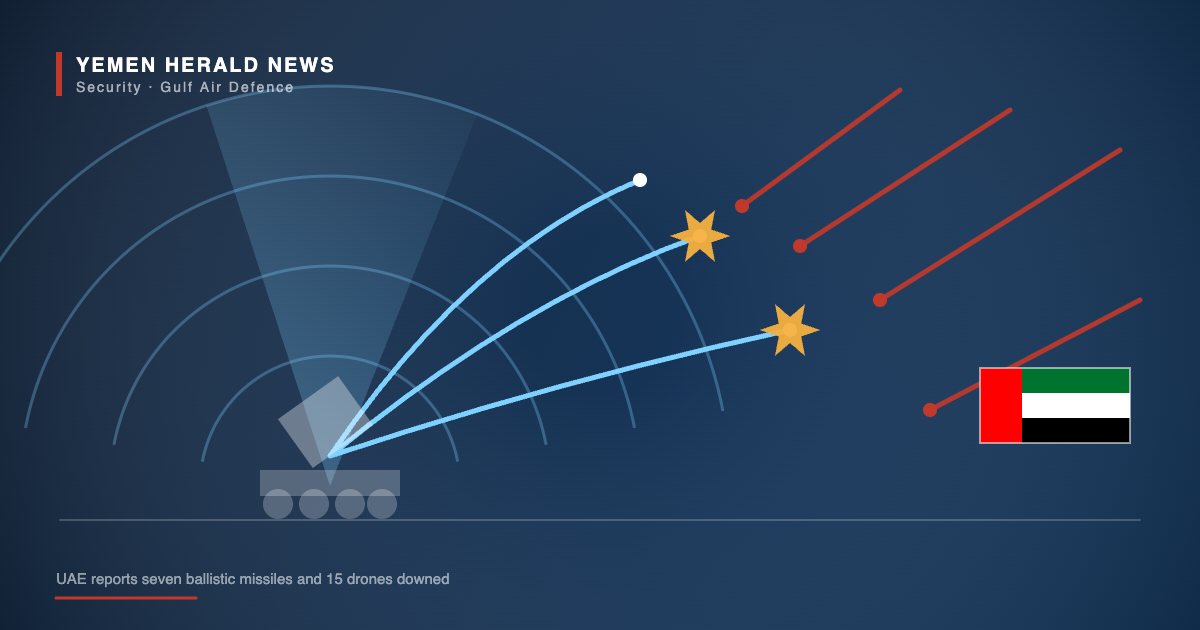
The United Arab Emirates Ministry of Defence said its air defences intercepted seven ballistic missiles and 15 drones launched from Iran, in one of a near-daily series of engagements reported over the country during March 2026.
The ministry described the launches as part of what it called blatant Iranian aggression against the country. It said that since the attacks began, UAE systems had engaged a cumulative total of 334 ballistic missiles, 15 cruise missiles and 1,714 drones. Figures released later in the month put the running totals higher still, at 378 ballistic missiles, 15 cruise missiles and 1,835 drones, indicating that launches continued at a comparable pace through the following weeks.
Those cumulative numbers imply an average of roughly nine ballistic missiles a day directed at the UAE over the period, with considerable variation between individual days. Open-source analysis published at the time recorded a low of four ballistic missiles on some days and a peak of seventeen on 8 March. The drone totals were an order of magnitude larger, which is consistent with the use of comparatively cheap one-way attack aircraft to saturate defences and force the expenditure of more expensive interceptors.
Each intercepted salvo also consumed interceptors that cost far more than the weapons they destroyed. That asymmetry became one of the defining strategic problems of the campaign for the Gulf states and for their suppliers, since production rates for advanced interceptors are measured in hundreds a year while incoming drones were being counted in thousands over weeks.
The human cost was acknowledged in the ministry’s statements. Two members of the UAE Armed Forces were killed while on duty during the attacks. A Moroccan civilian working with the armed forces also died, and eight foreign nationals from Pakistan, Nepal, Bangladesh, Palestine and India were killed. Authorities reported 171 people injured over the period, with wounds ranging from minor to severe. The heavy representation of expatriate workers among the dead reflects the composition of the UAE’s population, in which foreign nationals form a large majority.
Casualty figures of that scale alongside interception totals in the hundreds point to a defence that was intercepting the great majority of incoming weapons but not all of them. The UAE at one stage narrowed the detail it published on interception rates, a decision reported by defence trade press as a move to avoid giving an adversary feedback on which systems and tactics were performing. On at least one occasion the ministry disclosed that of seven ballistic missiles detected, six were intercepted and one fell inside the country.
The UAE’s layered air defence architecture is among the most developed in the Gulf. It combines the Terminal High Altitude Area Defense system, which engages ballistic missiles outside or high within the atmosphere, with Patriot batteries for lower-tier interception and shorter-range systems and electronic warfare measures against drones and cruise missiles. The country was the first export customer for THAAD, and the sustained ballistic missile campaign represented the most demanding operational test that architecture had faced.
Defending against drones presents a different problem from defending against ballistic missiles. Slow, low-flying and small, they are hard to detect against ground clutter and are cheap enough to be launched in numbers that make it uneconomic to counter each one with a high-value interceptor. Air forces across the region responded by mixing guns, short-range missiles, jamming and, where possible, fighter aircraft, and the very large drone totals reported by the UAE reflect that sustained lower-tier effort.
The economic consequences were felt well beyond the defence ministry. Insurance costs for shipping and aviation in the Gulf rose, some international staff were temporarily relocated by their employers, and the region’s role as a transit hub was tested by repeated interruptions. Even so, financial data published for the same period showed banking deposits and central bank reserves continuing to grow, and several global investment firms publicly reaffirmed their commitment to Dubai and Abu Dhabi as bases.
The engagements also drew in the country’s civil authorities. The National Emergency Crisis and Disasters Management Authority issued public guidance during the attacks, at times confirming that particular threats had been engaged outside UAE borders, and the population was repeatedly advised to follow official channels rather than unverified social media accounts. Airspace closures and flight diversions disrupted the Gulf’s aviation hubs during the heaviest waves.
The claims described here are those of the UAE Ministry of Defence. Interception totals published by any party to a conflict are difficult to verify independently, and the Iranian authorities offered their own accounts of the effectiveness of their strikes. Independent researchers, including analysts compiling open-source datasets on the missile and drone campaign, worked from official statements, imagery and flight-tracking data, and their reconstructions did not always match the figures issued by either side.
What is not in dispute is the scale and duration of the campaign. Thousands of munitions were launched at Gulf states over a period of weeks, air defence stocks were drawn down at a rate that raised questions about resupply, and civilian life in the region was disrupted for a sustained period. The interceptions reported on this occasion formed one entry in a running tally that continued to grow through the remainder of March 2026.
About the Author