Kuwait Says Refinery Fires at Mina Al-Ahmadi and Mina Abdullah Are Extinguished After Drone Attacks
 Yemen Herald News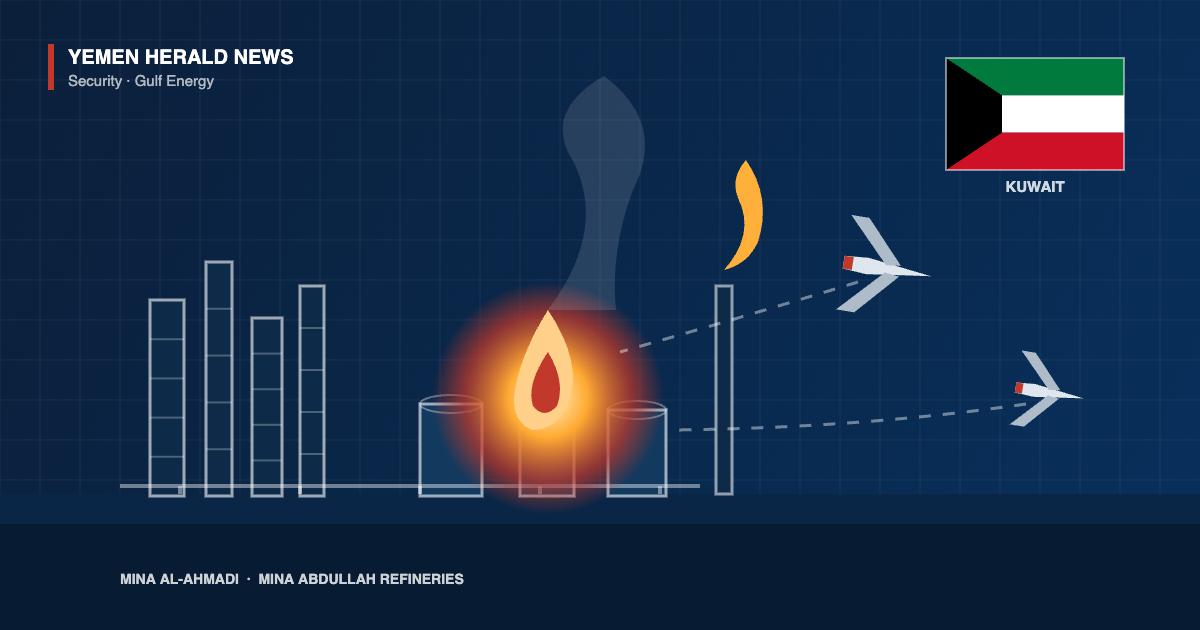
Kuwait Petroleum Corporation said in March 2026 that fires at the Mina Al-Ahmadi and Mina Abdullah refineries had been extinguished after drone attacks on both facilities. The corporation said the blazes were limited in extent and that no one was injured, according to a statement carried at the time by the state news agency KUNA.
The attack on the Mina Abdullah refinery started a fire, and a separate limited blaze broke out at Mina Al-Ahmadi. Kuwait’s General Fire Department deployed six firefighting teams across the two sites. KPC said the response had been carried out in line with the highest safety standards, and that precautionary measures were put in place to protect personnel and secure the installations while the fires were being brought under control.
Mina Al-Ahmadi is one of the largest refineries in the Gulf, with a nameplate capacity of around 346,000 barrels per day, and is operated by Kuwait National Petroleum Company, a KPC subsidiary. Mina Abdullah, to its south, is the other main pillar of Kuwait’s domestic refining system. Together with the newer Al-Zour complex, the two plants account for the bulk of the country’s capacity to turn crude into fuels for export and domestic use.
KPC issued its account through KUNA rather than through a briefing, which is the corporation’s normal practice for incidents affecting its installations. The statement gave no detail on which units were affected, how long any shutdowns lasted, or what the attacks meant for throughput, and the corporation did not attribute the drones to any party.
The incident was not isolated. Reporting at the time indicated that Mina Al-Ahmadi was struck by drones more than once over a short period in March, including on consecutive days, and that the facility was hit several times within roughly a fortnight. The Kuwaiti army said on one of those occasions that a fire had been brought under control without casualties. Units were shut down as a precaution even where the physical damage was described as limited.
That pattern — repeated strikes causing modest physical damage but forcing precautionary shutdowns — is characteristic of drone attacks on refining infrastructure. Refineries are dense arrangements of pressurised vessels, furnaces and pipework carrying flammable material, so operators tend to isolate and shut affected units at the first sign of fire rather than risk escalation. The output lost to those shutdowns can exceed the damage done by the weapon itself.
The attacks came during a broader escalation in which Iran struck energy infrastructure across the Gulf. Facilities in several countries were hit over the same period, including the Ras Laffan Industrial City in Qatar, the centre of that country’s liquefied natural gas industry. The strikes were reported as retaliation in a wider confrontation that had already drawn in Israeli attacks on Iranian gas installations.
For Kuwait, the significance ran beyond the immediate firefighting. Hydrocarbons dominate the country’s export earnings and government revenue, and the refining complexes on the coast south of Kuwait City are among its most concentrated points of economic value. Damage to them affects not only crude processing but also the fuel supply that runs the domestic power system, which is heavily dependent on oil and gas.
The corporation’s insistence that operations continued and that safety standards were maintained served a market function as well as a public reassurance one. Refinery outages move product prices quickly, and buyers with term contracts watch closely for any signal that supply schedules might slip. Statements of this kind are written with those audiences in mind as much as with the domestic public.
Kuwait’s refining system had also been in the middle of a long modernisation programme, built around the Al-Zour refinery and the upgrading of the two older coastal plants, intended to raise capacity and produce cleaner fuels for export. Attacks that force repeated precautionary shutdowns complicate that work, because commissioning and maintenance schedules depend on predictable, uninterrupted operation.
Air defence and site protection became a live issue across the Gulf during this period. Drones are comparatively cheap, fly low and slow, and are difficult to engage economically with systems designed for ballistic threats. That asymmetry — inexpensive attacking systems against expensive defensive ones, protecting sprawling industrial sites that cannot be hardened everywhere — was one of the recurring lessons of the escalation.
The vulnerability was not new. Gulf energy infrastructure had been targeted before, most prominently in the 2019 attacks on Saudi Aramco’s Abqaiq and Khurais facilities, which briefly removed a significant share of the kingdom’s production. Those attacks prompted investment in detection and point defence across the region, but the 2026 strikes demonstrated how much exposed surface remains at plants covering many square kilometres.
The Kuwaiti response followed the pattern set by its neighbours: acknowledge the strike, confirm that fires were contained, stress that no one was hurt, and avoid detailing the extent of damage to specific units. Governments across the Gulf were careful during this period to project continuity of operations, in part to discourage the perception that attacks were achieving their intended effect on regional energy supply.
For Yemen, where attacks on shipping in the Red Sea and Bab al-Mandab had already unsettled maritime trade, the strikes on Kuwaiti refineries fed a familiar argument advanced by the government in Aden — that energy and transport infrastructure across the region is being treated as a legitimate target, and that the consequences fall on civilian supply chains.
About the Author