UAE Central Bank Approves Bank Resilience Package Backed by Reserves Above AED 1 Trillion
 Yemen Herald News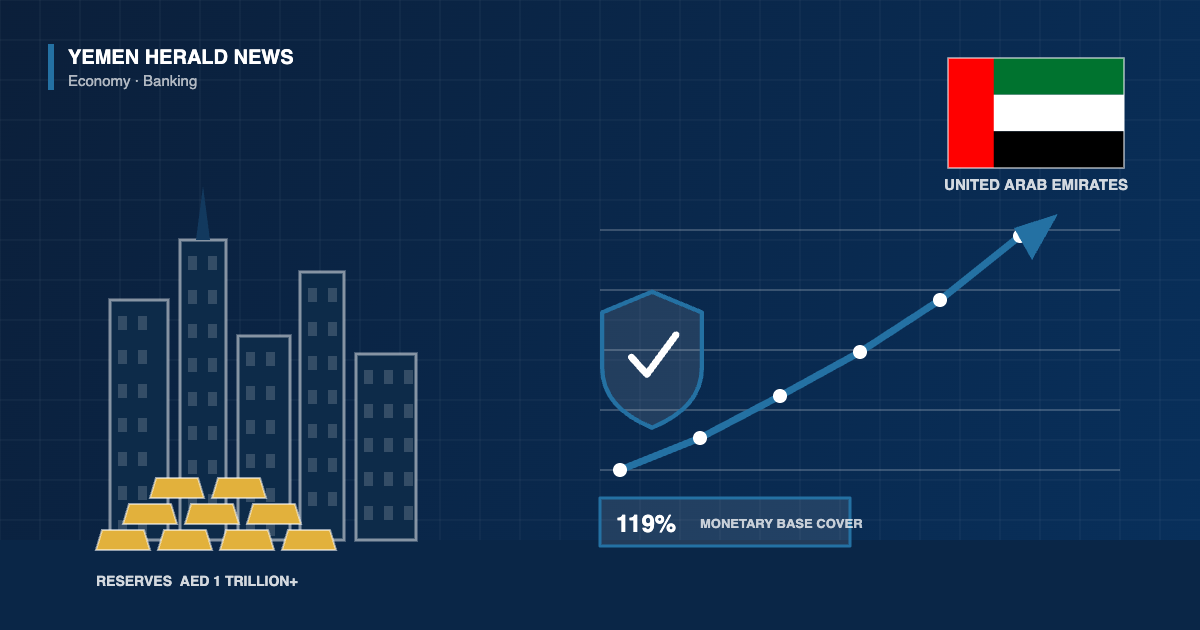
The Central Bank of the United Arab Emirates approved a package of measures in March 2026 intended to reinforce the stability of the country’s banking sector, drawing on foreign exchange reserves that had risen above AED 1 trillion. The decision was taken at the board’s second meeting of the year, held on 18 March, and was presented as a proactive step rather than a response to distress at any individual institution.
The meeting was chaired by Sheikh Mansour bin Zayed Al Nahyan, Vice President, Deputy Prime Minister, Chairman of the Presidential Court and chairman of the central bank’s board. He was joined by the vice chairmen, Abdulrahman Saleh Al Saleh and Jassem Mohamed Bu Ataba Al Zaabi, and by the central bank’s governor, Khaled Mohamed Balama.
The measure the board signed off is known as the Financial Institution Resilience Package. In substance it gives banks wider access to liquidity from the central bank and greater flexibility to draw on the capital buffers they hold, so that they can continue lending into the economy rather than pulling back at a moment of uncertainty. Buffers of this kind are built up precisely so that they can be released when conditions tighten.
The board set out the position from which it was acting. Foreign exchange reserves stood at more than AED 1 trillion, equivalent to roughly USD 270 billion and a record for the institution, against a monetary base cover ratio of 119 per cent. That ratio, which measures reserves against the currency and central bank liabilities they underpin, is the technical anchor of the dirham’s long-standing peg to the US dollar.
The banking sector itself was described as holding assets of AED 5.4 trillion, with liquidity reserves of around AED 920 billion, of which more than AED 400 billion was held at the central bank. Those figures were offered as evidence that the system had ample capacity to absorb shocks before any support measures were drawn upon at all.
The central bank grouped the measures into several strands covering monetary policy operations, temporary relief on liquidity and capital requirements, the management of credit risk, and continued support for the provision of financing to businesses and households. Taken together they were designed to keep credit flowing on normal terms if external conditions deteriorated.
The context for the decision was the regional confrontation involving Iran that had disrupted airspace, shipping and energy infrastructure across the Gulf during the same weeks. Financial systems are exposed to such episodes indirectly — through market volatility, deposit behaviour, insurance costs and the willingness of international counterparties to maintain lines of credit — and central banks typically move to remove doubt before those channels tighten.
The announcement’s intended audience extended well beyond domestic lenders. The UAE has spent two decades positioning Dubai and Abu Dhabi as international financial centres, hosting regional headquarters for global banks, asset managers and, more recently, a substantial cluster of hedge funds. That positioning depends on a reputation for regulatory predictability, and the resilience package was framed to reinforce it at a moment when the region’s stability was being questioned.
The currency peg is central to that reputation. The dirham has been fixed against the dollar since the 1990s, which means the central bank’s primary obligation is to hold sufficient reserves to defend the rate. Publishing a cover ratio comfortably above 100 per cent is a direct statement that the peg is not under strain, and it is one of the few figures international investors watch closely in Gulf monetary announcements.
Reserves of the size the board reported also give the authorities room to act without recourse to external assistance. A cover ratio near 120 per cent means the central bank holds substantially more in reserve assets than the monetary base it is obliged to back, so liquidity can be supplied to the banking system without the constraint that faces monetary authorities operating with thinner cushions.
The central bank also emphasised continuing supervision alongside the new flexibility. Allowing banks to run with lower buffers temporarily works only if the regulator retains a clear view of credit quality, so the package was accompanied by references to ongoing oversight of risk management and to the monitoring of financing services. The balance sought was support for lending without a weakening of prudential standards.
Measures of this general type have precedents. Central banks in the Gulf and elsewhere released capital buffers and expanded liquidity facilities during the pandemic, and the operational machinery for doing so was already familiar to banks in the Emirates. That experience made it possible to act quickly in March 2026, since the frameworks did not have to be designed from scratch.
What the announcement did not include was any indication that banks were experiencing difficulty. No institution was named, no facility was reported as drawn, and the board’s language throughout described strength rather than repair. The package was, in effect, an insurance policy activated in advance — cheap to maintain if unused, and available should conditions worsen.
For the wider region, the episode illustrated the divergence between Gulf financial systems and those of countries consumed by conflict. Yemen’s banking sector has been fragmented by years of war, with rival monetary authorities in Aden and Sanaa, a collapsed exchange rate in government-held areas and severe constraints on correspondent banking.
About the Author