Qatar Says Ras Laffan Fires Contained After Missile Strikes on LNG Facilities
 Yemen Herald News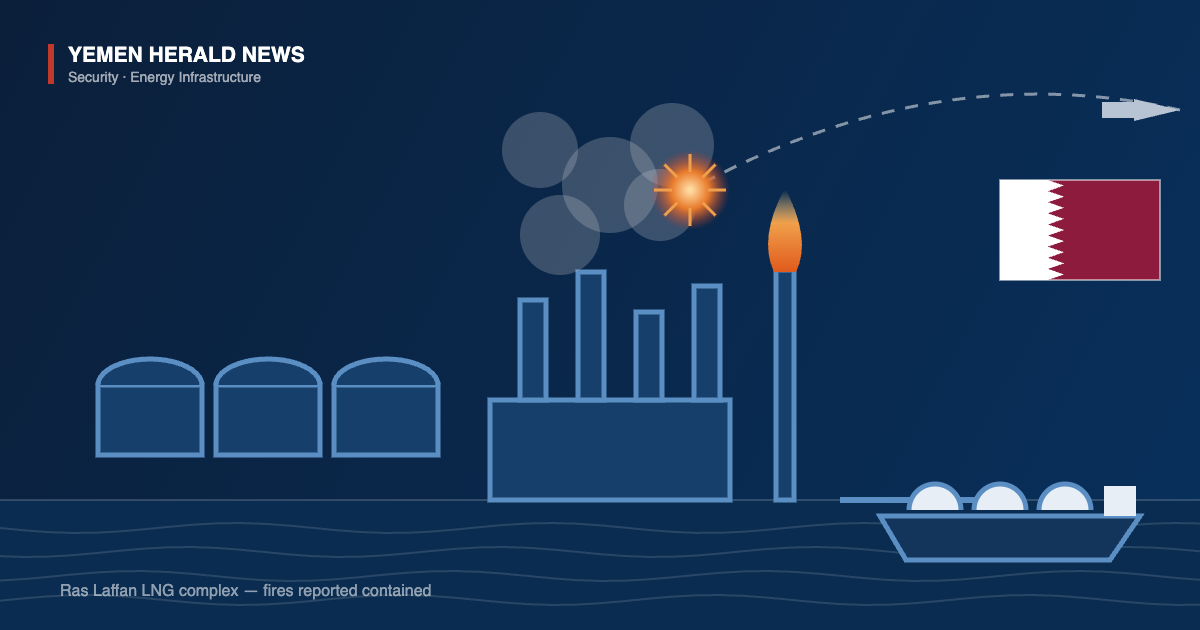
Qatar’s Ministry of Interior said in March 2026 that all fires in the Ras Laffan industrial area had been fully contained and that no injuries had been reported. The announcement, issued on the social media platform X, followed a series of missile strikes on the complex that QatarEnergy said had caused extensive damage to several of its liquefied natural gas facilities.
The ministry credited civil defence forces with bringing the blazes under control and said teams were engaged in cooling and securing operations at the affected sites to prevent any further incidents. It added that the explosives unit of the Internal Security Force, known as Lekhwiya, was managing hazardous remnants left at the scene — a reference to unexploded material and munition debris that has to be cleared before normal operations can resume.
QatarEnergy had reported earlier the same day that key LNG installations at the site were hit. The state company said emergency response teams were deployed immediately, that all personnel were accounted for and that no casualties had occurred. Qatari officials said Iran had launched five ballistic missiles, one of which struck Ras Laffan, and reporting at the time described sizeable fires and substantial damage across more than one facility.
Ras Laffan is not an ordinary industrial site. It is the centre of Qatar’s liquefied natural gas industry and one of the largest LNG production and export complexes in the world, handling the trains, storage tanks and loading berths through which the country’s principal export moves. Qatar is among the largest LNG suppliers globally, and a sustained disruption there would register in gas markets well beyond the Gulf.
That is what made the strike significant out of proportion to the physical damage. LNG liquefaction trains are enormous, individually engineered installations that cannot be replaced or substituted quickly. Even limited damage forces cautious inspection and shutdown, and buyers on long-term contracts across Asia and Europe watch any interruption closely because alternative cargoes are scarce and expensive at short notice.
Qatar’s foreign ministry condemned the attack in strong terms, describing it as a blatant assault on Ras Laffan Industrial City and a violation of its sovereignty. Doha also expelled Iranian attachés in response, a step beyond the diplomatic language used by some of its neighbours and notable given Qatar’s long-standing role as an intermediary between Tehran and Washington.
Doha’s decision to expel Iranian diplomatic staff was the sharpest element of the response. Qatar has spent years cultivating a position as a channel of communication in disputes involving Iran, and has hosted negotiations that other Gulf capitals could not. Downgrading that relationship, even partially, carried a cost Qatar had previously been reluctant to pay, and it signalled that an attack on Ras Laffan sat in a different category from the rhetorical hostilities of earlier years.
The strike fitted a wider pattern that developed through the second half of March, in which Iran turned increasingly to energy infrastructure across the Gulf Arab states. Kuwait’s Mina Al-Ahmadi and Mina Abdullah refineries were hit by drones in the same week, with fires at both, and the United Arab Emirates reported an attack on the Habshan gas facility and the Bab oil field. Reporting at the time linked the escalation to Israel’s bombing of Iran’s South Pars offshore gas field days earlier.
For a country whose economy and state revenues rest so heavily on a single export handled at a single complex, the episode exposed an uncomfortable concentration of risk. Qatar’s position had until then rested partly on the assumption that its diplomatic utility to all sides made it an unlikely target; the missile strike removed that assumption and prompted a visible hardening of its public stance.
Air defence over the site also came under scrutiny. Qatari officials said five ballistic missiles were launched and that one reached Ras Laffan, which implies most were engaged successfully but underlines how little margin there is when the target is a single high-value complex. A leakage rate that would be considered good against a dispersed target set is a serious problem when one impact can shut down a national export industry.
The strikes came a week after the Security Council adopted Resolution 2817 on 11 March 2026, which condemned in the strongest terms what it described as unprovoked missile and drone attacks by Iran against Gulf Cooperation Council states and Jordan. Gulf governments cited the continuing attacks as evidence that the resolution had not changed Tehran’s calculations.
For Yemen the effect travelled through markets rather than politics. Yemen imports nearly all its fuel and much of its food, and disruption to Gulf energy infrastructure feeds into regional prices, war-risk insurance premiums and shipping availability. Combined with the pressure already on Red Sea routes, the March strikes contributed to a period of tighter and more expensive supply into Yemeni ports.
The fighting continued for about three more weeks. The United States and Iran agreed a ceasefire on 7 and 8 April 2026 that also covered Israel, ending more than five weeks of open conflict, though Gulf states reported drone activity within hours of the announcement and the truce frayed repeatedly through the months that followed. Energy operators across the region maintained heightened protective measures well after the formal end of hostilities.
About the Author