Yemen’s ambassador in Havana raises Houthi threat to Red Sea with Cuban official
 Yemen Herald News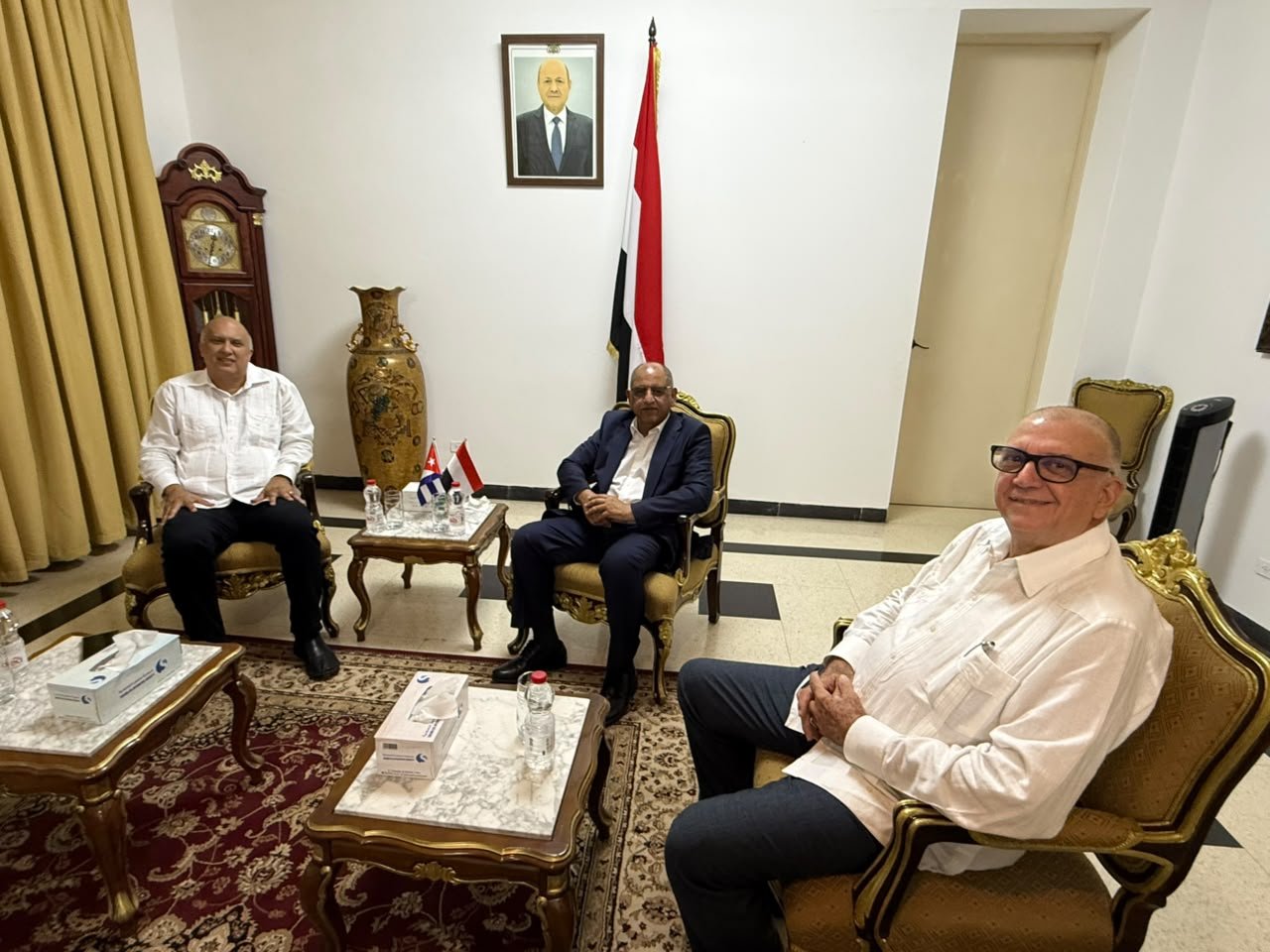
HAVANA, Cuba — Yemen’s ambassador to Cuba raised the Houthi threat to Red Sea shipping in talks with a senior Cuban foreign ministry official on Sunday, the state news agency Saba reported.
Ambassador Mohammed Nasher met Carlos Hernandez, director general of bilateral relations at Cuba’s Ministry of Foreign Affairs, the agency said.
The two discussed Yemeni-Cuban relations and cooperation, according to Saba.
The talks also covered what the Yemeni side described as Iran’s continued support for the Houthi movement and the threat that support poses to Yemen’s security and to international navigation in the Red Sea and the Bab al-Mandab strait, the agency reported.
Iran denies arming the Houthis. The movement says its weapons are locally produced.
Successive reports by the UN Panel of Experts on Yemen have described weapons and components of Iranian origin reaching Houthi-held areas, findings Tehran has rejected.
Hernandez affirmed Cuba’s support for Yemen and its internationally recognised government, for Yemen’s sovereignty, unity and territorial integrity, and for efforts to reach peace and stability, Saba said.
The account of the meeting rests on Saba, which is run by the internationally recognised government. Cuba’s foreign ministry has not published its own readout, and Yemen Herald found no independent confirmation of what was said.
Cuba kept close ties with the People’s Democratic Republic of Yemen, the socialist state in the south that merged with the north in 1990. Cuban doctors and advisers worked in Aden during that period.
Yemeni envoys have raised the Red Sea file in a series of capitals in recent weeks. Saba reported meetings on the subject by Yemen’s ambassadors in Berlin, Prague and Geneva since the start of September.
Cuba and Yemen are both members of the Non-Aligned Movement. Yemen’s ambassador to the movement, Asmahan al-Tawqi, delivered a national statement to its meeting at the start of September, Saba reported.
The Houthi movement seized Sanaa in September 2014 and pushed south the following year, prompting a Saudi-led military intervention in March 2015. Most foreign embassies left the capital that year.
The internationally recognised government has since sought recognition and support in capitals that host no Yemeni-accredited mission in Sanaa. Havana is among them.
Yemen’s government has also pressed European states to designate the Houthi movement. Saba reported that its ambassador to Prague urged the Czech Republic and the European Union to do so on 4 September.
Houthi forces began attacking merchant shipping in the Red Sea and the Gulf of Aden in November 2023, starting with the seizure of the car carrier Galaxy Leader. They said the campaign was pressure on Israel over the war in Gaza.
Much of the traffic that had used the Suez Canal moved to the longer route around southern Africa.
The European Union launched Operation Aspides in February 2024 to escort merchant vessels through the corridor. The Council of the European Union has since extended the operation into 2027 and allocated 15 million euros to it.
Bab al-Mandab separates Yemen from Djibouti and Eritrea and links the Red Sea to the Gulf of Aden. Shipping bound for the Suez Canal from the Indian Ocean passes through it.
The meeting came during the heaviest fighting inside Yemen since the United Nations brokered a truce in April 2022.
Houthi forces launched simultaneous ground assaults in southern Hodeidah and in three districts west of Taiz on Thursday, according to Al Jazeera and Arab News, which described the attack as the largest since that truce. The National reported that government forces counted 14 ballistic missiles fired at rural areas of the two governorates.
Government troops recaptured a hilltop in Jabal Habashi the following day, Arab News reported. Al Jazeera reported that Houthi units have been pressing to cut off the government-held port of Mokha and to move towards ground bordering Bab al-Mandab.
At least four civilians were killed and nine wounded in a missile strike on the Heijah al-Abd road south of Taiz on Saturday, Al Jazeera and The National reported. Both outlets attributed the attack to Houthi forces.
Hans Grundberg, the UN special envoy for Yemen, called the escalation extremely alarming and warned that it risked widening the conflict, his office said. He urged the parties to halt hostilities and to use the Military Coordination Committee.
The UN Office for the Coordination of Humanitarian Affairs said nearly 1,800 families fled in less than 48 hours and that several displacement camps in Maqbanah and Jabal Habashi emptied under shelling. It said emergency stocks were severely depleted.
The Presidential Leadership Council was formed in April 2022, when Abd Rabbu Mansour Hadi transferred his powers to the eight-member body. Rashad al-Alimi chairs it. The council is seated in Aden, and parts of the government work from Riyadh.
The April 2022 truce formally lapsed that October. Front lines stayed largely static until this year, when fighting resumed on the western fronts.
The United Nations humanitarian plan for 2026 puts the number of people needing assistance in Yemen at more than 22 million, of whom 18.3 million are acutely food insecure. It records more than 2.2 million children under five as acutely malnourished, including 516,157 severe cases.
The plan counts 5.2 million people displaced inside the country and seeks 2.16 billion dollars to reach 12 million of them.
Saba did not say whether the two sides agreed on any follow-up.
About the Author