UAE Condemns Iranian Attack on Habshan Gas Facility and Bab Oil Field as a Dangerous Escalation
 Yemen Herald News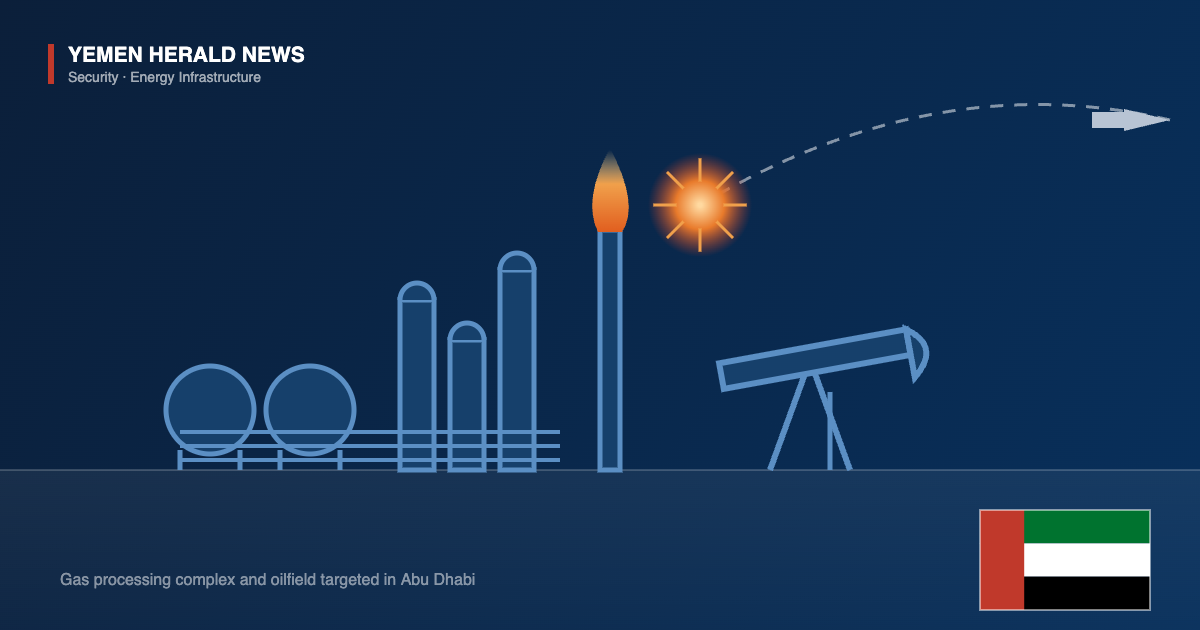
The United Arab Emirates condemned an attack on its Habshan gas facility and the Bab oil field in March 2026, attributing the strike to Iran and describing it as a terrorist act. The foreign ministry said the country’s air defence systems had intercepted the attack and that no injuries were reported, but framed the targeting of energy installations as a marked step up in an already severe regional confrontation.
In its statement the ministry called the attack a dangerous escalation and a violation of international law. It said that striking critical infrastructure and oil facilities constituted a direct threat not only to regional security and stability but to global energy security, language that placed the incident in an international frame rather than a purely bilateral one.
The UAE also reserved what it called its full right to take all necessary measures to protect its sovereignty, its national security and its national interests. That phrasing has recurred in Emirati statements throughout the conflict and stops short of announcing any specific retaliatory step, leaving the government’s options open while signalling that it does not regard interception alone as the limit of its response.
The two sites named are central to Abu Dhabi’s hydrocarbons operation. Habshan is one of the largest gas processing complexes in the country, handling associated and non-associated gas from inland fields and feeding onward into the domestic network and export chain. The Bab field is among the emirate’s major onshore oil producers. Damage to either would carry consequences well beyond the immediate area.
That vulnerability was demonstrated again a fortnight later. In early April the UAE suspended operations at Habshan after debris from a missile interception fell on the site, a reminder that even successful air defence engagements can force production shutdowns. The economic exposure created by this phase of the war came as much from precautionary suspensions and elevated insurance costs as from direct damage.
The interception itself was notable. Gulf air defence networks were designed principally around the protection of population centres, air bases and ports, and the conflict forced a rapid extension of that coverage to dispersed inland energy assets that are difficult to shield comprehensively. Processing complexes present a large physical footprint with a small number of genuinely critical nodes, which makes them attractive targets and awkward things to defend.
The attack came within a broader campaign. Fighting had escalated sharply from late February 2026, when the United States and Israel launched a joint offensive against Iran, after which Iran began striking American and allied military and infrastructure targets across the region. Saudi Arabia, Kuwait, Qatar, Bahrain and Jordan all reported attacks over the same weeks, alongside the UAE.
Abu Dhabi had already taken its case to the Security Council. On 11 March the Council adopted Resolution 2817, condemning in the strongest terms what it described as unprovoked missile and drone attacks by Iran against the UAE, fellow Gulf Cooperation Council states and Jordan. The Habshan strike came roughly a week later, and Emirati officials cited it as evidence that the resolution had not deterred further attacks.
Energy markets watched the sequence closely. The Gulf accounts for a substantial share of global oil and gas supply, and attacks on processing hubs rather than wellheads are particularly consequential because processing capacity is concentrated in a small number of large, hard-to-replace facilities. Insurers and shipping operators repriced risk across the region during this period.
Emirati officials also pressed the argument that attacks on civilian energy infrastructure sit outside any plausible reading of the laws of armed conflict, regardless of the wider dispute between Iran and the United States. Tehran has rejected the characterisation of its strikes as terrorism and has framed them as responses to the joint American and Israeli offensive against it, a position it maintained throughout the war.
For Yemen the read-across was practical rather than political. Yemen imports the overwhelming majority of its fuel, food and medicine by sea, and the shipping and insurance costs generated by attacks on Gulf energy infrastructure and on vessels in the Red Sea feed directly into landed prices at Yemeni ports. Periods of heightened risk in the Gulf have repeatedly coincided with tighter and costlier supply into Aden and Hodeidah.
The UAE maintained through this phase that its posture was defensive. Officials consistently drew a line between intercepting projectiles over Emirati territory and participating in offensive operations against Iran, a distinction Abu Dhabi has been careful to preserve in public messaging even while condemning Tehran in the strongest terms available to it.
The fighting continued for roughly three more weeks after the Habshan strike. The United States and Iran agreed a ceasefire on 7 and 8 April 2026 that also covered Israel, ending more than five weeks of open conflict. It did not hold cleanly — Gulf states reported drone activity within hours — and the truce frayed repeatedly over the months that followed as attacks resumed at intervals.
What the Habshan and Bab attack established, and what later events confirmed, is that energy infrastructure had become a recognised category of target in this war rather than an incidental one. That shift is the reason Emirati statements moved from describing attacks as violations of sovereignty to framing them as threats to global energy security — a deliberate widening of the audience for the complaint.
About the Author