Japan Beat Australia 1-0 in Sydney to Win a Third Women’s Asian Cup
 Yemen Herald News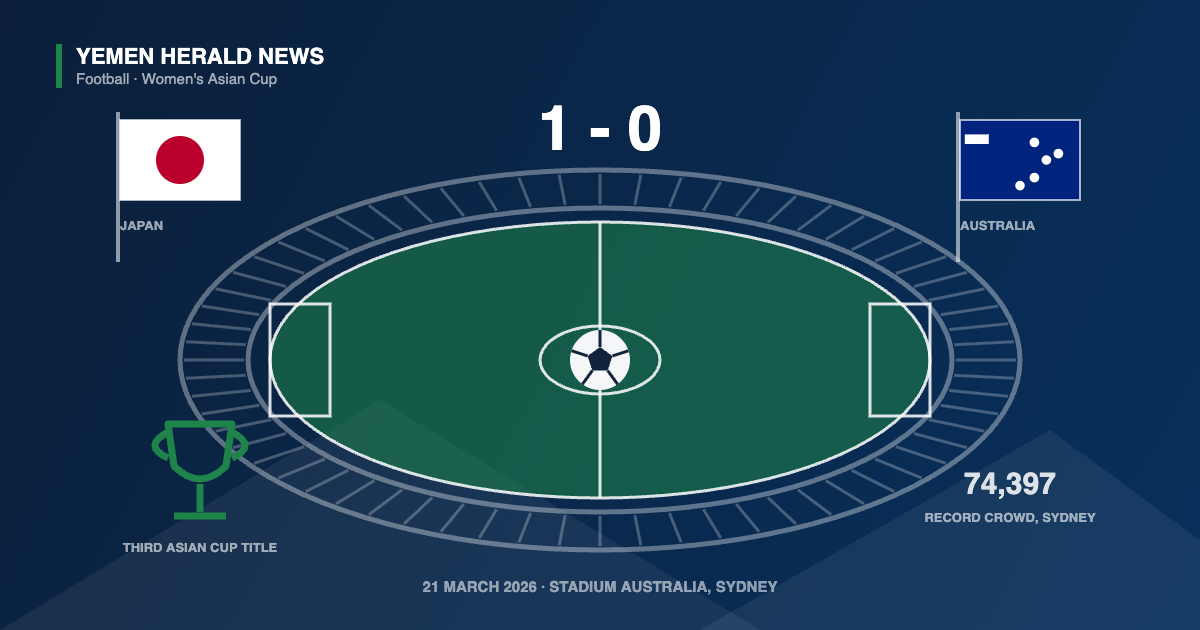
Japan beat Australia 1-0 at Stadium Australia in Sydney on 21 March 2026 to win the AFC Women’s Asian Cup for a third time. Maika Hamano scored the only goal of the final in the 17th minute and was named player of the match. The result denied the hosts a first continental title in front of the largest crowd the competition has drawn.
The goal came from distance and from an unpromising position. Hamano collected the ball roughly five metres outside the penalty area, turned her marker, and drove a swerving shot past the diving Australia goalkeeper Mackenzie Arnold into the corner of the net. It was the sort of strike that decides a final without any of the build-up that usually precedes one, and it arrived early enough to shape the remaining seventy-odd minutes.
Hamano, 21, is a forward on loan at Tottenham Hotspur from Chelsea. Her club published its own account of the goal after the match. She had been among the more prominent Japanese attackers through the tournament, and the final confirmed a progression that had been visible in the earlier rounds rather than announcing an unexpected one.
The attendance was 74,397, a record for the Women’s Asian Cup and a figure that would have been implausible for the competition a decade earlier. Organisers reported total tournament attendance of more than 350,000 across all matches, well above the previous high. Staging the tournament in Australia, where the 2023 World Cup had already established a large audience for the women’s game, accounted for much of that.
The symmetry of the result was unusual. It was Japan’s third Women’s Asian Cup title in four editions, and the third time in the past four tournaments that Japan and Australia had contested the final. Japan won each of those three finals by the same 1-0 scoreline, in 2014, in 2018 and again in 2026. Few fixtures in international football have produced so consistent a pattern over so long a period.
Japan’s route to the final was emphatic. Across six matches they scored 29 goals and conceded one. They beat the Philippines 7-0 in the quarter-finals and South Korea 4-1 in the semi-final. Australia reached the final by beating China, with Sam Kerr scoring the winner, and arrived with the advantage of home support and the disadvantage of a Japanese side that had conceded a single goal in a month of football.
The final itself was closer than the aggregate record suggests. Australia began with composure and created the better early chances, including one that Caitlin Foord failed to convert in the 11th minute. Japan named an unchanged side from the semi-final, while Australia made one alteration in central defence. After Hamano’s goal the hosts pressed with increasing urgency, and Alanna Kennedy came close to an equaliser in the 88th minute, but the Japanese goalkeeper Ayaka Yamashita and the defence in front of her absorbed the pressure.
Japan’s defensive record through the competition was the foundation of the win. Conceding once in six matches meant that a single goal was, in practice, sufficient in almost any fixture they played, and it allowed the side to manage the final rather than chase it. Australia’s problem after the 17th minute was not a lack of chances so much as the knowledge that they would need to breach a defence that had barely been breached all month.
The tournament carried consequences beyond the trophy. It doubled as the Asian qualifying competition for the World Cup in Brazil, and Japan, Australia, South Korea, China, North Korea and the Philippines all secured places through it. For several of those sides the qualification mattered more than the final placing, and the group stage was played with that in mind.
For Australia the defeat was a difficult conclusion to a well-supported home tournament. The Matildas have been the most commercially successful women’s national team in the region for several years, and reaching the final in Sydney represented a substantial achievement in itself. Losing it to a single long-range strike, against the same opponent and by the same score as in two previous finals, gave the loss a particular sting.
Japan’s position as the leading side in Asian women’s football has now been established across more than a decade. The Nadeshiko won the World Cup in 2011 and have remained competitive at every level since, and the 2026 tournament suggested that the depth of their squad, rather than the form of any individual, is what sustains them.
For the rest of the confederation the tournament served as a reminder of the distance still to be covered. Six places at the World Cup were available and they went to the countries that have invested most heavily in domestic women’s leagues and youth systems. The gap between those sides and the remainder of the field was, in several matches, considerable.
The competition also offered a measure of how far the women’s game has travelled in Asia. Crowds of the size seen in Sydney were once confined to a handful of European and North American fixtures. That a continental championship final can now fill a stadium built for an Olympic Games is the more durable result of the month, whatever the scoreline.
About the Author