Yemen’s agriculture minister asks FAO for funding partnership on farming and fisheries
 Yemen Herald News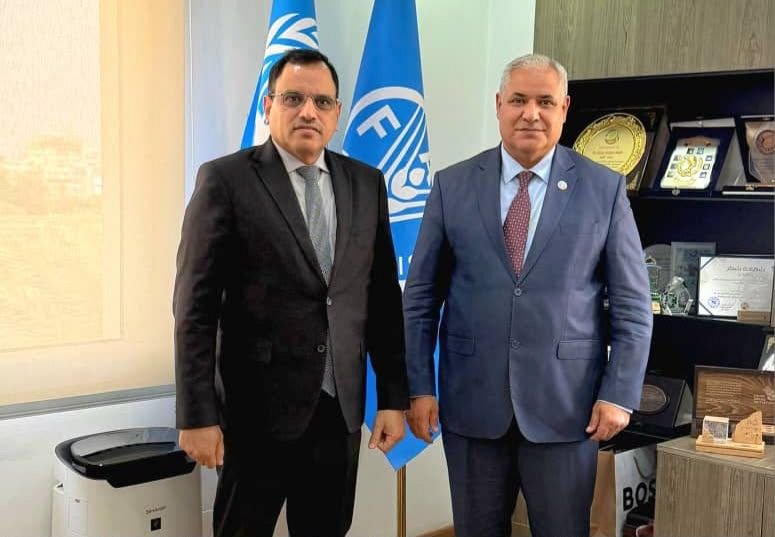
CAIRO, Egypt — Yemen’s agriculture minister asked the UN Food and Agriculture Organization for a working partnership to fund farming and fisheries projects, the state news agency Saba reported.
Salem al-Soqtari held the talks in Cairo on 9 September with Abdul Hakim al-Waer, the FAO deputy director-general and regional representative for the Near East and North Africa.
Al-Soqtari said an effective partnership with the organisation was needed without delay.
“We’re looking forward to join efforts and closely coordinate with FAO to mobilize support and resources to finance programs and projects in agriculture and fisheries sectors,” he said.
The account of the meeting rests on Saba, and no independent confirmation of what was agreed has been published.
The two discussed preparing studies and designs for new projects, according to the agency.
Those cover integrated coastal zone management, agricultural and rural development, and the protection and management of natural resources.
They also cover building the capacity to deal with the effects of climate change.
Saba said the studies were intended as a step toward raising funding in coordination with partners and donors.
No figures, timetable or list of sites were given.
Al-Soqtari has dealt with the organisation before. He led Yemen’s delegation to an FAO global conference on smart farming, and has held earlier talks with the agency on plant protection.
He met the UN Development Programme this year on joint cooperation.
Agriculture and fishing employ a large share of Yemen’s workforce, and both sectors have contracted through the war.
Yemen imports the great majority of its staple food, which leaves households exposed to shipping costs and to movements in the exchange rate.
The Yemeni riyal has lost value in government-held areas, raising the local price of imported wheat, rice and fuel.
Fishing communities on the Red Sea and the Gulf of Aden have been among the worst affected by the conflict, with boats lost and landing sites damaged.
Attacks on merchant shipping since late 2023 have added insurance costs and pushed many operators to route vessels around the Cape of Good Hope.
Brent crude held above $100 a barrel on Thursday as traders weighed the risk of further disruption to supply, Saba reported. Fuel is a direct input for pumps, tractors and fishing boats.
The meeting took place while Yemeni officials were in Cairo for the 166th session of the Arab League Council at ministerial level.
Foreign Minister Afrah al-Zouba used the same visit to hold talks with her Egyptian counterpart, Badr Abdelatty, and with the Arab League secretariat.
Fighting at home has worsened since the delegation travelled.
Combat between the Houthis and the internationally recognised government resumed on 3 September, when a Houthi offensive opened in Taiz governorate.
The Presidential Leadership Council answered with a counter-offensive in al-Jawf and al-Bayda.
It is the heaviest fighting in Yemen since the 2022 truce lapsed.
On Thursday the Houthis seized the Red Sea port city of Mocha as government forces withdrew, sources told Al Jazeera and the Reuters news agency.
The International Organization for Migration has recorded 30,378 people displaced inside Yemen this year.
The UN Population Fund said its emergency teams had reached 8,365 newly displaced people in Taiz governorate.
Yemen’s Executive Unit for internally displaced people counted 2,183 families displaced in Taiz and Hodeidah.
Displacement of that kind takes farming households off their land during a growing season.
The UN Office for the Coordination of Humanitarian Affairs said in its March 2026 plan that more than 22 million people in Yemen need aid.
The plan puts the number who are acutely food insecure at 18.3 million.
It records more than 2.2 million children under five who are acutely malnourished, 516,157 of them severely, and 5.2 million internally displaced people.
OCHA sought $2.16bn this year to reach 12 million people.
Humanitarian funding has fallen short of recent appeals, and agencies have cut programmes in response.
One earlier scheme, the World Bank-funded Yemen Desert Locust Response Project, reached about 100,000 people in Lahj, Shabwa, Hadramout, Abyan, Sanaa and Hodeidah, according to FAO project documents.
The organisation has said Yemen remains on high alert for desert locust, which breeds along the Red Sea and Gulf of Aden coasts and can strip crops in the interior.
Belgium and the World Bank have both funded locust surveillance and control work through the agency.
Yemen’s national agriculture and fisheries strategy sets out targets for coastal management and rural development of the kind raised in the Cairo talks.
A World Food Programme delegation inspected Mukalla port and its operating needs this week, according to Saba. The port is one of the entry points for imported food on the Arabian Sea coast.
Yemen’s planning minister held talks with the International Committee of the Red Cross and OCHA on strengthening the humanitarian response, the agency said.
Planning Minister Mohammed al-Faqmi has also been discussing a new UN development framework for the country.
The FAO runs work in Yemen on crop production, livestock, fisheries and locust control, alongside cash-for-work schemes.
The FAO office in Yemen also runs cash-for-work schemes that repair terraces, irrigation channels and rural roads.
Saba did not say whether donors had been approached for the projects raised in Cairo.
The ministry gave no date for a follow-up meeting.
About the Author