Al-Alimi says Houthis will bear full consequences of what he calls a military adventure
 Yemen Herald News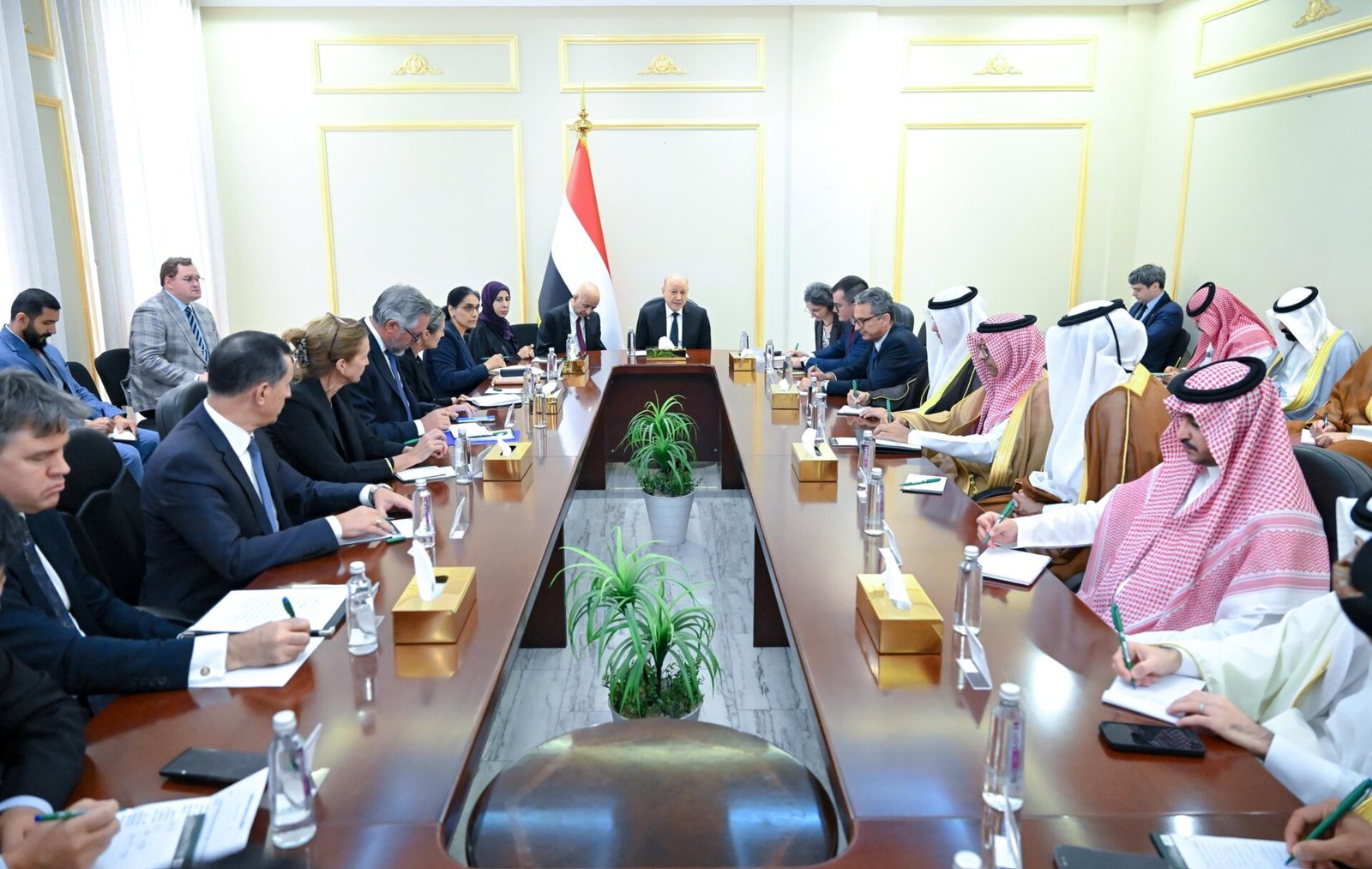
ADEN, Yemen — Rashad al-Alimi said the Houthis would bear the full consequences of what he called a military adventure, in remarks issued on 5 September.
The chairman of Yemen’s Presidential Leadership Council said Taiz governorate would not be a safe passage for the group and its backers.
He was speaking during contacts with military and field commanders, according to Yemen Monitor, which reported the remarks.
Al-Alimi said the armed forces had seized the initiative on the ground and were able to keep reclaiming territory.
He said developments on the Taiz and Hodeidah fronts showed the forces could counter Houthi attacks and sustain operations.
Yemen Herald could not independently confirm the battlefield claims, which rest on the council’s own account.
Al-Alimi praised the National Resistance, the Giants Brigades and the Tihamah brigades after what he described as the securing of Hays district in Hodeidah governorate.
He also commended forces on the Haifan front in Taiz and the role of the air force in supporting ground operations.
Government forces had announced the recapture of Hays and the securing of its rural areas after clashes with the Houthis.
That claim did not hold. On Thursday, five days after the remarks, sources told Al Jazeera that the Houthis had taken Hais along with the Red Sea port city of Mocha as government troops withdrew.
Three Yemeni government sources separately told the Reuters news agency that Mocha had fallen. The government issued no official confirmation on Thursday.
Al-Alimi said the forces that repelled the Houthi attacks were capable of reclaiming all territory and of continuing to defend citizens.
He said the Houthis had chosen to test the state and its armed forces on one of Yemen’s most resilient fronts.
Their miscalculations would carry wide consequences, he said.
Al-Alimi directed commanders to continue operations, consolidate control over recovered areas and improve coordination between formations.
He told them to observe international humanitarian law and the rules of engagement, and to protect civilians and public and private property.
He held the Houthis responsible for violations he said accompanied the escalation, including shelling, sniping and drone attacks on residential areas and public roads.
Those attacks caused civilian casualties and displaced hundreds of families, according to him. The Houthis dispute the government’s characterisation of the fighting and make their own accusations against government forces.
Al-Alimi called on political and social forces and on the media to close ranks and strengthen confidence in the armed forces.
He warned against what he described as campaigns of scepticism and treason that he said served only the Houthis.
He renewed an appeal to tribesmen and fighters in Houthi-controlled areas not to send their sons into the fighting, and urged those still in the group’s ranks to leave.
Al-Alimi directed the authorities to treat the wounded and to look after the families of government fighters killed in the operations.
Fighting resumed on 3 September, when a Houthi offensive opened in Taiz governorate.
The Presidential Leadership Council answered with a counter-offensive in al-Jawf and al-Bayda.
It is the heaviest fighting in Yemen since the 2022 truce lapsed.
Al-Subaihi, a member of the council, visited the Jabal Habashi and al-Kadha fronts in Taiz this week and pressed commanders on coordination between formations.
Yemen’s defence minister said the armed forces would continue their duties until state institutions are restored.
The Houthi-run Saba agency said Saudi forces carried out 40 further air strikes on Taiz, Hodeidah, al-Jawf and Marib on Thursday. Saudi authorities did not confirm that account.
Pakistan has urged Iran to restrain the group, and said a defence pact it finalised last month with Saudi Arabia and Turkiye could be activated if attacks on Saudi territory persist.
The Yemeni army said on 8 September that it had taken the Al-Yatmah area in Khabb wa al-Shaaf district in al-Jawf. No independent account of that engagement has been published.
An AFP tally put the death toll from fighting in southwest Yemen above 300 by 8 September.
The Houthis attacked civilian and energy sites in southern Saudi Arabia on 8 September, striking areas including Abha, Najran, Jizan and Khamis Mushait. Saudi authorities said 73 people were injured.
US Secretary of State Marco Rubio said that day that the Houthis were, in many ways, agents and proxies of Iran.
The European Union called the attacks a dangerous escalation and urged the group to comply with UN Security Council resolutions 2722 and 2826.
Russian Foreign Minister Sergei Lavrov called the strikes on Saudi territory unacceptable.
Hans Grundberg, the UN special envoy for Yemen, said this week that the attacks risked widening the war.
The International Organization for Migration has recorded 30,378 people displaced inside Yemen this year.
The UN Population Fund said its emergency teams had reached 8,365 newly displaced people in Taiz governorate.
Yemen’s Executive Unit for internally displaced people counted 2,183 families displaced in Taiz and Hodeidah.
The UN Office for the Coordination of Humanitarian Affairs said in its March 2026 plan that more than 22 million people in Yemen need aid, and that 18.3 million are acutely food insecure.
The plan records 5.2 million internally displaced people and more than 2.2 million children under five who are acutely malnourished, 516,157 of them severely.
OCHA sought $2.16bn this year to reach 12 million people.
Al-Alimi has chaired the eight-member Presidential Leadership Council since April 2022, when Abd Rabbu Mansour Hadi transferred his powers to it.
About the Author