Houthis seize Mocha as government forces withdraw from Yemen’s Red Sea coast
 Yemen Herald News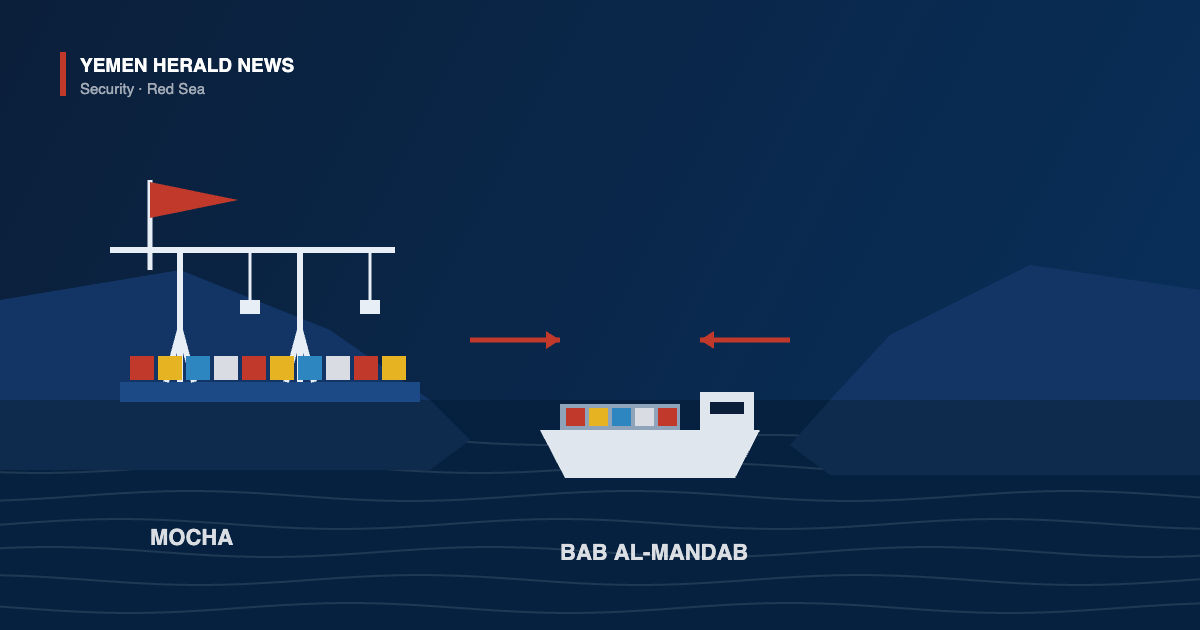
MOCHA, Yemen — Houthi fighters seized the Red Sea port city of Mocha on Thursday as Yemeni government forces withdrew, sources told Al Jazeera and the Reuters news agency.
The Iran-aligned group took the city after hours of fighting, Al Jazeera’s Yemen correspondent Yousef Mawry said, citing sources on the ground.
Three Yemeni government sources separately told Reuters that Mocha had fallen.
Yemen’s internationally recognised government had issued no official confirmation on Thursday.
Government troops pulled back southward toward Dhubab, a military source told the AFP news agency.
Mawry said the district of Hais was also taken.
Mocha lies about 150 kilometres south of Hodeidah, the port the Houthis have controlled since 2014. It had served as a main base for government forces along Yemen’s Red Sea coast.
Anti-Houthi forces had held the city since 2017, when a coalition-backed offensive pushed the group off much of the southern Red Sea coastline.
Mocha overlooks Bab al-Mandab, the channel linking the Red Sea to the Gulf of Aden.
“This gives the Houthis the eyes, the ears, and the pressure to monitor international trade,” Mawry said. He put the share of global trade passing through the strait at 10 to 12 percent.
Wolfgang Pusztai, a defence analyst, said the capture left the group able to cut the road leading to Taiz. He called it a “very significant blow against the government.”
Pusztai said Houthi forces could now dominate almost the whole of Yemen’s Red Sea coastline.
He contrasted the two waterways. The Strait of Hormuz is about 50 kilometres wide. Bab al-Mandab is roughly 20.
“This means they could control it just with artillery; they wouldn’t need to even use missiles or drones to attack ships,” Pusztai told Al Jazeera.
The Houthis had spent the previous 10 days pushing west of Taiz with Mocha as the objective, according to Al Jazeera.
Fighting between the group and the internationally recognised government resumed on 3 September, when a Houthi offensive opened in Taiz governorate. The Presidential Leadership Council answered with a counter-offensive in al-Jawf and al-Bayda.
It is the heaviest fighting in Yemen since the 2022 truce lapsed.
The Houthi-run Saba agency said on Thursday that Saudi forces had carried out 40 further air strikes on Taiz, Hodeidah, al-Jawf and Marib. Saudi authorities did not confirm that account.
Rajeh Badi, Yemen’s ambassador to Qatar, accused Iran of reigniting the war after a lull of about five years and of using the Houthis to tighten Tehran’s hold on Red Sea shipping.
Badi said the relationship between Iran and the group was “no longer a secret,” describing it as one of Tehran’s regional arms alongside Hezbollah in Lebanon and the Popular Mobilisation Forces in Iraq.
“Its grip over these two choke points would be more powerful than any nuclear arsenal,” Badi told Al Jazeera.
Pusztai said Iran holds “a huge influence” over the group, but added that its fighters “are not only proxies of Iran. They are fighting also their own war.”
Abdulaziz Alghashian, a Saudi foreign policy analyst, described the advance as “concerning; it’s disappointing, but maybe not overly surprising.”
He attributed it less to Houthi strength than to what he called a “discombobulation of the anti-Houthi forces.”
Alghashian said Saudi Arabia would probably favour a tit-for-tat response rather than a prolonged campaign.
The Houthis attacked civilian and energy sites in southern Saudi Arabia on 8 September, striking areas including Abha, Najran, Jizan and Khamis Mushait. Saudi authorities said 73 people were injured.
US Secretary of State Marco Rubio said that day that the Houthis were “in many ways, agents and proxies of the Iranians.”
Pakistan has urged Iran to restrain the group. Islamabad said a defence pact it finalised last month with Saudi Arabia and Turkiye, the Mecca Defence Alliance, could be activated if the attacks continue.
Hans Grundberg, the UN special envoy for Yemen, said this week that the attacks risked widening the war.
An AFP tally put the death toll from the fighting in southwest Yemen above 300 by 8 September.
The International Organization for Migration has recorded 30,378 people displaced inside Yemen this year, with the Taiz front driving much of the recent movement.
The European Union called the attacks on Saudi Arabia a dangerous escalation and urged the Houthis to stop them and to comply with UN Security Council resolutions 2722 and 2826.
Russian Foreign Minister Sergei Lavrov called the strikes on Saudi territory unacceptable.
The UN Population Fund said its emergency teams had reached 8,365 newly displaced people in Taiz governorate.
Yemen’s Executive Unit for internally displaced people counted 2,183 families displaced in Taiz and Hodeidah.
Traffic through Bab al-Mandab has run well below pre-2023 levels since the group began attacking merchant shipping, with many operators routing vessels around the Cape of Good Hope instead.
The UN Office for the Coordination of Humanitarian Affairs said in its March 2026 plan that more than 22 million people in Yemen need aid and 18.3 million are acutely food insecure.
The plan records 5.2 million internally displaced people and more than 2.2 million children under five who are acutely malnourished, 516,157 of them severely.
OCHA sought $2.16bn this year to reach 12 million people.
About the Author