Netherlands condemns Houthi attacks on civilians in Yemen and Saudi Arabia
 Yemen Herald News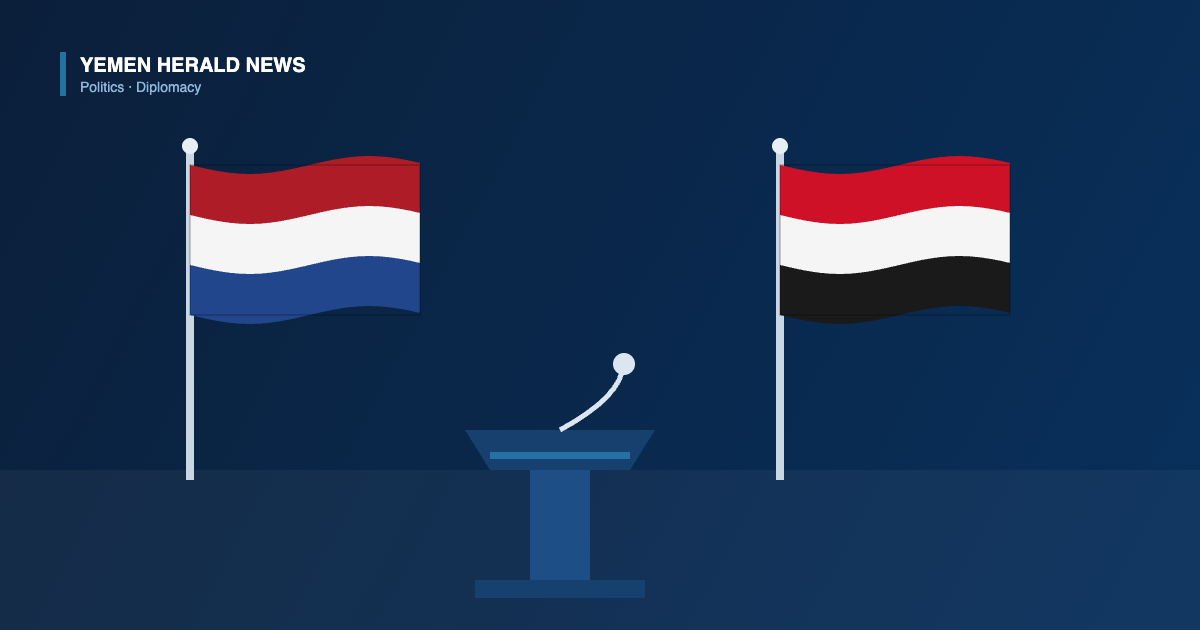
THE HAGUE, Netherlands — The Netherlands has condemned Houthi attacks on civilians in Yemen and Saudi Arabia, Yemen’s state news agency Saba reported on Sept. 9.
Dutch Foreign Minister Tom Berendsen said on the social platform X that he stood with all those affected by the attacks, according to the agency.
Berendsen affirmed his country’s support for its partners, Saba said. The agency reported that the Netherlands also restated its commitment to supporting stability in the region and to preventing further escalation.
The account of the Dutch statement rests on that Saba report, filed from The Hague and published in Aden. Yemen Herald found no independent confirmation of it published elsewhere.
The condemnation followed days of Houthi missile and drone attacks on southern Saudi Arabia.
Saudi authorities said 73 civilians were wounded on Sept. 8 in attacks on Abha, Khamis Mushait, Jazan and Najran, according to reports by Al Jazeera and CNN. Fires broke out at energy sites, those reports said.
Houthi military spokesman Yahya Sarea said the group fired dozens of ballistic missiles and drones at Saudi Aramco facilities in Abha, Najran and Jazan, and at King Khalid Air Base near Khamis Mushait.
Maj. Gen. Turki al-Maliki, spokesman for the Saudi-led coalition, said the Houthis struck Khamis Mushait, Abha and Jazan again on Sept. 9 with ballistic missiles and drones.
Al-Maliki said the coalition would answer the attacks under Article 51 of the United Nations Charter, which covers self-defence.
Saudi officials describe the campaign as terrorism. The Houthis present it as a response to Saudi involvement in Yemen.
The fighting widened on Sept. 10. Houthi forces took the Red Sea city of Mocha as government troops pulled back, Al Jazeera reported, citing its own correspondent. Reuters reported the same, citing three Yemeni government sources.
Mocha sits near the Bab al-Mandeb Strait, the channel linking the Red Sea to the Gulf of Aden. It lies about 150 kilometres south of Hodeidah, the Houthi-held port on the same coast.
Tariq Saleh, a member of Yemen’s Presidential Leadership Council, called the pullback a tactical withdrawal to reorganise forces.
Council head Rashad al-Alimi said events at Mocha and Bab al-Mandeb were “not a purely Yemeni affair” and asked the international community to act. He said the strait “cannot become another Strait of Hormuz” and that “Yemen cannot become another Iran.”
Foreign Minister Afrah al-Zouba sent a message to the U.N. Security Council seeking a firm international position on Yemen’s western coast, Al Jazeera reported.
Wolfgang Pusztai, a defence analyst, told Al Jazeera that holding Mocha puts the Houthis in a position to cut the road to Taiz and to reach most of Yemen’s Red Sea coastline.
Pusztai said Bab al-Mandeb is about 29 kilometres wide at its narrowest point, against about 34 kilometres for the Strait of Hormuz, and that artillery alone could cover that distance.
Abdulaziz Alghashian, a Saudi foreign policy analyst, told the same broadcaster the advance reflected disarray among anti-Houthi forces rather than Houthi strength. He said Riyadh would probably seek a tit-for-tat response.
Field commanders in Taiz and on the western coast said attempts were under way to retake Mocha, Al Jazeera reported from Taiz.
Houthi spokesman Mohammed Abdul Salam called the coastal offensive a national operation asserting Yemeni sovereignty. He said shipping in the Red Sea and Bab al-Mandeb remained safe and uninterrupted.
The group’s ban on Saudi-linked vessels stays in force, the Houthi-affiliated Saba news agency in Sanaa reported.
That agency also said Saudi forces carried out 40 further air strikes on Sept. 10 in Taiz, Hodeidah, al-Jawf and Marib. Yemen Herald could not independently verify the figure.
Yemen’s Supreme Political Council, the Houthi-led authority in Sanaa, said clashes on the western coast had stopped after government reinforcements were pushed back. The council asked states concerned with maritime security to press Saudi Arabia against sending more reinforcements to Mocha.
Yemen’s ambassador to Qatar, Rajeh Badi, accused Iran of reigniting the war after a lull of about five years, in remarks to Al Jazeera.
The Netherlands was one of several governments to speak. Turkey condemned the attacks on Saudi Arabia, Yemen Monitor reported. Russian Foreign Minister Sergey Lavrov called them unacceptable.
Pakistan warned Iran to restrain the group and said a defence pact with Saudi Arabia and Turkiye could be activated if attacks on Saudi territory continue, Al Jazeera reported. The three states finalised that accord, named the Mecca Defence Alliance, in August.
Berendsen took office as Dutch foreign minister on Feb. 23, 2026, succeeding David van Weel, according to the Dutch government. He belongs to the Christian Democratic Appeal and sat in the European Parliament from 2019, where he led his party’s delegation.
Aid agencies say the escalation adds to Yemen’s existing relief needs. The United Nations humanitarian needs and response plan for Yemen, published in March 2026, counts more than 22 million people in need of assistance.
That plan lists 18.3 million people as acutely food insecure. It records more than 2.2 million children under five as acutely malnourished, including 516,157 severe cases.
The plan counts 5.2 million people displaced inside Yemen. It seeks $2.16 billion to reach 12 million of them this year.
About the Author