Coalition says Houthi missiles and drones targeted Khamis Mushait, Abha and Jazan
 Yemen Herald News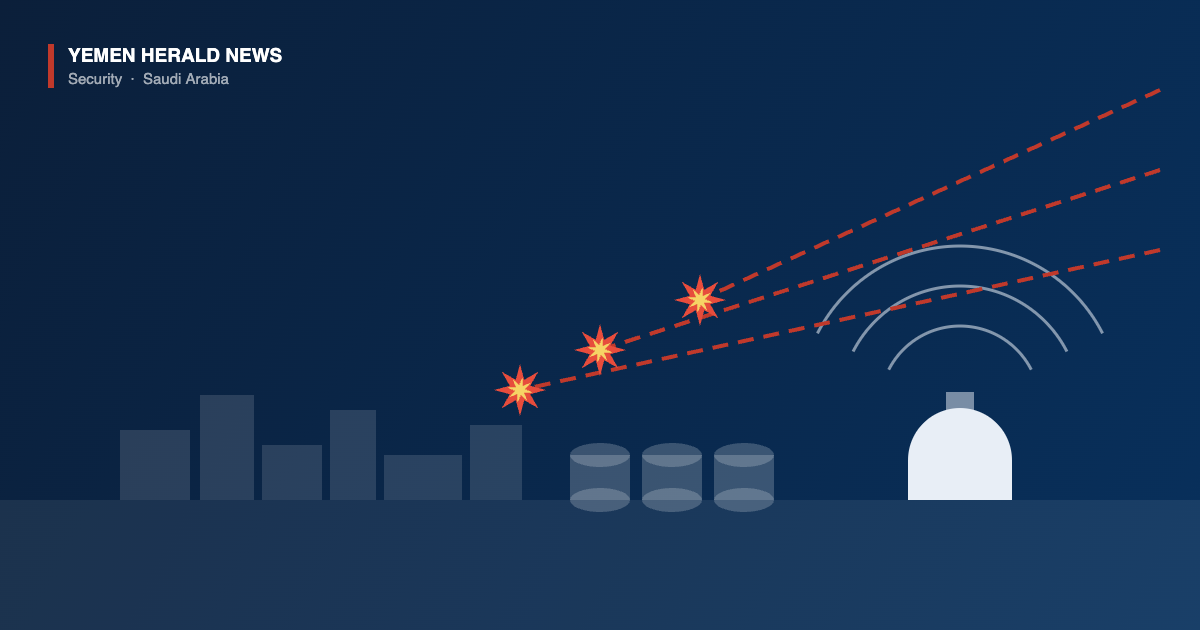
RIYADH, Saudi Arabia — The Saudi-led coalition said Houthi forces fired ballistic missiles and drones at three cities in southern Saudi Arabia on Wednesday, and vowed to respond.
Coalition spokesman Maj. Gen. Turki al-Maliki named the targets as Khamis Mushait, Abha and Jazan.
He said the launches reflected what he called the group’s escalatory approach and its targeting of civilians and civilian facilities in the kingdom.
Al-Maliki said the coalition’s Joint Forces Command would answer the attacks in a way that protected Saudi sovereignty, installations, national capabilities and civilians.
He cited the right of self-defence under Article 51 of the United Nations Charter. Any response would comply with international humanitarian law, he said.
The Houthi movement did not immediately comment on Wednesday’s launches. It has claimed responsibility for earlier waves in the same campaign.
Saudi authorities said an earlier barrage on Tuesday wounded 73 people, among them women and children. The coalition did not break the figure down by city.
Those strikes hit Abha, Khamis Mushait, Jazan and Najran, four cities near the Yemeni border. Fires broke out at several energy sites.
Operations were suspended at some facilities, Saudi authorities said. They did not say how long the shutdowns would last.
Houthi military spokesman Yahya Sarea said the group had launched dozens of ballistic missiles and drones in that attack.
He said the targets included Saudi Aramco installations at Abha, Najran and Jazan, the Jazan City for Primary and Downstream Industries, and King Khalid Air Base near Khamis Mushait.
The Houthi military said the barrage answered more than 100 Saudi air strikes on Yemen over three days. Yemen Herald could not independently verify that count.
Saudi Civil Defense issued repeated public warnings through the kingdom’s National Early Warning Platform for Emergencies. One alert covering Khamis Mushait was the fourth in 24 hours, and authorities said soon afterwards that the danger had passed.
The exchanges are part of a wider escalation that began this month. A truce agreed in 2022 collapsed in July.
Fighting has run along the whole front line since. More than 300 people have been killed in the renewed offensives, according to tallies compiled from both sides.
On Saturday alone, more than 60 people were killed in the south-west. Government sources reported 26 troops killed; Houthi medical and military sources reported 31 fighters killed.
Fighting spread along Yemen’s western coast from Sept. 3. On Thursday the Houthis took the Red Sea city of Mocha after government forces pulled back, according to Al Jazeera and Reuters, which each cited their own sources.
Tariq Saleh, a member of Yemen’s Presidential Leadership Council, described the pullback as a tactical withdrawal to reorganise his forces on the coast.
The International Organization for Migration said about 18,500 people were displaced in Taiz and Hodeidah governorates after hostilities escalated on Sept. 3.
Hans Grundberg, the United Nations special envoy for Yemen, warned this week that the fighting risks widening into a broader war. He pointed to Houthi pressure on the Bab al-Mandab Strait, the passage linking the Red Sea to the Gulf of Aden.
Rashad al-Alimi, who chairs the Presidential Leadership Council, said the situation around Mocha and the strait was not a purely Yemeni matter and called for international action.
Pakistan said its defence pact with Saudi Arabia and Turkiye could become operational if Houthi attacks on Saudi territory continue. The three governments finalised the arrangement, named the Mecca Defence Alliance, in August.
Abha and Khamis Mushait sit inland in Asir province. Jazan lies on the Red Sea coast, close to the Yemeni border.
Houthi-run Saba said Saudi forces carried out a further 40 air strikes on Thursday, on Taiz, Hodeidah, al-Jawf and Marib governorates.
Wolfgang Pusztai, a defence analyst, said the capture of Mocha allows the Houthis to threaten the road to Taiz and to reach almost the whole Yemeni Red Sea coast. He told Al Jazeera the strait is narrow enough to be covered by artillery alone.
Bab al-Mandab is about 29 kilometres across at its narrowest point. Between 10 and 12 per cent of global trade passes through it.
The Houthis have also taken Zuqar Island in the southern Red Sea, CNN reported, after rocket fire and a ground assault.
Mohammed Abdul Salam, a Houthi spokesman, called the coastal offensive a national operation asserting Yemeni sovereignty. He said the group held no further territorial ambitions and that shipping in the Red Sea and the strait remained safe.
The Supreme Political Council, the Houthi-led authority in Sanaa, said fighting on the western coast had stopped after government reinforcements were pushed back. It asked states concerned with maritime security to press Saudi Arabia against sending more troops to Mocha.
The Yemeni government disputes that account and says its forces are preparing to retake the city.
Foreign Minister Afrah al-Zouba sent a message to the Security Council this week seeking a firm international position on the western coast.
Rajeh Badi, Yemen’s ambassador to Qatar, accused Iran of restarting the war after a lull of about five years. Iran denies arming the Houthis.
The United Nations humanitarian plan for Yemen, issued in March, put more than 22 million people in need of assistance and 18.3 million in acute food insecurity. It sought 2.16 billion dollars to reach 12 million of them.
The Houthis said their ban on Saudi-linked shipping in the Red Sea remains in place, the group’s Saba news agency reported.
About the Author