Al-Alimi tells departing Egyptian ambassador that Bab al-Mandeb is not Yemen’s concern alone
 Yemen Herald News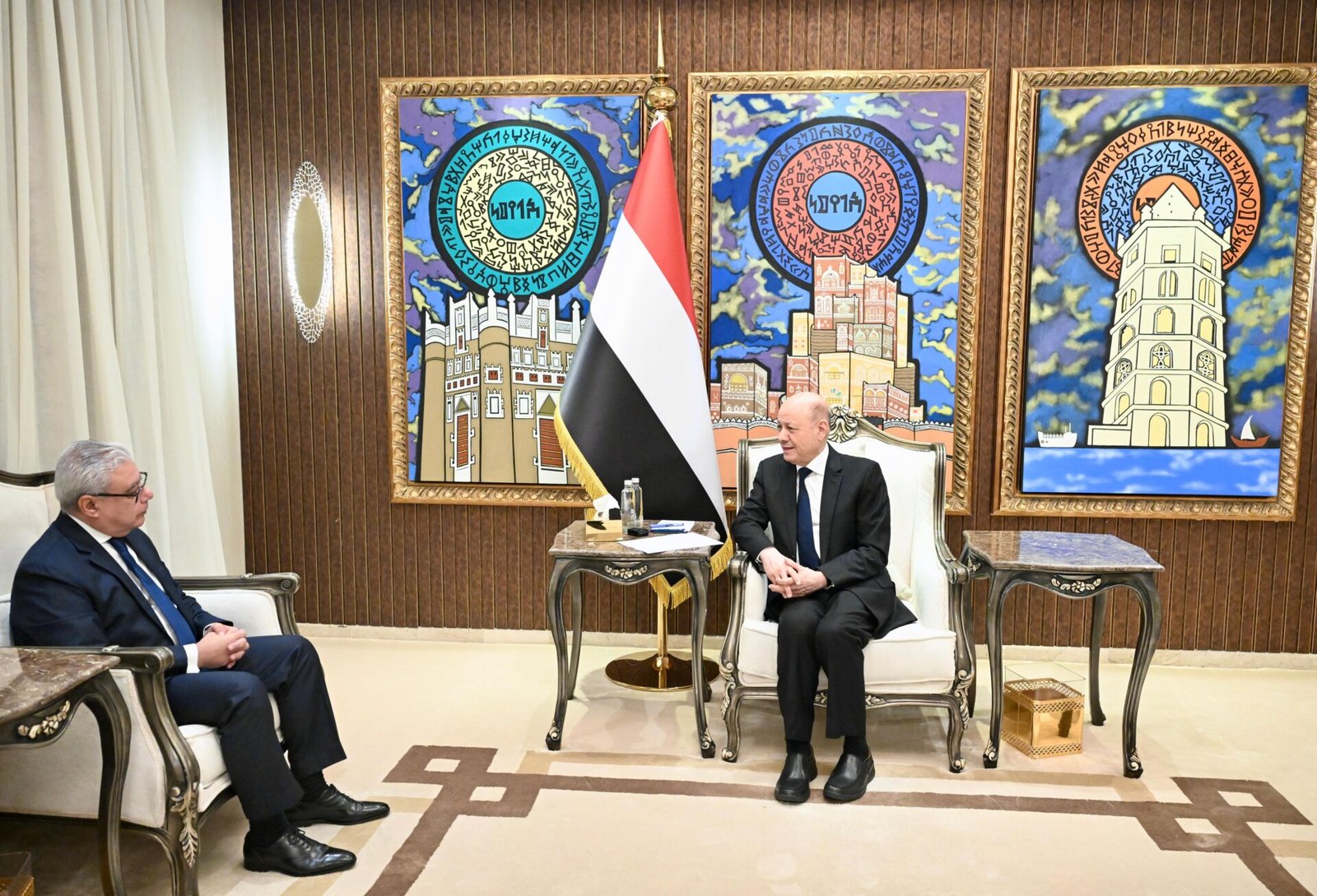
RIYADH, Saudi Arabia — Yemen’s Presidential Leadership Council chairman received Egypt’s departing ambassador on Thursday and said the security of Bab al-Mandeb is not Yemen’s concern alone.
Rashad al-Alimi met Ambassador Ihab Ahmed Abu Srie, whose tenure in Yemen has ended, the state news agency Saba reported.
Al-Alimi praised the ambassador’s work and wished him well in his career.
He said Egypt had stood alongside the Yemeni people and pointed to what he called Egypt’s historical role in Yemen and the region.
The two discussed the escalation on the western coast of Taiz governorate, according to the agency.
Al-Alimi said Houthi forces there were operating with expertise he linked to Iran’s Revolutionary Guard and allied groups.
Iran denies arming or directing the Houthis. The group rejects the characterisation and describes its operations as its own.
Al-Alimi said any attempt to change the military situation near Bab al-Mandeb could not be treated as a Yemeni matter alone.
He said the strait is an international passage and that a threat to it reaches the Red Sea, the Suez Canal and global trade.
Protecting the Yemeni coast and restoring state control over land, ports and territorial waters is a shared Yemeni, Egyptian, Arab and international interest, he said.
The account of the meeting rests on Saba, the state news agency of Yemen’s internationally recognised government. Yemen Herald found no independent report of the exchange and no comment from the Egyptian embassy.
Bab al-Mandeb separates Yemen from Djibouti and Eritrea and narrows to about 30 kilometres. Traffic through it feeds the Red Sea approach to the canal.
Egypt has a direct financial stake in that traffic.
Suez Canal revenue fell to about 4 billion dollars in 2024 from 10.3 billion dollars in 2023, the Suez Canal Authority reported, a drop of more than 60 percent.
The number of ships transiting fell to 13,213 in 2024 from more than 26,000 the previous year.
The decline followed Houthi attacks on merchant shipping that began in late 2023 and pushed many operators onto the longer route around southern Africa.
Canal traffic showed partial recovery late last year. Revenue in dollars rose about 17 percent year on year in October 2025 and vessel numbers rose about 16 percent, according to Suez Canal Authority figures.
Shipping through the Suez route carried roughly 12 percent of global trade before the attacks began, by industry and International Monetary Fund estimates.
The Red Sea coast of Taiz governorate includes the port of Mocha, held since 2018 by forces under Tariq Saleh, a member of the Presidential Leadership Council.
Al-Alimi chaired a meeting of the National Defence Council the same day.
Saba said council members Sultan al-Aradah, Abdulrahman al-Muharrami, Abdullah al-Alimi, Othman Mujalli, Mahmoud al-Subaihi and Salem al-Khanbashi attended. Tariq Saleh was absent with an excuse.
The Presidential Leadership Council was formed in April 2022, when President Abd Rabbu Mansour Hadi transferred his powers to the eight-member body.
Al-Alimi, a former interior minister and academic, has chaired it since.
The council and much of the cabinet operate from Aden and from the Saudi capital.
Fighting between Houthi forces and government units has intensified over recent weeks, ending a truce that had largely held for four years.
Houthi forces struck targets inside southern Saudi Arabia on Sept. 8. Saudi officials said more than 70 people were wounded and fires broke out at oil and utility sites in Abha, Jazan, Najran and Khamis Mushait.
The Saudi-led coalition said Houthi missiles and drones had targeted Khamis Mushait, Abha and Jazan. Royal Saudi Air Force Col. Turki al-Malki said the coalition would take what he called all necessary operational measures to deter the group.
The Security Council met on Yemen on Thursday at the request of Britain and Bahrain.
Britain’s deputy permanent representative, Kate Foster, told the session that the Houthis bear full responsibility for the escalation.
The International Organization for Migration has recorded 30,378 people displaced inside Yemen this year.
The United Nations humanitarian plan for Yemen, published in March, put the number of people needing assistance at more than 22 million and the number facing acute food insecurity at 18.3 million.
It counted 5.2 million internally displaced people and more than 2.2 million acutely malnourished children under five, of whom 516,157 were severely malnourished. The plan sought 2.16 billion dollars to reach 12 million people.
United Nations special envoy Hans Grundberg said the strikes on Saudi Arabia risk widening the conflict beyond Yemen’s borders.
Egypt joined the Saudi-led coalition that intervened in Yemen in 2015, contributing naval units to operations in the Red Sea.
Cairo has kept diplomatic relations with the internationally recognised government throughout the war, and has hosted Yemeni students, patients and officials in large numbers.
Yemen’s charge d’affaires in Cairo raised student and detainee cases with Egyptian officials on Sept. 2.
Egypt has not published its own account of Thursday’s farewell call.
Most foreign missions accredited to Yemen have operated from Riyadh since embassies left Sanaa.
Saba did not name a successor, and did not say whether the post would be filled from Riyadh or Cairo.
It did not say when the new ambassador would present credentials.
About the Author