Spain condemns Houthi attacks on Yemeni government forces and Saudi sites
 Yemen Herald News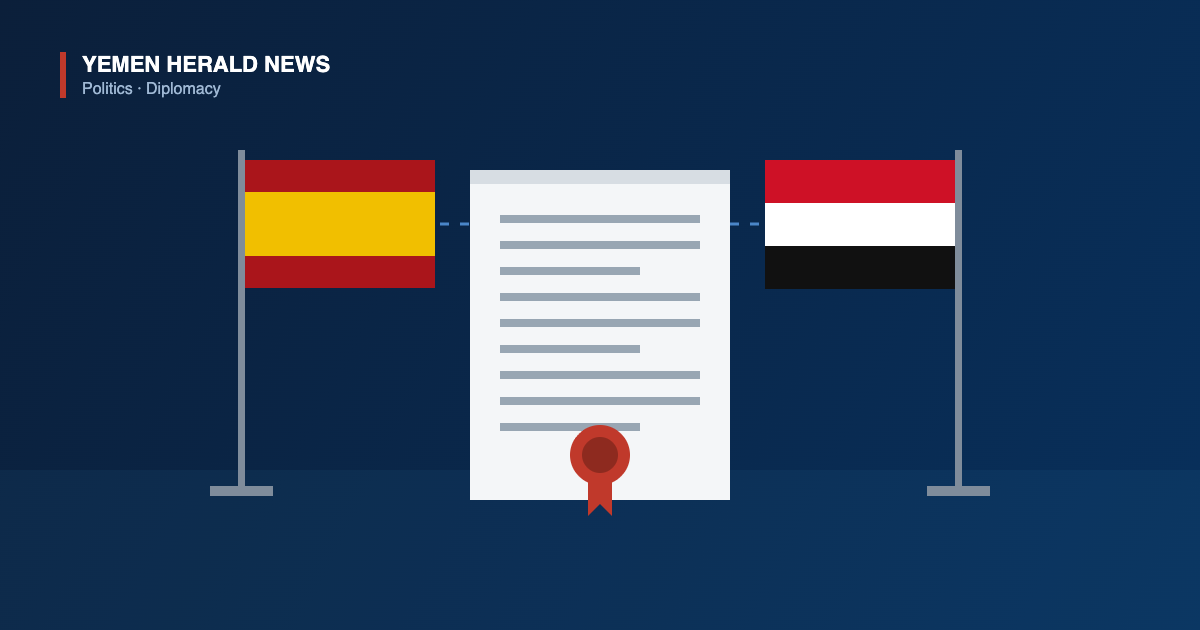
MADRID, Spain — Spain’s government condemned Houthi attacks on Yemeni government forces and on civilian infrastructure in Saudi Arabia, its foreign ministry said in a statement on Tuesday.
The ministry called the attacks indiscriminate. It said they struck troops of Yemen’s internationally recognised government and civilian sites in several locations across Saudi Arabia.
Spain extended wishes for a speedy recovery to those wounded. It expressed solidarity with the Yemeni and Saudi governments.
The statement said Spain was deeply concerned by the spread of regional instability it attributed to the Houthis. That instability threatened Saudi sovereignty and territorial integrity, the ministry said, as well as freedom of navigation in the Red Sea.
Spain also addressed what it described as a resurgence of violence inside Yemen.
It said it supported the Presidential Leadership Council, the body heading the internationally recognised government, in its efforts to keep the country stable. The ministry said attempts to interfere in Yemen’s internal affairs violated Security Council resolution 2216.
That resolution was adopted in April 2015. It imposed an arms embargo on Houthi leaders and demanded the group withdraw from territory it had seized, including Sanaa. European governments continue to cite it when they address the war.
This account rests on the text published by Spain’s foreign ministry. Yemen Herald found no independent confirmation of the statement’s contents.
The statement followed missile and drone attacks on southwestern Saudi Arabia. The Saudi-led coalition said the attacks wounded 73 people.
Saudi authorities said fires broke out at energy facilities and that operations were disrupted. Targets included Abha, Najran, Jizan and Khamis Mushait, according to Saudi statements and international news reports.
The Houthis said the attacks answered Saudi military operations in Yemen.
Other governments responded within hours. Egypt called the attacks a dangerous escalation. Jordan and the United Arab Emirates said the barrage violated Saudi sovereignty. The Arab Parliament issued its own condemnation.
The European Union’s diplomatic service released a separate statement through its spokesperson. The United Kingdom and the Netherlands have since issued similar statements.
US Secretary of State Marco Rubio said the Houthis were acting for Iran. “The Houthis, in many ways, are agents and proxies of the Iranians,” he told reporters.
Iran’s foreign ministry spokesman, Esmaeil Baghaei, rejected that account. He said the Houthis act independently of Tehran.
Hans Grundberg, the United Nations special envoy for Yemen, said the attacks risked widening the war. The Security Council met in an emergency session on the escalation.
The fighting has continued since. The Houthis said Saudi warplanes carried out dozens of strikes on provinces they control in the days that followed. Saudi Arabia has not publicly addressed those figures.
Al Jazeera reported that more than 40 Saudi strikes hit Taiz and Hodeidah, and that the toll from the fighting had passed 500. Yemen Herald could not independently verify that figure.
The International Organization for Migration said nearly 20,000 people had fled fighting near the Red Sea coast.
A truce brokered by the United Nations took effect in April 2022 and halted most cross-border exchanges between the Houthis and Saudi Arabia. It formally lapsed that October, though attacks on Saudi territory stayed rare until this week.
Saudi Arabia and the Houthis held direct talks in 2023 and 2024 on a roadmap to end the war. No agreement was signed.
Freedom of navigation in the Red Sea runs through most European statements on Yemen. Houthi forces began attacking merchant shipping in the corridor in late 2023. Traffic through the Bab al-Mandab strait fell sharply in the months that followed, and much of it has not returned.
Spain has stayed out of the naval operations mounted in response to the Houthi campaign against shipping. It declined to join the US-led Operation Prosperity Guardian in December 2023 and did not contribute ships to the European Union’s Operation Aspides, launched in February 2024.
Spanish officials said at the time that Madrid would act only through NATO or EU-coordinated missions. Spain has long supplied vessels to Operation Atalanta, the European Union’s counter-piracy mission off Somalia.
The Presidential Leadership Council was formed in April 2022, when Abdrabbuh Mansour Hadi transferred his powers to it. Rashad al-Alimi chairs the eight-member body, which sits in Aden.
Spain and Yemen have kept up contact through the escalation. Yemen’s foreign ministry said Foreign Minister Afrah al-Zouba discussed Red Sea security with Spain’s ambassador last week.
It said separately that Yemen’s ambassador briefed a Spanish foreign ministry official on the Houthi escalation and on shipping security.
Yemen’s foreign ministry condemned the attacks on Saudi Arabia and called for international action. It has said the Houthis are trying to widen the fighting beyond Yemen’s borders.
The United Nations says more than 22 million people in Yemen need humanitarian assistance. Its plan for 2026 put the number of acutely food insecure at 18.3 million and sought 2.16 billion dollars to reach 12 million people.
The same plan counted 5.2 million people displaced inside the country before the latest fighting. It recorded more than 2.2 million children under five as acutely malnourished, 516,157 of them severely.
Spain’s statement announced no new measures. It did not mention aid, sanctions or any change to Spain’s diplomatic presence, and carried no attribution to a named official.
About the Author