Yemen’s air force says it struck weapons convoys on Al-Sittin Road north of Taiz
 Yemen Herald News
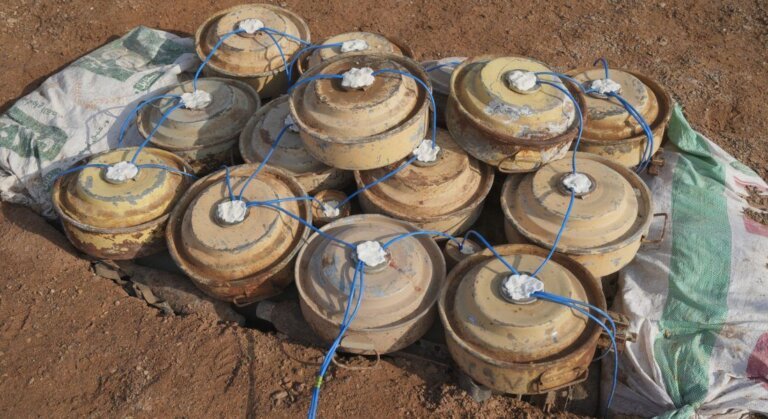
TAIZ, Yemen — Yemen’s air force struck trucks carrying weapons and ammunition on Al-Sittin Road north of Taiz on Saturday, military sources told the Defence Ministry-affiliated outlet September Net.
The sources said the strikes hit dozens of trucks and vehicles loaded with weapons, ammunition, missiles and military equipment.
The convoy was moving toward Sanaa through districts the Houthis control in Taiz province, the same sources said.
No casualty figure was given.
The account rests on September Net, which is run by the Yemeni armed forces, and on the military sources it cited. Yemen Herald found no independent confirmation of the strikes or of any damage, and the Houthi movement has not responded.
Al Jazeera reported on Sunday that Houthi military build-ups in Taiz had been hit in air attacks. It gave no detail on the Al Sittin Road convoy.
Al-Sittin Road, also rendered as Sixtieth Street, is one of the main routes running north out of Taiz city.
The strikes follow a week of similar claims from government forces around the province.
A military source in the Taiz Military Axis said on Sept. 7 that the air force had destroyed more than 21 military vehicles carrying fighters and equipment, including 23mm guns, as they moved to reinforce Houthi positions west of the city, September Net reported.
The Taiz Military Axis said separately in a statement on Facebook that army shelling had hit Houthi gatherings and reinforcements on the city’s northern front.
The statement gave no figures and did not identify the units it said were hit.
Yemen Herald could not verify either claim. The Houthis dispute government accounts of their losses and publish their own battlefield footage through the Ansarullah Media Centre, which released video of fighting in the area on Sept. 12.
The exchanges run in both directions.
Yemen’s Defence Ministry said Houthi mortar fire damaged homes in Taiz, with six shells landing on villages in the Al-Ashmalah area west of the city, September Net reported, citing unnamed local sources.
The shelling caused panic among residents, particularly women and children, the report said. No casualties were reported.
The government-aligned National Resistance Forces said the Houthis had launched new attacks on Mokha using ballistic missiles and drones.
Government forces have also reported strikes farther west. September Net said on Sept. 9 that the air force hit Houthi positions in western Taiz.
Fighting across the province has intensified since early September.
The Houthis opened a large-scale offensive on Sept. 4 against government forces in western Taiz governorate and the Hayis district of Hodeidah, using heavy weapons, drones and large numbers of fighters, the International Crisis Group said.
They have since advanced on Mocha and al-Waziyah and over stretches of the mountain chain that overlooks the Red Sea, according to Al Jazeera.
Mocha lies on the Red Sea coast, north of the Bab al-Mandab Strait.
On the coast, a local government official said the Houthis had taken full control of Mayyun Island, at the mouth of the strait.
Rajeh Badi, Yemen’s ambassador to Qatar, told Al Jazeera on Sept. 9 that the government had responded by opening fronts in al-Jawf, Marib and al-Bayda.
He described the Houthi push as an attempt to seize commanding ground over Red Sea shipping lanes. The Houthis reject that characterisation and present the offensive as a response to what they call continued aggression.
Hans Grundberg, the UN special envoy for Yemen, warned on Sept. 7 of grave consequences for civilians from the escalation and called on the warring parties to prevent further fighting.
The fighting has drawn in Saudi Arabia.
Maj. Gen. Turki al-Maliki, spokesman for the Saudi-led coalition, said the Houthis struck Khamis Mushait, Abha and Jizan with ballistic missiles and drones on Sept. 9, Al Jazeera reported. He did not give casualty figures.
The European Union condemned the attacks on Saudi Arabia in a statement on Sept. 8, saying they had injured 73 civilians, including women and children, and targeted civilian and economic infrastructure in the south of the kingdom.
The bloc called on the Houthis to end all attacks inside and outside Yemen, including against commercial shipping in the Red Sea, and to comply with Security Council Resolutions 2722 and 2826.
The EU’s naval mission in the Red Sea, Operation Aspides, had its mandate extended to Feb. 28, 2027. Requests from commercial vessels for protection rose 39% between February and August, the mission said.
The fighting has displaced tens of thousands.
The International Organization for Migration said at least 76,000 people have fled fighting in Yemen since July.
Yemen has seen a relative lull since April 2022 in a war that began nearly 12 years ago between government forces and the Houthis, who have held Sanaa since September 2014.
Fighting has resumed in recent weeks in Marib, al-Jawf, al-Dhalea and Taiz.
Taiz, Yemen’s third-largest city, has been partly encircled by Houthi forces for most of the war, with supply routes into the city repeatedly cut.
The UN humanitarian office said in its March 2026 plan that more than 22 million Yemenis need assistance and 18.3 million are acutely food insecure.
It put the number of internally displaced at 5.2 million and sought USD 2.16 billion to reach 12 million people.
More than 2.2 million children under five are acutely malnourished, the plan said, 516,157 of them severely.
September Net is affiliated with Yemen’s Defence Ministry and publishes in Arabic and English.
About the Author