Planning Minister Mohammed al-Faqmi and IOM chief call for more humanitarian funding
 Yemen Herald News
ADEN, Yemen — Yemen’s planning minister and the head of the International Organization for Migration’s mission in the country called for more international humanitarian funding, the state news agency Saba reported Monday.
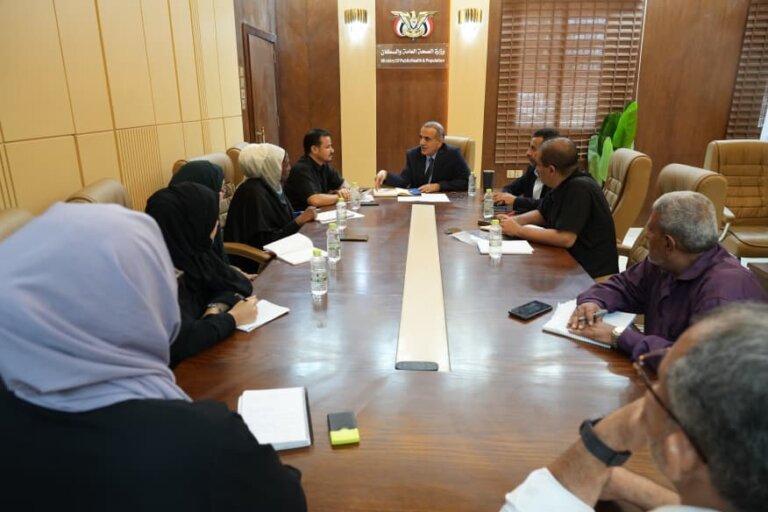
Minister of Planning and International Cooperation Mohammed al-Faqmi met Abdusattor Esoev, the IOM’s chief of mission in Yemen, Saba said.
Saba rendered the IOM official’s name as Abdul Sattar Isouyf. The organisation itself spells it Abdusattor Esoev.
The two discussed the humanitarian situation and the displacement needs created by the fighting, according to the agency.
Saba attributed that displacement to what it called Houthi militia escalation. That wording is the government’s own characterisation of the conflict.
The meeting reviewed urgent needs for food, shelter, water, sanitation and healthcare, particularly for the injured, the agency said.
Al-Faqmi said aid should be directed according to actual needs and coordinated with government authorities so that it reaches people who need it, according to Saba.
Both sides called for stronger coordination and additional international funding to sustain assistance for displaced and affected communities.
The account rests on Saba, which is run by the internationally recognised government. Yemen Herald found no independent report of the meeting, and the IOM has not published an account of its own.
Al-Faqmi took the constitutional oath before the chairman of the Presidential Leadership Council this month, according to the Yemeni news site Yemen Monitor.
His ministry works from Aden, the seat of the internationally recognised government.
The IOM runs a displacement tracking programme in Yemen that it has operated in cooperation with the planning ministry.
The IOM has published a running count of displacement since the fighting escalated.
It said on Sept. 11 that at least 46,000 people had been displaced in south-western Yemen, and called the rise alarming.
The following day it put the figure at more than 76,000, counting displacement since July.
By Sept. 13 it said the total had passed 85,000 and that about 2,000 people had crossed into Djibouti.
The organisation said separately that 1,628 Ethiopian migrants returned from Yemen to Djibouti in August.
Yemen sits on a migration route used by people travelling from the Horn of Africa toward Gulf states.
The displacement followed an offensive Houthi forces began on Sept. 3, according to Al Jazeera.
They captured the Red Sea port of Mocha on Sept. 10.
They reached Mayyun island, also known as Perim, the following day as government forces withdrew, international news organisations reported.
The advance gave the group control of Yemen’s Red Sea coastline and positions commanding the Bab al-Mandab Strait.
Bab al-Mandab links the Red Sea and the Gulf of Aden on the route to the Suez Canal.
Mocha lies on Yemen’s Red Sea coast, north of the strait.
Houthi military spokesman Yahya Saree said on Sept. 11 that navigation through the strait was safe for all companies except Saudi ships, which he said had already been banned.
Saudi Arabia has carried out airstrikes in Yemen during the offensive, including at Mocha airport, international news organisations reported.
The United Nations reported on Sept. 11 that hospitals were receiving an influx of trauma patients, and that emergency and surgical units faced rising demand.
Yemen’s human rights ministry said Monday that a preliminary count recorded 150 civilians killed and more than 200 wounded in what it called Houthi violations since Sept. 3, Saba reported.
Those figures come from one party to the conflict and have not been independently confirmed.
UN special envoy Hans Grundberg condemned Houthi strikes on Saudi Arabia as the Security Council held an emergency session on Sept. 11.
European Commission President Ursula von der Leyen condemned the attack on Saudi Arabia, Saba reported.
The Coalition to Support Legitimacy in Yemen said attacks on Saudi Arabia this month wounded 73 civilians.
Saudi Civil Defence said a Houthi projectile wounded two people and damaged a mosque in the Jazan region on Saturday.
Foreign Minister Afrah al-Zouba asked the UN human rights chief to document Houthi violations, Saba reported.
Yemen’s cabinet approved relief measures for families displaced by the advance, Saba reported on Sept. 13.
Prime Minister Shaya al-Zindani received the governor of Hodeidah on Monday and said restoring full state authority was a fixed national goal, Saba said.
President Rashad al-Alimi instructed officials to double relief efforts in calls on Sunday with members of the Presidential Leadership Council and Prime Minister Shaya al-Zindani, according to Saba.
The UN Office for the Coordination of Humanitarian Affairs said in the humanitarian needs and response plan it published in March that more than 22 million people in Yemen need assistance.
It put the number of acutely food insecure people at 18.3 million.
More than 2.2 million children under five are acutely malnourished, OCHA said, including 516,157 with severe acute malnutrition.
The plan recorded 5.2 million internally displaced people, a total that predates the current offensive.
OCHA sought $2.16 billion this year to reach 12 million people.
The World Health Organization issued a separate health emergency appeal for Yemen for 2026.
The ministry did not give a date for further talks with the organisation.
Saba did not say whether the two men discussed a figure for the additional funding they sought.
About the Author