Shura Council chairman bin Daghr discusses Bab al-Mandab escalation with French ambassador
 Yemen Herald News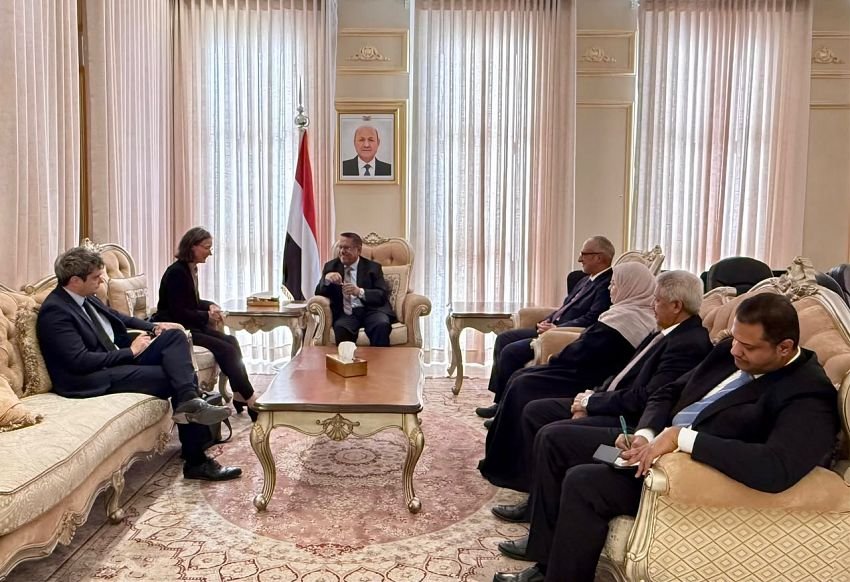
ADEN, Yemen — Shura Council chairman Ahmed Obaid bin Daghr discussed the Houthi advance along Yemen’s western coast with French ambassador Catherine Corm-Kammoun in Aden on Tuesday.
The two reviewed developments in Mokha and around the Bab al-Mandab Strait, and what they mean for security in Yemen and the wider region, the state news agency Saba reported.
Bin Daghr said Houthi control of those areas would give the group a greater capacity to threaten international shipping lanes, according to the agency. He said the strait could be used as a tool for pressure and blackmail.
Commercial shipping and the security of maritime routes were at risk, he said, along with the flow of global trade.
Corm-Kammoun reaffirmed France’s support for efforts to reach peace and stability in Yemen, Saba said.
She stressed the importance of protecting international shipping and freedom of trade in the Red Sea and Bab al-Mandab, and rejected any threat directed at commercial vessels.
France was ready to keep backing international efforts toward a political settlement, she said.
Saba is the state news agency of the internationally recognised government, and the account of the meeting rests on its report. No independent confirmation has been published.
France holds the presidency of the UN Security Council for September. It called for the emergency session the Council held in New York on Tuesday on Houthi control of Yemen’s Red Sea coast.
Bahrain, Denmark, Greece, Latvia and the United Kingdom joined France in requesting that meeting, diplomatic sources told Arab News.
Yemen’s representative told the Council the escalation was no longer an internal matter. He described it as a threat to regional security, freedom of navigation, energy supplies and trade networks.
Houthi forces took the Red Sea port of Mokha, in western Taiz province, last week.
They also took the Hodeidah districts of Hays and al-Khawkhah, the coastal town of Dhubab, and Perim Island at the mouth of the strait.
Greater and Lesser Hanish and Zuqar Island, in the middle of the Red Sea, followed.
The group has declared a blockade on Saudi shipping and said the strait is closed to certain vessels.
The advance has run alongside attacks on Saudi Arabia. The kingdom’s East-West pipeline, which carries crude from the eastern oil fields to the Red Sea, has been shut since an attack this month.
Brent crude has traded above $100 a barrel. Saudi Arabia has leaned more heavily on its Red Sea export route since Iran closed the Strait of Hormuz in the war that began in February.
Bin Daghr condemned Houthi attacks on civilian facilities in Saudi Arabia and held the group responsible for them, Saba said. He called for what he described as a firm and deterrent international response.
The Houthis say their strikes target military and energy infrastructure. They denied a Saudi allegation this week that they sent a drone toward Mecca.
Saudi Arabia issued security alerts in parts of the country on Tuesday, including in Mecca.
The Organization of Islamic Cooperation, which represents more than 57 states, condemned the attempt and said it violated the sanctity of holy sites.
The Houthis said on Wednesday, without providing evidence, that they had shot down a Saudi-led coalition F-15 over Marib. The Associated Press said it could not verify the claim.
The response bin Daghr called for has so far stopped short of military action.
President Donald Trump said on Saturday that the Houthis “called us, and they don’t want to fight with us,” adding that the group appeared focused on Saudi Arabia.
Vice President J.D. Vance said on Monday that Washington had been in “constant contact” with the Saudis and in “direct conversations with the Houthis themselves.” He called the situation “a very fluid and dynamic thing.”
A defence pact signed in August between Saudi Arabia, Turkey and Pakistan has not been invoked. Officials from Turkey and Pakistan told The Associated Press that no Saudi request for support had been received.
The Turkish official said work to institutionalise the alliance had to be completed before the pact became operational. Both officials spoke on condition of anonymity.
Iran’s foreign minister, Abbas Araghchi, travelled to Beijing this week for talks expected to cover the conflict and shipping through the Strait of Hormuz.
Chinese President Xi Jinping offered Beijing’s help in ending the conflict at a BRICS summit in New Delhi at the weekend.
Bin Daghr praised France’s position toward Yemen and toward the Presidential Leadership Council, the eight-member body headed by Rashad al-Alimi that has governed from Aden since 2022.
He said continued international support was needed to end what he called the Houthi coup, to restore state institutions, and to preserve Yemen’s unity, sovereignty and territorial integrity.
The International Organization for Migration has said 85,818 people have fled the fighting, and that more than 2,000 have reached Djibouti.
Yemen’s planning ministry has registered 12,597 newly displaced families across six governorates.
More than 22 million people in Yemen need assistance, according to the UN humanitarian response plan published in March. It puts 18.3 million people at acute levels of food insecurity.
The plan seeks $2.16 billion to reach 12 million people this year.
Bin Daghr served as prime minister from 2016 to 2018. He has since led the Shura Council, the appointed upper chamber of Yemen’s parliament.
About the Author