Taiz water output falls to about a tenth of pre-war level as siege cuts off wellfields
 Adel Haddad
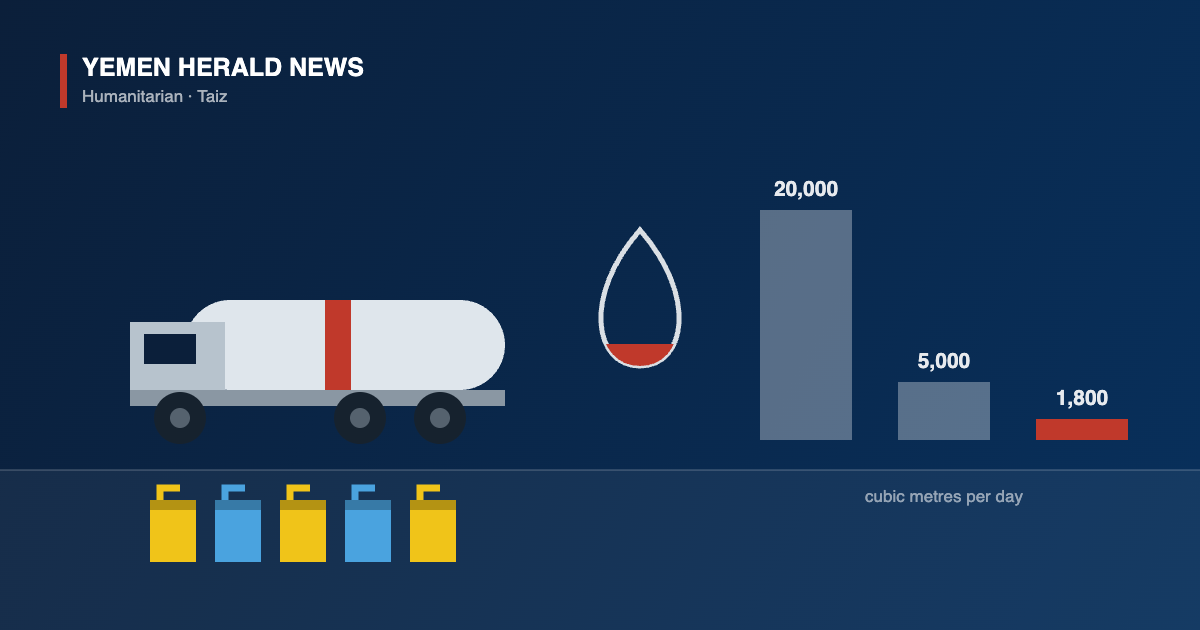
TAIZ, Yemen — Yemen’s third-largest city is producing about 1,800 cubic metres of water a day, roughly a tenth of its pre-war supply, the local water authority says.
Wafiq al-Aghbari, director-general of the Local Water and Sanitation Corporation in Taiz governorate, gave the figure to Al Jazeera on Wednesday.
He said the corporation now draws that water entirely from emergency wells inside the city.
Before 2014, Taiz received about 20,000 cubic metres a day from six wellfields, al-Aghbari said.
Only one of those lies inside the city limits. Before the war it was used only in emergencies.
By 2015 the city had lost access to all five external fields, he said. They fell under Houthi control or onto front lines.
Repairs in later years brought daily capacity back to 5,000 cubic metres, which al-Aghbari put at about 14 percent of what the city needs.
The corporation lost 3,200 cubic metres of that after Houthi forces encircled Taiz in October, he said.
Pumping stopped at the Hadhran al-Dhabab wellfield outside the city when Houthi forces seized it, costing 1,200 cubic metres a day, according to al-Aghbari.
Wells inside the city stopped for lack of diesel, costing a further 2,000.
UNICEF says water production in Taiz has nearly halved, Al Jazeera reported.
Yemen Herald could not independently verify the corporation’s production figures.
Charitable distribution points known as sabeel previously supplied up to 1.5 million litres of fresh water a day, al-Aghbari said, plus about 1 million litres of untreated water.
Fuel and water shortages have disrupted them.
The corporation has lost most of its international and local funding, he said, and is in financial crisis. He said fewer residents can afford commercial water as the economy has worsened.
One tanker owner, who did not give his name for security reasons, told Al Jazeera that prices rose at the start of the siege from 18,000 riyals a load to 30,000.
That is about $12 to about $20 at parallel market rates, by Al Jazeera’s conversion.
The same owner said Houthi inspections on the route to Hadhran al-Dhabab last for hours. He said he is sometimes held outside the city for more than a day.
Qaid al-Sharaabi, a Taiz resident, said he waited three days for a tanker of clean water.
He said he has paid double the price twice since the siege began.
Water from the emergency wells inside Taiz has long been unfit for human use, said Abdulqawi al-Shamiri, director of the city’s al-Taawun Hospital.
Much of it is contaminated or carries high salt concentrations, he said.
Al-Shamiri attributed the contamination to sewage entering the supply through poorly maintained networks, and to rubbish dumped in streets and floodwater channels.
He said Houthi forces have prevented waste from being taken to a landfill outside the city. He said residents are contracting cholera and acute diarrhoea.
An internal report by the governorate’s Cleaning and Improvement Fund, cited by Al Jazeera, found close to half the city’s rubbish going uncollected.
Figures Al Jazeera obtained from the Epidemiological Surveillance Department at Taiz’s Public Health and Population Office recorded 5,642 cases across three disease categories in the latest four-week reporting period.
They included 5,228 cases of acute watery diarrhoea, 232 suspected dengue fever cases and 182 suspected cholera cases.
Watery diarrhoea cases fell compared with the previous period.
Yasin Abdulmalik, who directs the surveillance department, said that decline likely reflects how hard it has become for residents to reach health facilities.
Taysir al-Samiei, a health communications official at the same office, said patients’ ability to reach hospitals fell 60 to 70 percent by the end of the siege’s second week.
The UN Office for the Coordination of Humanitarian Affairs reported on Nov. 2 that nearly a quarter of a million people had lost access to essential healthcare for want of supplies.
That included more than 186,000 children under five and 23,000 pregnant women, OCHA said.
Twelve hospitals were at risk of closing, according to the office, which also recorded more than 1,400 cases of acute diarrhoea and suspected cholera in a single week.
Cholera spreads mainly through contaminated water.
OCHA said all roads into the city were closed by the fighting and no commercial supplies were getting through.
The Houthis deny responsibility for the road closures and say government forces are to blame.
Human Rights Watch said on Oct. 29 that the siege may amount to the war crime of using starvation as a method of warfare.
The group said residents, aid workers and UN officials blamed the Houthis for the shortages.
The World Food Programme said on Oct. 14 that it could not reach more than 600,000 people in Taiz who depend on humanitarian aid.
The agency said most districts of the governorate are classified as facing emergency levels of hunger.
Yemen’s government says the siege affects nearly two million people.
The UN humanitarian response plan published in March put more than 22 million Yemenis in need of assistance and 18.3 million acutely food insecure.
OCHA said nearly 300,000 people had been forced from their homes nationwide since the beginning of August, on top of 5.2 million already displaced.
Houthi forces tightened their hold on Taiz in early October after advances in the surrounding countryside, al-Aghbari said.
The group first besieged the city in 2015, a year after the war began. Al-Aghbari said the water crisis dates to that siege.
About the Author