Qatar Condemns Iranian Strikes on Energy Facilities in Saudi Arabia and the UAE
 Yemen Herald News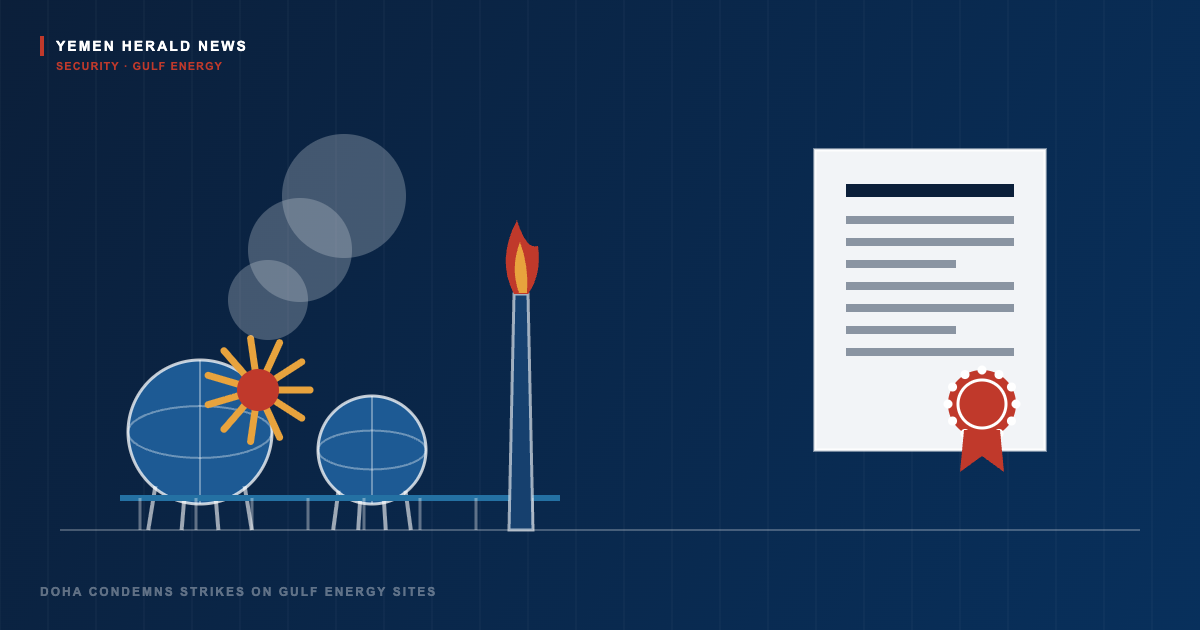
Qatar condemned in the strongest terms the Iranian targeting of energy facilities in Saudi Arabia and the United Arab Emirates, in a statement issued by its Ministry of Foreign Affairs in Doha on 19 March 2026 covering attacks over the preceding two days.
The ministry described the strikes as a blatant violation of international law and a serious threat to global energy security, to navigation and to the environment. It called Iran’s actions brutal attacks that had crossed all red lines by targeting civilians, civilian objects and vital facilities, and it pressed for urgent measures to prevent further escalation. Qatar urged de-escalation to restore security and stability regionally and internationally, and called for a collective response.
The attacks the statement referred to struck several of the region’s largest hydrocarbon installations. In Saudi Arabia, the Samref refinery and the Jubail petrochemical complex were among the targets. In the United Arab Emirates, the Al Hosn gasfield was hit, and operations were suspended at the Habshan gas facility after debris fell on the site following the successful interception of an incoming missile.
The condemnation carried added weight because of what had happened to Qatar itself the day before. On 18 March, Iranian missiles struck Ras Laffan Industrial City, the country’s principal gas facility, causing what Qatari authorities described as significant damage and starting a fire. Doha was therefore not commenting on its neighbours’ misfortune from a position of safety, but responding to a campaign that had already reached its own most important industrial site.
Qatar also took a step that went beyond declaratory language, declaring the Iranian embassy’s military and security attaches persona non grata and requiring them to leave the country within 24 hours. For a government that had spent years maintaining functional relations with Tehran, that was a pointed measure.
Qatar’s relationship with Iran has long been more complicated than that of most of its neighbours. The two states share the world’s largest known natural gas reservoir, known as the North Field on the Qatari side and South Pars on the Iranian side, a geological fact that has obliged a degree of practical cooperation regardless of political conditions. Doha maintained working ties with Tehran through the 2017 to 2021 rift with its Gulf neighbours, when Iranian airspace and supply routes helped it absorb the blockade. Qatar simultaneously hosts Al Udeid Air Base, the largest United States military installation in the region.
That balancing act is what made the March statement notable. Condemning Iran in this language, and expelling its military attaches, marked a sharper position than Doha had generally taken, and it followed directly from an attack on Qatari soil rather than from alignment with any bloc.
The reference to the environment in the ministry’s statement was not decorative. Strikes on refineries, gas processing plants and petrochemical complexes risk sustained fires, the release of sour gas and hydrocarbon spills, and the consequences are not contained by borders. The Gulf is a shallow, largely enclosed sea whose waters are also the source of much of the region’s desalinated drinking water, which makes large spills or contamination events a direct threat to civilian water supply in several states at once.
Gas plants are also hard to restart. A damaged separation train or compression unit cannot simply be patched and switched back on; operators must purge lines, verify pressure integrity and recommission equipment in sequence, work that takes weeks even where the damage looks modest. The suspension at Habshan made the point: the site was not destroyed, but production stopped anyway.
The commercial stakes are equally broad. The Gulf’s processing and export facilities handle a substantial share of the world’s liquefied natural gas and crude oil, and Ras Laffan in particular is the hub through which Qatari LNG reaches Asian and European buyers. Damage or the perception of risk at such sites feeds quickly into freight rates, war risk insurance premiums and forward energy prices, costs borne well beyond the countries actually attacked.
The energy strikes were part of a wider campaign that began on 28 February 2026, when the United States and Israel started military operations against Iran and Tehran responded with missile and drone salvoes across the region. Bahrain’s Defence Force reported intercepting scores of missiles and hundreds of drones in the campaign’s opening weeks. Kuwait reported strikes on its international airport, including damage to the airport’s radar system, and later on two of its ports. Jordan reported intercepting missiles crossing its territory. The common thread was pressure on energy, transport and logistics infrastructure.
Qatar’s statement was one of many. Reporting at the time recorded a joint condemnation issued by a group of Arab and Islamic states, and individual statements from Gulf governments using closely similar legal language about violations of international law and threats to civilian infrastructure. Tehran has generally declined to confirm individual strikes, and attribution in most cases rested on the accounts of the governments concerned.
For Yemen, the episode carried a familiar warning. Attacks on oil and gas infrastructure have been a recurring feature of the country’s own war since 2015, with strikes on export terminals halting crude shipments and depriving the government of its main source of foreign currency. The Gulf campaign of 2026 demonstrated on a larger scale what Yemen had already experienced: that energy installations are among the most economically consequential targets available, and among the hardest to defend.
About the Author