UAE Condemns Attack on Qatar’s Ras Laffan and Declares Full Solidarity with Doha
 Yemen Herald News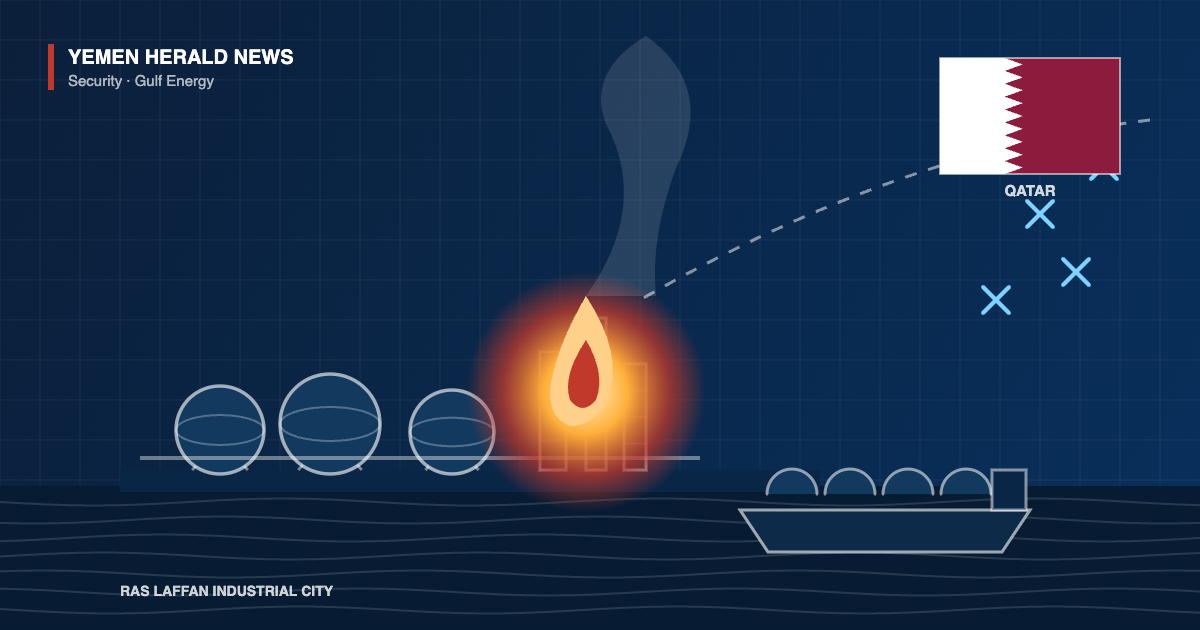
The United Arab Emirates condemned the attack on Qatar’s Ras Laffan Industrial City in March 2026, calling it a dangerous escalation and a violation of international law, and declaring its full solidarity with Doha. The statement was issued by Sheikh Abdullah bin Zayed Al Nahyan, the UAE’s Deputy Prime Minister and Minister of Foreign Affairs, a day after the strike, and formed part of a broader wave of condemnation from Gulf capitals.
According to Qatar’s own account at the time, the attack took place on 18 March 2026, when Iranian forces launched five ballistic missiles towards the country. Qatari air defences intercepted four of them. The fifth came down inside Ras Laffan Industrial City, starting a fire and causing what Doha described as significant damage. Qatar’s foreign ministry called the strike a flagrant violation of its sovereignty and a direct threat to its national security and to regional stability.
In his statement, Sheikh Abdullah said such attacks constituted a dangerous escalation and a breach of international law. He affirmed the UAE’s full solidarity with Qatar and its support for all measures Doha took to safeguard its security, protect its citizens and residents, and preserve its stability. The language was notably unqualified, reflecting how far Gulf states had converged in their public positions as the confrontation with Iran widened.
Sheikh Abdullah also placed the strike in a category beyond a bilateral dispute. An attack on industrial infrastructure of this kind, he said, represented a direct threat to global energy security as well as to the security and stability of the region and its people, and carried serious environmental and humanitarian repercussions. That framing pointed to why the incident drew attention well outside the Gulf.
Ras Laffan is not an ordinary industrial estate. It is the centre of Qatar’s liquefied natural gas industry, the point from which the country exports the product that made it one of the largest LNG suppliers in the world. The site combines gas processing trains, storage, and port facilities that load carriers bound for Asia and Europe. Damage there does not stay local; it registers in energy markets and in the supply plans of importing countries thousands of miles away.
The consequences reported at the time bore that out. Assessments circulated after the strike indicated that Qatar’s LNG export capacity would be reduced by close to 17 per cent, and that the shortfall could persist for between three and five years while repairs and replacement work were carried out. For buyers with long-term contracts, a reduction on that scale and over that horizon is not a temporary inconvenience but a structural change in supply.
The environmental and humanitarian concerns Sheikh Abdullah raised also followed from the nature of the target. Fires at gas processing facilities carry risks to workers on site, to air quality in surrounding areas and to the marine environment around the loading terminals. Industrial sites of this kind concentrate hazardous processes in a small area, which is why strikes against them are treated differently in diplomatic language from attacks on other categories of target.
The condemnation did not come from a detached observer. The UAE had itself been struck during the same period, and Sheikh Abdullah had spent the preceding days holding calls with foreign ministers and other officials about the consequences of missile attacks on Emirati territory and on neighbouring states. Abu Dhabi was therefore responding both as an ally of Qatar and as a country dealing with the same threat to its own infrastructure and population.
That shared exposure shaped the diplomacy. Gulf states that had spent earlier years in open political disagreement — the rift that isolated Qatar from several of its neighbours ended only in 2021 — presented a united front once their energy and transport infrastructure came under fire. Solidarity statements of the kind Sheikh Abdullah issued served as signals to Tehran and to international partners that the Gulf Cooperation Council states were treating attacks on any one of them as a common problem.
The wider context was a confrontation that had already disrupted civil aviation, shipping and energy flows across the region. Airspace was closed or narrowed in several countries, air defences were engaged repeatedly, and ports and industrial facilities were placed on alert. Against that backdrop, the strike on Ras Laffan stood out because it hit a facility whose output is counted in the energy balances of distant economies.
For Yemen, the episode carried an uncomfortable resonance. The Yemeni government has argued for years that attacks on shipping and on energy infrastructure in the Red Sea and the Gulf follow a shared logic, and that vessels and terminals are being used as instruments of pressure on international commerce. The strike on a major LNG facility reinforced that argument in the eyes of officials in Aden, who have repeatedly urged international action to protect maritime and energy routes.
The UAE statement itself made no commitments beyond diplomatic support, and Sheikh Abdullah did not set out any specific measures Abu Dhabi intended to take. Its significance lay in the position it recorded: that an attack on a neighbour’s energy infrastructure would be treated as an attack on the region’s collective security, and that the UAE would back whatever steps Qatar judged necessary to protect its territory and the people living on it.
About the Author