WHO says nearly 20 million people in Yemen need health assistance
 Yemen Herald News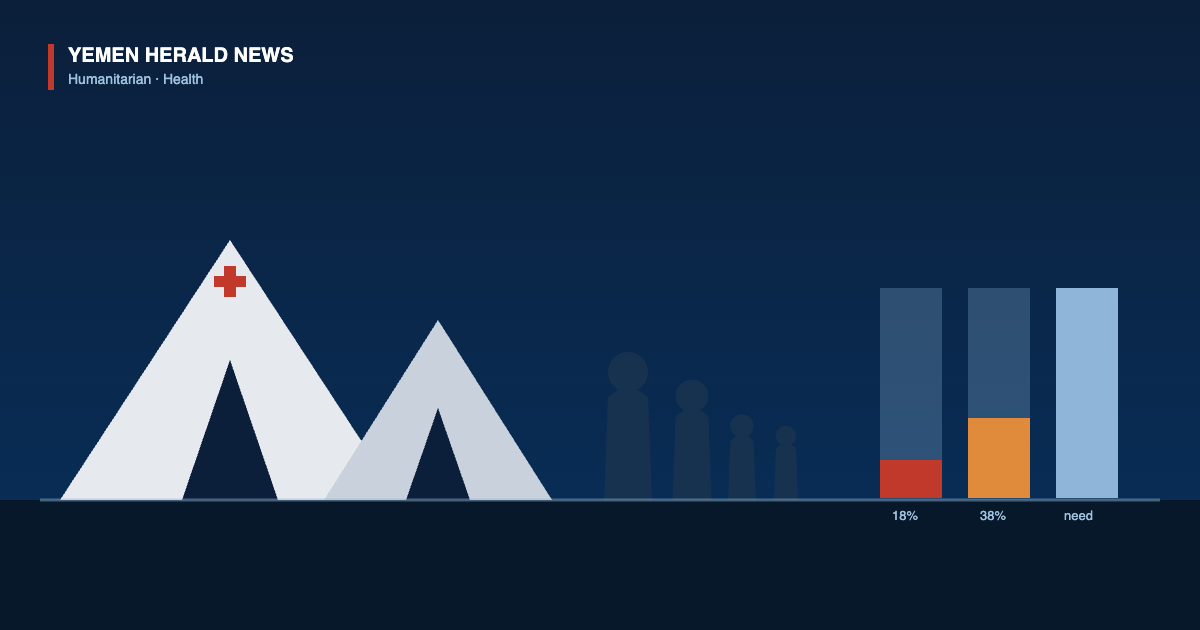
GENEVA, Switzerland — Nearly 20 million people in Yemen need health assistance and the country’s health system is being pushed closer to collapse, the World Health Organization’s director-general said Tuesday.
Tedros Adhanom Ghebreyesus said attacks on health facilities, shortages of supplies and fuel, and disruptions to referral services were driving the deterioration.
He was speaking at a WHO media briefing in Geneva.
“The recent escalation of violence is compounding an already severe health and humanitarian crisis,” Tedros said.
Fighting has caused a sharp increase in casualties and displacement, he said, placing greater strain on a system that was already under pressure.
Tedros said the risks of cholera, measles, polio, dengue and malnutrition were growing. He said displaced communities living in crowded conditions, with limited access to safe water and sanitation, faced the highest risk.
WHO is supplying Yemen’s Ministry of Health with emergency medical supplies and coordinating with partners to strengthen frontline response capacity, he said.
“Humanitarian access remains severely constrained, and funding shortfalls threaten our ability to sustain and scale up the response,” Tedros said.
He called for the protection of health workers and health facilities, safe and unhindered access for humanitarian partners, and increased international support.
The account of Yemen’s health needs given at the briefing rests on WHO’s own assessment and its own operational reporting. No independent confirmation of the agency’s current figures has been published.
WHO estimated at the start of the year that 19.3 million people in Yemen would need health assistance in 2026.
Resource constraints mean 7.3 million of them, or 38 percent, have been prioritised for the most urgent response, according to the agency.
WHO says 18 percent of the Health Cluster’s 2026 funding requirement has been covered.
The health figures sit inside a wider humanitarian caseload. The UN Office for the Coordination of Humanitarian Affairs said in its 2026 response plan, published in March, that more than 22 million people in Yemen need humanitarian assistance.
That plan put 18.3 million people in acute food insecurity.
It recorded more than 2.2 million children under five as acutely malnourished, including 516,157 with severe acute malnutrition.
OCHA counted 5.2 million internally displaced people.
Humanitarian partners appealed for $2.16 billion to reach 12 million people this year.
Of that, $1.6 billion was earmarked for prioritised life-saving interventions.
The plan counted 10.95 million women and girls among those needing assistance, along with 329,000 migrants and 63,000 refugees and asylum seekers.
Displacement has risen since the plan was written. The International Organization for Migration said 85,818 people have fled the fighting in Yemen, and that more than 2,000 have reached Djibouti.
IOM put the figure at about 76,000 earlier in the week, and at about 46,000 last week.
The UN refugee agency has appealed for $14 million for Yemen and said a camp in Djibouti is nearing capacity.
A local authority in Taiz counted 65,845 people displaced in the governorate since August.
IOM said 1,628 Ethiopian migrants returned from Yemen to Djibouti in August.
Yemen’s health minister, Qasim Buhaibeh, told Health Cluster partners this week to raise emergency readiness.
Buhaibeh asked the International Committee of the Red Cross to expand emergency and surgical support.
Planning Minister Mohammed al-Faqmi and the head of IOM called for more humanitarian funding.
Yemen’s government has asked UN agencies to expand their operations from Aden.
WHO appealed separately this year for urgent health funding for Yemen, saying the money was needed to protect millions of lives.
The agency said in a regional bulletin that Yemen’s health system was already under severe strain before the renewed fighting.
The Health Cluster is the coordination body that groups WHO with health agencies and non-governmental organisations working in Yemen.
UNICEF set out a separate 2026 humanitarian appeal for children in Yemen.
Yemen’s cabinet approved relief measures for families displaced by the fighting.
The Houthi-run Yemen Petroleum Company raised petrol and diesel prices in the areas it controls.
Foreign Minister Afrah al-Zouba asked the UN human rights chief to document Houthi violations.
The demining programme Masam said it cleared 2,166 mines and other munitions in Yemen in the first 11 months of its current phase.
Rashad al-Alimi, chairman of the Presidential Leadership Council, said government forces could regain the initiative on the western coast.
United States diplomats met Houthi representatives in Muscat, Reuters and Axios reported.
Greece and Spain each condemned Houthi attacks this month.
Yemen’s ambassador to the Czech Republic, Mohammed al-Hadhrami, asked Prague and the European Union to designate the Houthis as a terrorist group. The Houthis reject the designation and say their operations are lawful.
Brent crude traded above $108 a barrel this week, with Saudi Arabia’s East-West pipeline shut.
Tedros used the same briefing to report on the Ebola epidemic in the Democratic Republic of the Congo, where he said more than 7,200 cases and over 3,500 deaths have been recorded across seven provinces.
He said the epidemic had been contained mostly in the northeast of the country after four months.
Tedros closed the briefing by marking World Patient Safety Day, which fell on Wednesday.
WHO did not say how much of its own Yemen budget remains unfunded, or when it will next revise the 19.3 million figure.
About the Author