UN Security Council renews Yemen sanctions for a year and defers a decision on component controls
 Adel Haddad
NEW YORK, United States — The UN Security Council renewed its Yemen sanctions regime for a year on Nov. 12, dropping measures on precursor chemicals and flag-state powers during negotiations.
The Council adopted Resolution 2837 at its 10270th meeting, extending the asset freeze and travel ban first imposed under Resolution 2140 in 2014 until Nov. 14, 2027.
The mandate of the Panel of Experts that supports the sanctions committee runs until Dec. 15, 2027, according to the Council’s own meetings coverage.
All 15 members voted in favour, according to South24, an Aden-based research centre, and the Yemeni outlet Yemen Monitor.
The resolution asks the secretary-general to enlarge the Panel to six members and to add expertise in monitoring and reporting on maritime security, both outlets said.
It condemns Houthi attacks on Saudi Arabia, on commercial shipping and on civilian airports, and demands an immediate and unconditional halt to them, Yemen Monitor reported.
Member states are called on to step up action against smuggling of weapons and weapons components along land and sea routes, and to share more information in support of the arms embargo imposed by Resolution 2216 in 2015.
The text stops short of restricting the components themselves.
Instead the Council said it intends to decide by Jan. 11, 2027 on measures to prevent the supply, sale, transfer or diversion of specified materials, South24 reported.
That deferral followed Chinese objections, backed by Russia, that the Panel’s list of dual-use materials was not complete, the centre said.
References to precursor chemicals and their use in military manufacturing were deleted from a provision on the Panel’s recommendations, according to South24.
A year earlier the Council had asked for that work. Resolution 2801, adopted in November 2025, renewed the regime until Nov. 14 this year and requested the Panel to report by April 15 on the flow of dual-use components and precursor chemicals into Yemen, Security Council Report records.
The same resolution asked the Panel to advise on improving flag-state capacity to stop vessels suspected of breaching the regime from reaching Yemen.
Language on strengthening that capacity was removed from this year’s text after Russian objections, South24 said.
Russia also objected to expanding the Panel’s maritime expertise, the centre reported. That provision survived.
Russia’s chargé d’affaires to the UN, Anna Evstigneeva, said sanctions should support a political settlement rather than punish the parties, according to South24. She acknowledged the need to condemn attacks on Saudi civilian infrastructure and on navigation.
China’s representative said new measures must not affect humanitarian aid, civilians’ essential needs or legitimate commercial activity, the centre reported. South24 said earlier Panel reports had named China as a country of origin for some components, and noted that those findings do not establish Chinese government responsibility.
Negotiations also turned on what to call the Houthis.
Britain, which held the pen, circulated its first draft on Oct. 29 and revised texts on Nov. 3, 5 and 9, South24 reported.
Russia objected to reinstating wording describing the Houthis as a terrorist group, arguing it would close off political dialogue, and the phrase was taken out of the fourth draft, according to the centre.
Bahrain, supported by the United States, tried to restore it at the final stage and failed, South24 said.
The United States representative regretted that the 2022 terminology had not been restored and that the text was silent on the group’s ties to regional armed groups, including al-Shabaab, the centre reported. Yemen’s representative said members had not agreed to call the Houthis a terrorist organisation.
A provision on Houthi links to al-Shabaab was removed after objections from Russia, China, Somalia, Liberia and the Democratic Republic of the Congo, who called the wording too broad, according to South24.
Four days later Yemen’s parliament approved a domestic law designating the Houthis a terrorist organisation and criminalising their funding, the state news agency Saba reported on Nov. 16. Al Jazeera reported the same vote and said the bill was referred to Rashad al-Alimi, chairman of the Presidential Leadership Council.
One change did widen the sanctions criteria. The final text clarifies that designations may cover the arbitrary detention of UN personnel and of diplomatic and humanitarian workers, a provision Bahrain proposed with US backing, South24 reported.
At the Council’s last Yemen session before the vote, on Oct. 9, the UN special envoy, Hans Grundberg, said 72 UN staff remained in detention.
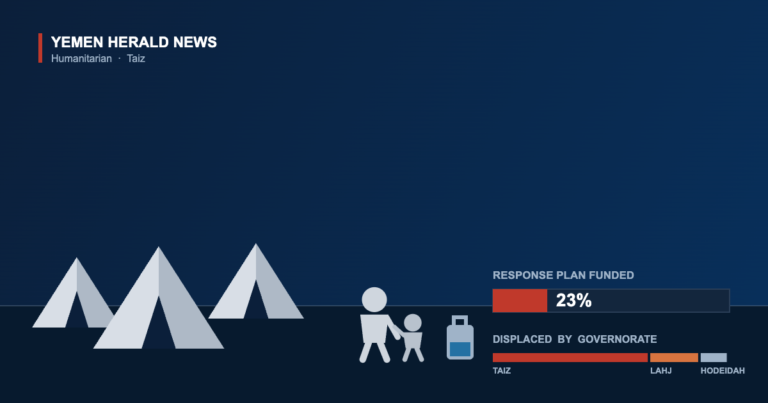
Mohamed Yahya, assistant secretary-general for humanitarian affairs, told that session more than 200,000 people had been displaced across Yemen since the start of August, the highest figure since the 2022 truce, and that the humanitarian appeal was 22 percent funded.
He said the UN human rights office had verified at least 46 civilians killed and more than 130 injured since August.
At the same session the US representative said the Council, when it renewed the regime in mid-November, must act on the Panel’s recommendations on dual-use components and precursor chemicals.
The Panel is also asked to keep tracking Houthi revenue and to recommend ways of preventing its diversion to military use without harming legitimate trade, South24 said.
France and Greece welcomed the addition of maritime expertise and monitoring of routes through the Red Sea, the Gulf of Aden and Bab al-Mandab, the centre reported.
About the Author