Hungary’s foreign ministry condemns Houthi escalation in Yemen and Saudi Arabia
 Yemen Herald News
BUDAPEST, Hungary — Hungary’s foreign ministry has condemned the military escalation by Houthi forces in Yemen and Saudi Arabia, Yemen’s state news agency Saba reported Saturday.
The ministry rejected attacks targeting civilians, civilian infrastructure and sacred sites, according to the agency.
It also rejected threats to freedom of navigation and transportation, and called for an end to the violence.
The statement expressed solidarity with the Yemeni government and with Saudi Arabia in confronting the attacks, Saba said.
The ministry warned that the escalation undermines prospects for a peaceful solution and poses further risks to regional stability and security, the agency reported.
The account rests on Saba alone. Hungary’s foreign ministry has not published the statement where it can be independently checked, and Yemen Herald found no independent confirmation of its wording.
Saba described the forces involved as an Iran-backed Houthi militia. That is the framing of Yemen’s internationally recognised government, which the agency serves. The Houthis reject the label and say they act on their own account.
The reference to sacred sites follows an episode this month that drew condemnation across the Muslim world.
The Saudi-led coalition said on 15 September that it had shot down a Houthi drone near Mecca. Turki al-Maliki, the coalition spokesman, said it was the first time in nearly a decade that the group had targeted the city.
Saudi officials called Mecca a red line.
The Houthis denied it. Yahya Saree, the group’s military spokesman, said its targets were Saudi oil facilities and military bases, and were far removed from the holy places. The group also said it had shot down a Saudi fighter jet.
The Organisation of Islamic Cooperation condemned the strike as heinous, denouncing what it described as attacks on Mecca and the Madinah region. Pakistan’s prime minister, Shehbaz Sharif, condemned it in similar terms.
The reference to navigation points to the Bab al-Mandab strait, where Houthi forces have extended their reach.
The group completed a push along Yemen’s Red Sea coastline this month and moved onto Perim Island, near the narrowest point of the strait.
A Houthi statement said maritime navigation was safe for all companies except Saudi vessels. It vowed to strike Saudi targets until what it called the aggression stopped and the blockade on Yemen was lifted.
The group reported an attack on a Saudi oil tanker in the Red Sea in August.
Oil moved above $100 a barrel during the escalation. Saudi Arabia’s energy ministry confirmed that strikes inside the kingdom had forced the shutdown of a major pipeline.
Traffic through Bab al-Mandab had become an alternative to the Strait of Hormuz for some cargoes, which is part of why the gains around the strait moved prices.
The attacks Hungary referred to began earlier in the month.
The coalition said Saudi air defences intercepted and destroyed a ballistic missile fired toward Riyadh early on Saturday, the same day Hungary’s statement was reported.
On 8 September, Houthi missile and drone attacks on the south of the kingdom wounded 73 people and started fires at oil facilities and utilities, Saudi authorities said.
The Houthi military spokesman said the operation had targeted Aramco sites at Abha, Najran and Jizan, along with an air base at Khamis Mushait.
Jazan holds a refinery with a capacity of about 400,000 barrels a day, among the kingdom’s largest.
Al-Maliki called those attacks a serious escalation and a flagrant violation of the kingdom’s sovereignty, and said Saudi Arabia would respond.
The Houthi military said the attacks answered more than 100 Saudi airstrikes in Yemen over the preceding three days, which it said had killed a large number of people. That count has not been independently confirmed.
The exchanges ended a truce that had held for four years.
The United States has ruled out a direct role in the fighting.
Other European governments have issued comparable statements. Spain’s foreign ministry condemned Houthi attacks on Yemeni government forces and on Saudi Arabia on 8 September. Turkey condemned the attacks on the kingdom.
Yemen has been working its missions in Europe since the fighting widened.
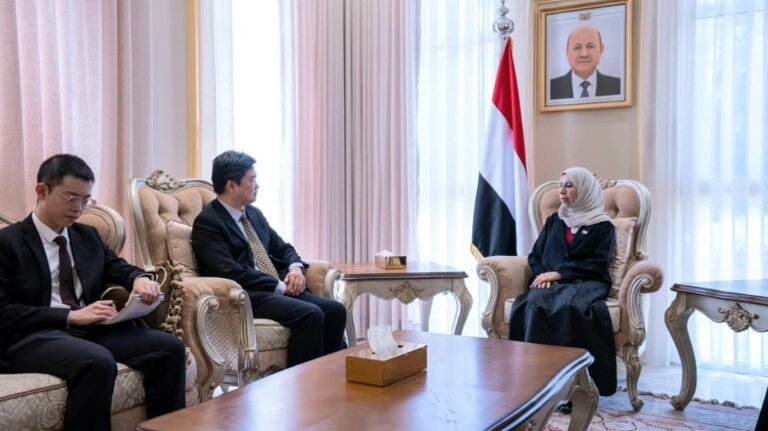
Ahmed Nagi, Yemen’s chargé d’affaires in Budapest, met János Lasztovka, who heads the Middle East and North Africa department at Hungary’s foreign ministry, on Thursday. The two discussed bilateral relations and the fighting in the Red Sea and around Bab al-Mandab, Saba reported. Nagi holds the rank of ambassador.
Members of the UN Security Council stressed this week the need for full implementation of resolution 2216 and renewed their support for the Yemeni government, according to the agency.
On the ground, Houthi forces advanced along Yemen’s western coast in early September, taking Hays and Khokha before entering Mokha.
UN agencies put the number of people displaced in the first two weeks of that fighting at about 112,000.
The United Nations humanitarian plan for 2026 counts more than 22 million people in Yemen in need of assistance, with 18.3 million acutely food insecure and more than 2.2 million children under five acutely malnourished, 516,157 of them severely. The plan lists 5.2 million internally displaced people and seeks $2.16 billion to reach 12 million of them.
Hungary is a member of the European Union.
Yemen’s mission in Budapest is headed by a chargé d’affaires rather than a resident ambassador.
About the Author