Houthis say they attacked Riyadh and an Aramco site in Yanbu
 Yemen Herald News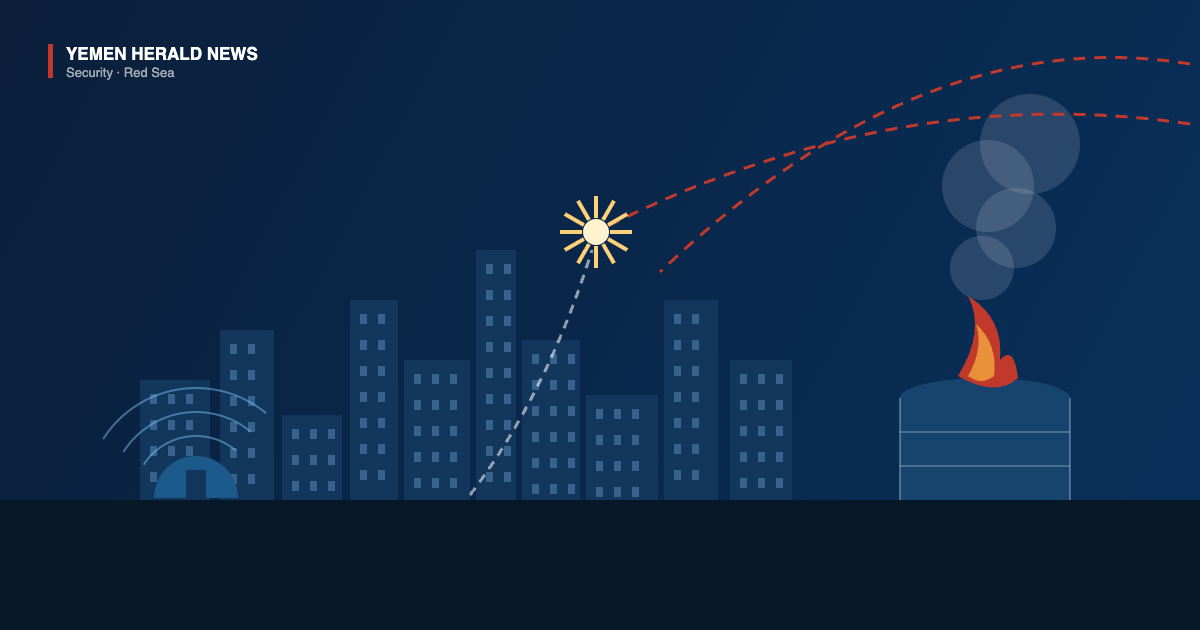
SANAA, Yemen — Yemen’s Houthi group said Saturday it fired ballistic and cruise missiles and drones at Riyadh and an Aramco facility in Yanbu, Saudi Arabia.
The announcement came in a statement broadcast by the group’s al-Masirah television channel.
Houthi military spokesman Yahya Sarea said two operations were carried out. The first targeted what he called “sensitive targets” in the Saudi capital.
The second struck a facility belonging to Saudi Aramco in Yanbu, an industrial and energy hub on Saudi Arabia’s Red Sea coast, he said.
Sarea said the attacks used “a large number of ballistic and cruise missiles and drones.” He said both operations succeeded and that fires broke out at the sites.
The Saudi-led coalition gave a different account.
It said its air defences intercepted and destroyed a Houthi ballistic missile aimed at Riyadh. The coalition said it also thwarted attacks on Baish, Taif, Farasan and Yanbu.
Coalition spokesman Turki al-Maliki said the attacks targeted “civilians and civilian objects.” He said the coalition would take “appropriate measures” to deter further strikes.
Explosions were heard twice in Riyadh on Saturday, Xinhua reported. Smoke rose near King Khalid International Airport in the northeast of the capital after the second, and some flights were delayed.
Saudi authorities issued an aerial threat alert for Riyadh overnight, then told residents on Saturday morning that the danger had passed.
Saudi civil defence sent warnings to mobile phones in Riyadh and in Al-Kharj, east of the capital, Reuters reported. It was the first such alert for the capital since the current escalation began, according to Xinhua.
Firefighters put out a fire at a fuel tank carrying the Aramco logo at a depot near the airport, Agence France-Presse reported. No casualties or damage were reported.
Yemen Herald could not independently verify which targets, if any, were struck. The Houthi account of the operations rests on the group’s own statement, and the coalition’s account on its own.
Sarea denied that the group deliberately targeted civilians.
He said the strikes on Riyadh answered intensified Saudi air raids on Houthi-held areas of Yemen.
The spokesman said the group would press what he called an “escalation for escalation” strategy. The operations would stop, he said, when Saudi airstrikes ceased and restrictions on Yemen were lifted.
Saudi Arabia has not said what caused the fire at the fuel depot.
The exchange follows a week of attacks on Saudi territory claimed by the group.
The Houthis said earlier in the week that they fired missiles and drones at King Khalid Air Base in Khamis Mushait, targeting hangars, radar systems, runways and ammunition depots.
In a statement on Monday, the group said Saudi warplanes had carried out 300 air raids across Yemen over the previous five days. Saudi Arabia has not confirmed that figure.
Members of the UN Security Council condemned the attacks on Saudi Arabia in a press statement on Friday.
They called on the Houthis to cease their military escalation and stressed the full implementation of Security Council Resolution 2216, adopted in 2015.
The Council members said they were deeply concerned by reports of civilian deaths and injuries and by the displacement of at least 125,000 people across Yemen since the start of September, citing the UN Office for the Coordination of Humanitarian Affairs.
OCHA put that figure at about 18,000 households.
The Council members expressed solidarity with Saudi Arabia and affirmed its right to self-defence under international law. They reaffirmed support for Yemen’s government and for the UN special envoy, Hans Grundberg.
The fighting followed the group’s advance along Yemen’s western coast in mid-September, which extended its reach toward the Bab al-Mandab Strait.
The strait links the Red Sea to the Gulf of Aden and carries a large share of seaborne trade between Europe and Asia.
The Security Council met on the group’s position at Bab al-Mandab on 15 September at France’s request.
The Council members recalled a statement issued on 7 August that condemned Houthi missile attacks on Saudi Arabia and attacks on commercial vessels.
They reiterated their condemnation of attacks and threats against commercial shipping in the Red Sea and the Bab al-Mandab Strait, and stressed the importance of safeguarding vessels and their crews.
A senior UN official told the Council this month that the group’s advance toward the chokepoint raised the risk of a wider conflict.
Yemen’s humanitarian response plan for 2026 seeks $2.16 billion to reach 12 million people. Tom Fletcher, the UN emergency relief coordinator, told the Council on 13 August that the appeal was barely 20 percent funded.
OCHA says more than 22 million people in Yemen need assistance and that 18.3 million are acutely food insecure.
Global fuel prices rose as the group extended its reach along the coast, NPR reported.
Resolution 2216 imposed a targeted arms embargo on the Houthi leadership and demanded that the group withdraw from areas it had seized, including Sanaa.
Khamis Mushait, site of the air base the group said it struck earlier in the week, lies in southwestern Saudi Arabia.
Saudi Aramco is the kingdom’s state oil company. Yanbu lies on the Red Sea north of Jeddah and hosts refineries and an export terminal for crude piped from the Eastern Province.
About the Author